

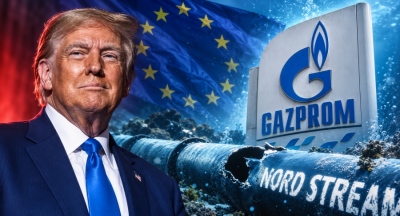
A reversal with potentially significant geopolitical and energy ramifications is reportedly being considered by the administration of Donald Trump, as, according to a report by The New York Times, Washington intends to propose to Europe the resumption of Russian natural gas supplies through Ukraine, within the framework of an overall agreement to end the conflict.
This specific approach, should it proceed, will reopen a debate that the European Union has attempted to close, seeking its decoupling from Russian energy supplies.
At the same time, it creates new questions regarding the true intentions of the American side, as the US has played a significant role in the effort to limit the presence of Gazprom in the European market.
According to the NYT, US Special Envoy Steven Witkoff and Jared Kushner, son-in-law of the American president, reportedly raised the proposal in meetings with European politicians and Volodymyr Zelensky.
The argument of Washington is that reopening pipelines could offer Europe access to economically affordable energy resources, while Ukraine would regain revenues from natural gas transit.
However, behind the economic dimension emerges a critical question: is this a genuine effort to overturn the energy policy of Europe, or a diplomatic game aimed at creating preconditions for an agreement with Moscow?
Igor Yushkov, a leading expert at the National Energy Security Fund, assesses that the American proposal may constitute a negotiating position, through which Donald Trump attempts to shape a framework of economic incentives for all involved parties.
In his assessment, returning to cooperation with Europe could yield benefits to Russia as well, as natural gas prices in the European market remain high.
Restoring Russian supplies could, therefore, contribute to lowering them, while Ukraine would have the ability to collect transit fees once again.
The critical issue, according to him, is whether Trump is more interested in the immediate political projection of a peace agreement or in safeguarding the strategic interests of the US, which do not necessarily include the return of Russia to the European gas market.
Yushkov considers the return of certain quantities of Russian natural gas to Europe probable, assessing, however, that previous supply volumes will hardly return.
In parallel, he points out that Europe could initially appear positive toward an agreement and subsequently back out, a fact demonstrating how fragile any discussion on energy rapprochement remains.
Pipelines at the center
Yet another dimension of the affair concerns the future of energy infrastructure and the prospect of American business interests attempting to acquire stakes in natural gas pipelines.
Yushkov mentions that certain American entrepreneurs may seek the advance purchase of shares in pipelines, anticipating future financial gains.
He clarifies, however, that so far official Washington has not made clear that control of the pipelines constitutes a mandatory prerequisite for the resumption of flows.
The case of Nord Stream presents particular interest.
According to him, American private enterprises could be interested in purchasing the pipeline that has survived, as such a move would limit the need for new investments to construct or repair infrastructure.
However, this prospect runs into significant political obstacles.
The question of whether Europeans will permit the reopening of Nord Stream 2 remains open, as this specific pipeline is treated with far greater political hesitation compared to the transit of Russian natural gas through Ukraine or Yamal-Europe through Poland.
Yushkov emphasizes that there are insufficient indications that these specific ideas constitute an official position of the American administration.
On the contrary, he assesses that they may express primarily the pursuits of individual business interests.
The European Union is unwilling...
The greatest obstacle to the implementation of such a plan remains the political stance of the current leadership of the European Union.
According to the analysis by Yushkov, European leaderships strongly oppose the easing of sanctions against Russia, maintaining that the conflict in Ukraine must first be resolved and subsequent restoration of economic relations examined.
The American approach, as described, moves in the opposite direction: economic cooperation could constitute part of the process leading to the termination of the conflict.
This disagreement does not concern only natural gas.
It touches the core of European strategy toward Russia and whether economic interdependence can return as a diplomatic tool.
Yushkov assesses that European politicians consider that they reinforce their position by projecting a hardline stance toward Moscow. In parallel, he points out that political forces demanding greater pragmatism and solutions to economic problems are gaining traction.
In his view, the current leadership of the EU is willing to incur economic costs in order to achieve political goals, something that makes the return of Russian natural gas exceptionally difficult under present circumstances.
«Different interpretation»
A different interpretation is offered by Alexander Frolov, deputy director of the Institute of Energy Policy at MGIMO and editor-in-chief of the portal InfoTEK.
Frolov points out that, in the first phase, the discussion is based on information circulating through media outlets and not on an officially formulated position of the American administration.
Even if the proposal is officially confirmed, this does not necessarily mean that Washington genuinely pursues its implementation.
As he explains, the US could propose to Europe the resumption of purchases of Russian energy resources, knowing in advance that the proposal will not be accepted.
In this way, the American side could present its move to Moscow as a sign of genuine effort to reach an agreement, even if chances of implementation remain limited.
Frolov also considers that the effort of the US to limit the influence of Russia in the European energy market constitutes a distinct and broader issue, in which political rhetoric may prevail over actual actions.
For him, there are no serious indications that Washington counts on a substantive shift in the stance of current leaders of the EU toward Russian energy resources.
Indeed, he assesses that the chances of the European leadership accepting such an agreement are exceptionally slim, as the energy policy of the EU is now tied to the broader direction of gradually abandoning fossil fuels.
Despite the difficulties, Frolov considers that the return of Russian natural gas to the European market would carry significance far greater than immediate economic gains.
As he points out, the resumption of full trade would constitute an indication that relations have entered a new phase, as the restoration of energy transactions would signify a substantive change in the political course of the European Union.
According to him, the discussion does not concern exclusively the recovery of a major market by Russia, but also whether the present policy of distancing from Moscow can be overturned.
Frolov simultaneously challenges the perception that the new markets of Russia in Asia constitute entirely a new alternative created after the rupture with Europe. As he notes, the turn to the East had begun more than 15 years ago, while the largest existing hydrocarbon pipelines toward the Asia-Pacific region were put into operation during the 2010s.
Consequently, the contrast between old European and new Asian markets does not fully reflect the reality of Russian energy relations.
The prospect of restoring Russian supplies depends, among other things, on the condition of existing infrastructure and on the political will of Europe.
Frolov assesses that the pipeline through Ukraine could resume operation, provided the appropriate conditions exist.
However, he considers that the primary problem is located not so much in Ukrainian pipelines as in the reduced capacity of the European gas market.
According to his estimate, the market has contracted by 100 billion cubic meters compared even to 2021, a fact that restricts possibilities for returning to previous supply quantities.
Regarding the Nord Stream pipelines, Frolov notes that Nord Stream 1 is completely out of service. Conversely, Nord Stream 2 could, according to his estimate, restart relatively quickly, but only one of its two strings is operational, limiting potential annual transport capacity to approximately 27.5 billion cubic meters.
In parallel, the Yamal-Europe pipeline is reported as fully operational.
However, he emphasizes that the technical capability of gas transport is not sufficient on its own. Without a radical change in the policy of the European Union, discussion over the repair or resumption of the Nord Stream pipelines lacks substantive purpose.
The critical question regarding supply security
Yet another issue that remains open concerns security guarantees for the resumption of energy flows and the manner in which unhindered operation of pipelines could be safeguarded in an environment of ongoing geopolitical confrontation.
Frolov assesses that Donald Trump may not even be focusing on these issues at the present stage of discussions.
This observation highlights one of the core gaps of the affair: even if a political agreement exists, its implementation will require addressing complex energy, economic, and political issues.
The alleged proposal of Washington brings back to the forefront the prospect of Russian natural gas returning to Europe, without however ensuring that this can be realized.
On the one hand, the resumption of supplies could create economic benefits for Russia, offer cheaper energy resources to Europe, and secure transit revenues for Ukraine.
On the other, the opposition of the European leadership, the policy of sanctions, and the shift in energy priorities of the EU constitute severe obstacles.
At the same time, discussions on the future of pipelines and the potential involvement of American corporate interests add yet another parameter to an already complex geopolitical scene.
The fundamental question, therefore, is not only whether Russian natural gas will return to Europe. It is whether Washington genuinely pursues a new energy equilibrium or whether this specific proposal constitutes part of a broader negotiating tactic toward Moscow.
Until the official posture of the involved parties is clarified, the return of Russian natural gas remains a prospect with significant political ramifications, but also with serious uncertainties regarding its realization.
www.bankingnews.gr



Readers’ Comments