

According to the Ukrainian service, Russia began using the Filin in attacks against Ukrainian targets toward the end of the summer of 2026
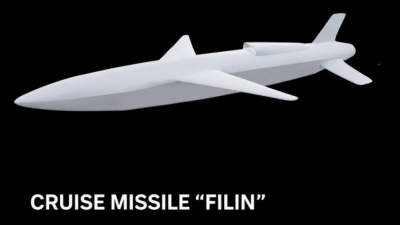
A new Russian long-range weapon is causing concern in Ukraine, as the Ukrainian military intelligence service itself revealed the existence and technical specifications of the Filin cruise missile. With a range reaching 1,200 kilometers, speeds up to 800 km/h, and a low-observable design, the new missile is added to Russia's constantly expanding arsenal. The revelation was made on October 22, 2026, by the Main Directorate of Intelligence of the Ministry of Defense of Ukraine (GUR), which published detailed data and a 3D model of the new weapon system on the War&Sanctions platform. According to the Ukrainian service, Russia began using the Filin in attacks against Ukrainian targets toward the end of the summer of 2026.
The missile capable of striking targets hundreds of kilometers away
The Filin is being developed by Russian company NPO Molniya, which belongs to the Tactical Missiles Corporation group. It is a ground-launched cruise missile designed for long-range strikes. According to data disclosed by Ukrainian intelligence services, it features:
Range: 600 to 1,200 kilometers.
Maximum speed: 800 km/h.
Length: 3.5 meters.
Wingspan: 3 meters.
Maximum takeoff weight: 210 kg.
Warhead: 50 or 100 kg.
Maximum flight ceiling: 6,000 meters.
Its fuselage is manufactured from composite materials, such as carbon fiber and fiberglass, while certain components are produced using 3D printing technology. This design aims to limit weight and detectability, though its actual degree of radar stealth has not been independently confirmed.
Ultra-low altitude flight – The challenge for Ukrainian air defense
One of the most significant features of the Filin is its ability to conduct flights at very low altitudes. This specific capability can complicate its timely detection by ground radar systems, restricting air defense reaction times. The missile utilizes a combination of inertial navigation and a satellite system with a 16-channel Kometa unit, designed to demonstrate heightened resilience against electronic interference. Its launch is executed with the assistance of a solid-fuel booster before the main jet engine takes over. What particularly concerns Ukrainian military analysts is Russia's attempt to combine long range, relatively limited cost, and low observability into a single weapon system.
The R500 engine and the link to other Russian weapons
According to Ukrainian analysis, the Filin utilizes the R500 engine produced by Russian firm Reynolds. The same engine type has also been identified in the Russian weapon systems S-71K Kover and S-71M Monokhrom. This element suggests that the Russian defense industry seeks to utilize common components and technological solutions across different weapon categories, facilitating their production and maintenance. Concurrently, Ukrainian findings confirm the ongoing use of foreign electronic components in Russian military systems, despite international restrictions on advanced technology exports.
Filin, Dan-T, and Geran: The new generation of Russian weapons
The revelation of the Filin arrives just one day following reports by Rostec regarding the development of new attack unmanned aerial vehicles featuring characteristics approaching those of cruise missiles. Among them sits the Dan-T, while Russia is concurrently developing faster versions of Geran drones. This trend reveals Moscow's strategy to create weapon systems combining the operational flexibility of drones with the speed and range of missiles. The Ukrainian military intelligence service points out that the Filin fits precisely into this rationale of developing new, relatively economical precision weapons.
New headache for Kyiv
The emergence of the Filin constitutes yet another challenge for Ukrainian air defense, which is already called upon to confront attacks by ballistic missiles, cruise missiles, and large numbers of drones. The combination of different weapon types forces Ukrainian forces to employ multiple surveillance and interception systems, increasing operational demands and defense costs. Despite published technical data, the number of Filin missiles produced, their actual cost, and their effectiveness under combat conditions remain unknown. The essence of the new revelation is that Russia continues to expand its long-range strike capabilities, investing in weapons attempting to combine power, speed, and lower production costs. For Ukraine, the Filin represents an additional threat in a war where the contest between missiles, drones, and air defense systems is becoming ever more decisive.
www.bankingnews.gr












Readers’ Comments