

Three days before the Serbian parliamentary elections of October 25, Serbia finds itself faced with one of the most significant political contests in its modern history.
For months, the center of public debate was Aleksandar Vučić, his government, and the opposition.
As the ballot box approaches, however, it becomes increasingly clear that the third, and perhaps most decisive, protagonist of these elections is the «student movement» born after the tragedy of Novi Sad.
This movement does not resemble a classic partisan opposition.
It does not resemble either the pro-Western movements that appeared in other countries of Eastern Europe.
For many analysts, it constitutes the greatest political surprise of recent years in Serbia.
The tragedy that changed the Serbian political scene
The starting point of the current crisis is set on November 1, 2024.
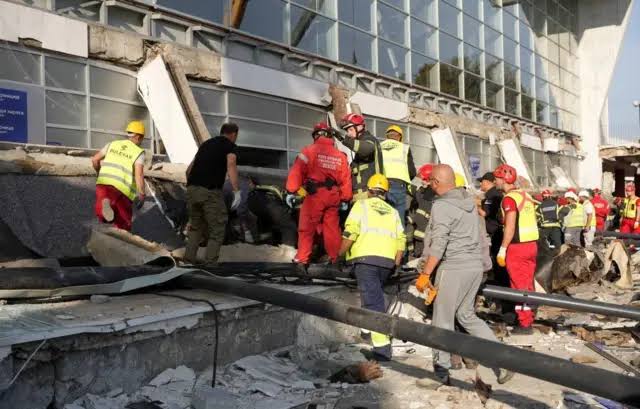
The collapse of the canopy at the railway station of Novi Sad caused the death of 17 people, including an unborn child, as one of the dead women was pregnant.
The shock was immense. Even greater, however, was the anger that followed.
The station had previously been renovated at a cost of tens of millions of euros, and very quickly questions began to be formulated regarding: the quality of the works, the transparency of the contracts, state supervision, potential corruption...
Almost two years later, a large part of Serbian society continues to believe that sufficient answers have not been given. This is perhaps the most crucial element to understand the current political climate.
From memorial services... to marches
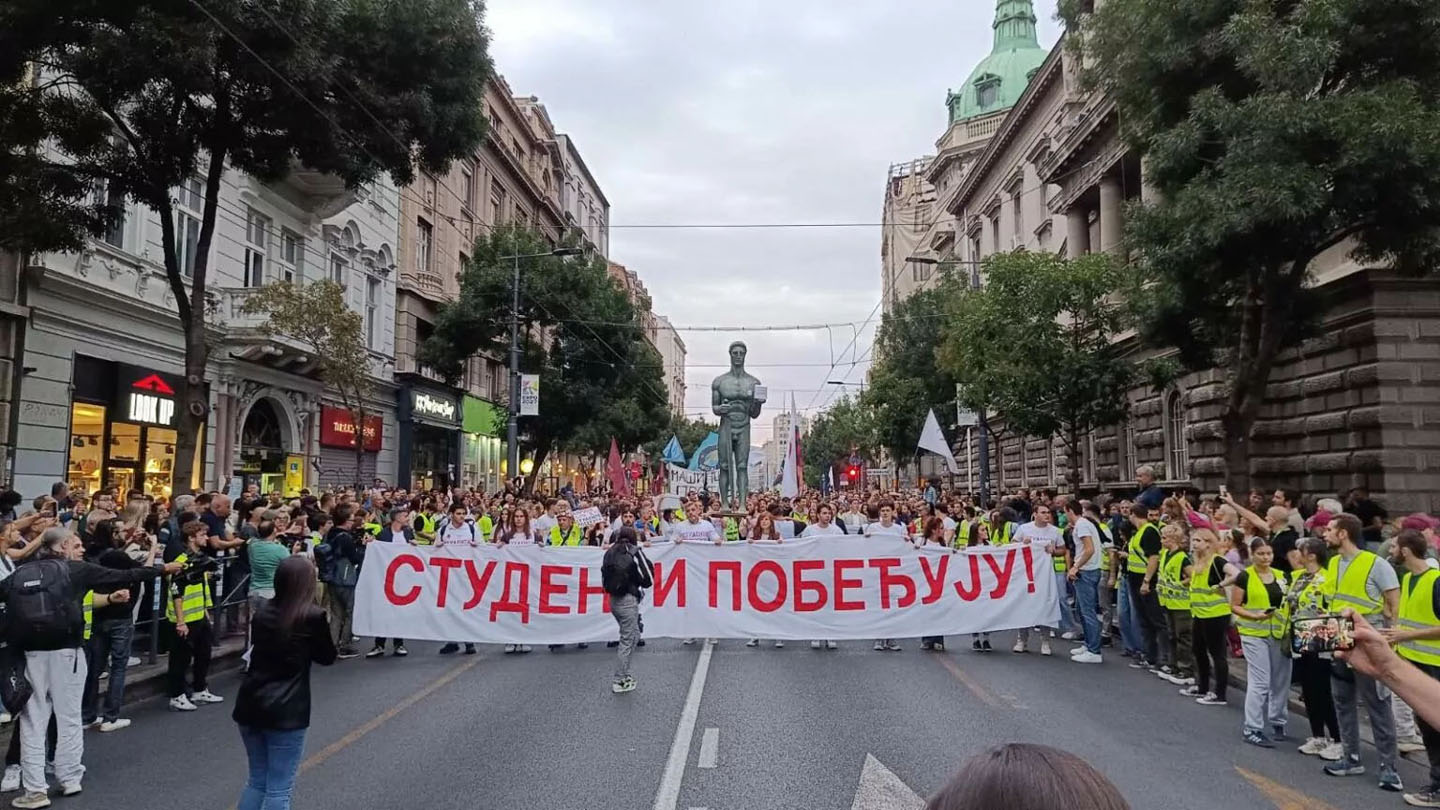
Initially, the protests had a symbolic character. Citizens gathered to honor the memory of the victims.
As the months passed, however, the content of the mobilizations shifted.
The discussion moved to the functioning of institutions, the responsibility of state mechanisms, corruption, justice, the accountability of those in power...
Students quickly became the organizational hub of this new dynamic.
Today they do not constitute merely a protest group. They represent one of the primary political factors of the electoral contest.
This is not a classic anti-government movement
What is interesting is that this movement does not easily fit into conventional political categories.
Government supporters often describe it as an attempt at destabilization or as a «color revolution».
The students themselves reject this interpretation.
They argue that the mobilizations were born out of a specific tragedy and out of the demand for state institutions to function.
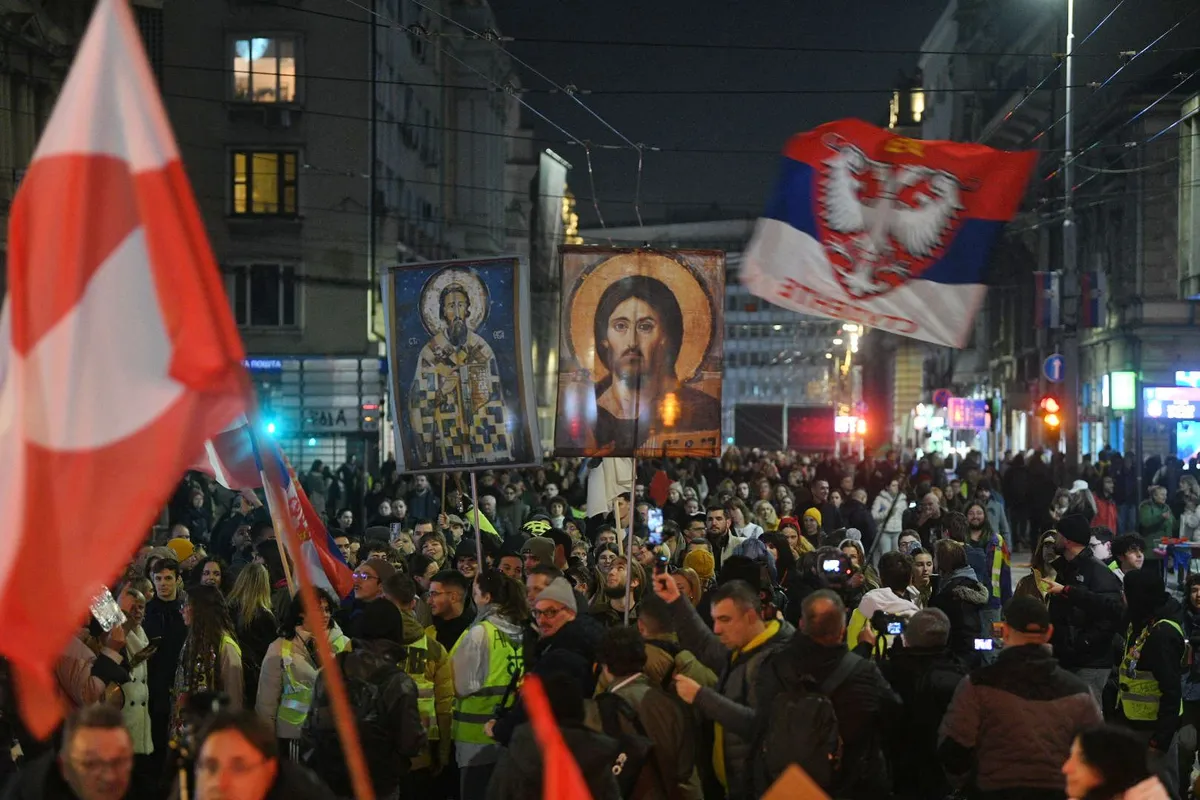
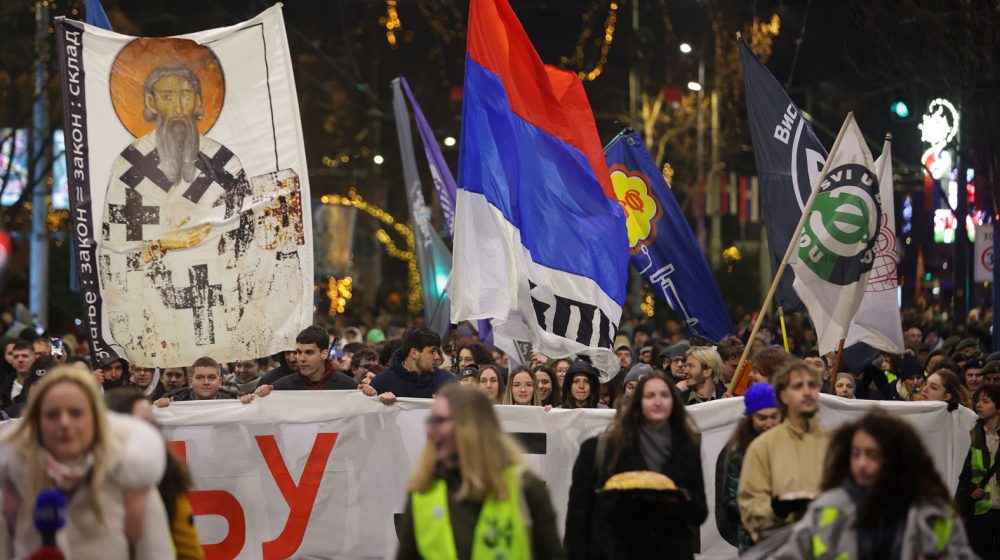
The imagery presented at their gatherings reinforces this argument.
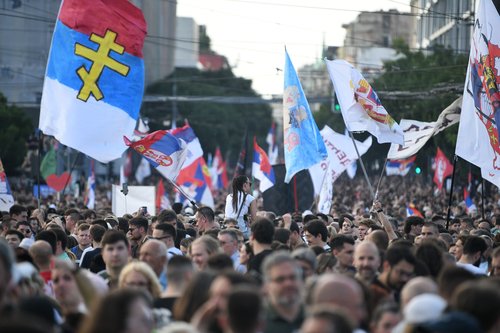
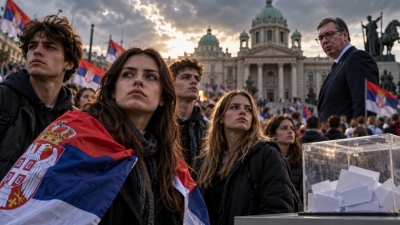
Serbian flags, flags of Republika Srpska (the «Serb Bosnia»), references to Kosovo and Metohija, Orthodox crosses, icons of Christ Pantocrator, symbols of Serbian historical tradition, as well as flags against NATO and the EU dominate the marches.
Flags of foreign states or classic pro-European symbols observed in other protest movements across the region are almost entirely absent.
The Karađorđević factor and the blow to the government narrative
One of the most characteristic snapshots of recent days was the presence of the heir of the Karađorđević dynasty, Prince Filip Karađorđević, and his wife Princess Danica among the crowd that welcomed the students in Belgrade.
The image carried special symbolism.
The Karađorđević dynasty is directly connected with the Serbian state, national struggles, and the historical continuity of the Serbian nation.
For a segment of society, it still represents traditional Serbia, a Serbia resisting the modernity and postmodernity characterizing almost all European societies.
That is why the public presence of Prince Filip and Princess Danica beside the protesters provoked intense discussions.
The fact acquires even greater significance considering that certain political factions, even parts of the patriotic right, had previously accused the students of being «unpatriotic», «pro-Western», or even «contrary to national values».
The sight of the heir to the Serbian throne publicly greeting the students significantly complicates this narrative.
In parallel, historical and national symbols traditionally linked to the Serbian patriotic space appear in several marches, such as the Holy Cross, icons of Christ Pantocrator, references to Karađorđe, messages in favor of Kosovo and Metohija, and symbols of the Serbian Orthodox Church...
This element is particularly important, as it demonstrates that a significant portion of the movement does not define itself as liberal or pro-European in the «classic» sense.
Kosovo remains present
Another element that causes an impression is that, despite focusing attention on internal problems of Serbia, Kosovo continues to have a strong presence in the mobilizations.
During the very same days that the students were marching toward Belgrade, Serbian media reported a new incident in «Kosovo», where special units of the so-called «Kosovo Police» stopped an ambulance from Zubin Potok and conducted a multi-hour check.
At the same time, break-ins into Serbian homes and agricultural storage facilities were reported.
That is why many protesters insist that the political change they desire does not entail abandoning national issues.
The strongest surprise: the older age groups
Perhaps, however, the most important development of the pre-election period is different.
For the first time in years, the students are not mobilizing only young people.
During the marches toward Belgrade, thousands of older citizens came out to welcome them.
In many regions of Serbia, residents offered water, food, shelter, and... symbolic support.
This carries particular significance.
Older generations historically constituted the primary electoral base of the governing camp.
The fact that an increasing number of pensioners and middle-aged citizens express sympathy toward the student movement (the «Student List») is considered by many one of the most critical developments of recent months.
The elections and the real stake
Aleksandar Vučić continues to maintain significant influence, highlighting economic growth, stability, and the policy of balance among Russia, the European Union, and China.
However, the elections of October 25 will not determine solely the next prime minister.
They will also decide something more.
Whether the social energy born after Novi Sad can be transformed into an established political force.
For the first time in years, the big question is not only what Vučić will do.
It is what the students and those who see in their movement the hope for a different Serbia will do.
And that is perhaps the real stake of the most crucial elections the country has known for more than a decade...
www.bankingnews.gr






Readers’ Comments