

For decades the Arctic was on the margins of international current affairs.
The issues that dominated concerned climate change, environmental protection, and scientific research.
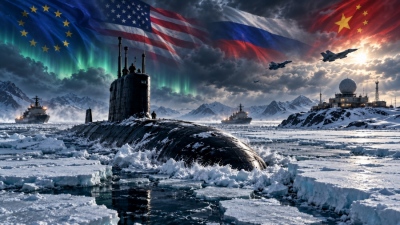
Today, however, the North Pole is gradually being transformed into one of the most important geopolitical spaces on the planet.
The new Arctic strategy presented by the European Commission captures this shift in the clearest manner.
Brussels no longer views the Arctic as a remote frozen world, but as a region where trade routes, energy resources, military security, and the very balance of power among the Great Powers are at stake.
And if the Baltic is developing into an area of direct military confrontation between Russia and NATO, the Arctic tends to become the «long-term» geopolitical front of the 21st century.
The great shift of Brussels
The new European strategy constitutes essentially an admission that the era of «soft Arctic policy» has ended.
In 2021 the European Union placed particular emphasis on environmental protection and even discussed restrictions on hydrocarbon exploitation in the region. Five years later, priorities have shifted strikingly.
The new strategy focuses on security, military readiness, critical infrastructure protection, submarine cable surveillance, satellite systems deployment, and closer cooperation with NATO.
Brussels is planning, furthermore, the acquisition of additional icebreakers, the creation of an «Arctic Cable Center», the development of a specialized Maritime Security Center, and the enhancement of Europe's satellite presence in the region.
Ursula von der Leyen herself characterized the Arctic as «the frontline of global Great Power competition», while Kaja Kallas spoke openly of an increased presence of Russia and China in the region.
This change is not merely «technical». It is strategic.
How Russia gained the lead
While Europe plans, Russia has been investing for decades. Since the early 2000s, with the rise of Vladimir Putin to power and the effort to restore Russian dominance in the «Near Abroad», Moscow treated the Arctic as a vital space (in the sense attributed to the term «Lebensraum» by German geopolitical theorist Friedrich Ratzel) for the country's future.
The outcome of this policy was the creation of an extensive network of ports, military bases, airfields, refueling hubs, surveillance stations, and energy infrastructure.
At the same time, Russia assembled the largest icebreaker fleet in the world. Today it possesses around forty icebreakers, several of which are nuclear-powered.
The countries of the European Union possess merely a small fraction of this number.
That is why in Brussels they recognize that Russia begins the new period of competition from a clearly more advantageous position.
The Northern Sea Route and the «new Suez»
Perhaps the most significant reason why the Arctic acquires such value is called «Northern Sea Route».
It is the route that follows the northern coast of Siberia and connects Europe with East Asia.
As the ice recedes, this route becomes increasingly navigable.
For many routes between Europe and Asia it can noticeably reduce distances, transit time, fuel costs, and even dependence on chokepoints such as Suez.
This carries immense significance.
In the 21st century, whoever influences the major trade arteries also influences the global economy, and whoever influences the global economy influences the «destinies of the world».
It is no coincidence, moreover, that Russia treats the Northern Sea Route as its strategic advantage.
Nor is it a coincidence that the European Union and the United States are monitoring its development with particular care.
The enormous energy stake
The Arctic is not just sea routes. It is also resources. Resources that the European Union does not possess.
Many estimates consider that a large share of untapped reserves of oil, natural gas, rare earths, and strategic minerals is located in Arctic regions.
For Russia the significance is even greater.
A large percentage of its energy output is already tied to regions of the Russian North.
As global demand for critical minerals grows, the value of the Arctic is expected to rise even further.
That is why the discussion over the region is not simply about control of ice and seas.
It is about the control of future sources of wealth...
Why the Arctic is a national security matter for Russia
In Russian strategic thinking, the Arctic is not considered a distant periphery. Far from it, indeed...
It is considered part of the core of its national security.
The reason is simple.
The shortest strategic routes between Russia and North America pass through the Arctic space.
During the Cold War, the North Pole constituted a central area for the deployment of strategic bombers, nuclear submarines, and early warning systems.
Its importance has not diminished..
For Moscow, maintaining a strong presence in the Arctic is directly linked to strategic deterrence and the balance of power vis-a-vis the United States, the major geopolitical competitor.
Therefore, from the Russian perspective, a weakening in the North could affect the entire security architecture of the country.
China's entry into polar competition
The other major development is the presence of China.
Beijing does not possess Arctic territory, obviously.
Nevertheless, it treats the region as a critical element of its future strategy.
China is interested in new trade routes, energy sources, transport infrastructure, and access to raw materials.
This is why Western analysts have spoken in recent years of the gradual emergence of an «Arctic axis of cooperation» between Moscow and Beijing.
The strengthening of this cooperation causes particular concern in European capitals, which consider that the Arctic zone may evolve into yet another field of convergence of Russian and Chinese strategic interests.
Finland, Sweden, and the new reality of NATO
The enlargement of NATO toward the European North also altered the strategic environment.
With the accession of Finland and Sweden, the North Atlantic Alliance acquired a far stronger presence in the northern regions of Europe.
For many strategic analysts, the geographic complexes of the Baltic and the Arctic now constitute two interconnected theaters of operations.
New infrastructure, ports, surveillance systems, and satellite capabilities do not concern solely the economy.
They are also linked to the long-term military planning of both NATO and Russia.
It is not by chance, therefore, that Moscow views the new European strategy with heightened suspicion.
The Arctic and the world to come
The rise in temperature is gradually altering geography.
Spaces that remained inaccessible for centuries are becoming increasingly reachable.
New routes are opening.
New deposits are acquiring value.
New infrastructure is being planned.
Faced with this transformation, the Arctic ceases to be the geopolitical margin of the planet and is transformed into one of the most critical hubs of the future.
That is why the confrontation does not merely concern Russia and the European Union.
It concerns who will determine the rules in a region that will shape the commercial, energy, and strategic balances of the coming decades.
And that is precisely why the battle for the Arctic is only just beginning...
www.bankingnews.gr



Readers’ Comments