

It was not a bolt out of the blue...
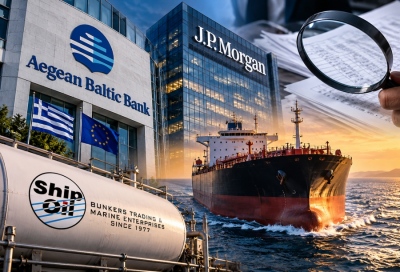
It is well known that Greek shipowners conduct significant business with Russians and Iranians. And Aegean Baltic Bank (ABBank), with principal shareholder Telis Mystakidis holding 48.8% alongside the Afthonidis family at 27.5%, could be no exception given its role as the primary financier of Greek shipowners. While everyone focuses on the investigation by the US FinCEN (Financial Crimes Enforcement Network) into suspicious transactions with Iran, BN (bankingnews) reveals a major new parameter.
Intervention by JP Morgan
American bank JP Morgan, which also serves as the correspondent bank for dollar transactions with Aegean Baltic Bank, conducted a surprise audit of Aegean Baltic Bank (ABBank) 10 to 12 days ago, focusing primarily on transactions with shipping firm ShipOil Bunkers. ShipOil Bunkers operates under Alberto Tsoris and George Tsoris, who serves as Managing Director. Following the investigation conducted by JP Morgan, it diagnosed that all dollar transactions with ShipOil Bunkers were completely legitimate. However, it is known that ShipOil Bunkers maintains transactions with Iran, though this constitutes common practice across all Greek shipowners.
Impact on Aegean Baltic Bank
Should sanctions be imposed on Aegean Baltic Bank by US authorities—particularly regarding dollar transactions—the bank's profitability could potentially drop from €13.5 million annually to between €5 and €6 million. Nevertheless, the institution remains exceptionally capital-adequate, backed by €175 million in equity. Furthermore, it should be noted that no risk of closure faces Aegean Baltic Bank, nor does any issue exist regarding bank deposits.
What Bankingnews.gr reported on October 21, 2026
American FinCEN (Financial Crimes Enforcement Network) is investigating transactions between Greek institution Aegean Baltic Bank (ABBank) and Iran. However, substantial indications suggest that behind all this principal shareholder Telis Mystakidis sits in the crosshairs over agreements unfulfilled with foreign entities.
What has happened?
Specifically, FinCEN, operating in close coordination with European and Greek authorities, is moving legally to investigate ties between Aegean Baltic Bank and the Iranian regime along with its proxies. As highlighted in the relevant announcement, FinCEN deployed an administrative subpoena under 31 U.S.C. § 5318(k) of the Bank Secrecy Act for the first time to gather evidence on banking institutions' relations with Iranian financial entities sanctioned by OFAC. This evolution brings to the fore Aegean Baltic Bank (ABB), which specializes in maritime finance and in which billionaire Telis Mystakidis holds a majority stake. In this context, it is worth noting that commercial activity by Greek shipowners in markets such as Russia and Iran represents an established and widespread practice governed by specific rules, and is not inherently illegal. In other words, maritime transport to and from countries under special regimes remains fully legal provided frameworks established by international bodies (such as the UN and the European Union) are strictly observed.
What this means for Aegean Baltic Bank
It is emphasized, however, that while Aegean Baltic stands as a well-capitalized bank holding €175 million in equity, it remains uniquely vulnerable to potential pressure from the US. Specifically, American authorities possess the capacity to target the bank by restricting its dollar transactions—the primary currency utilized for oil trade. Such a development is expected to adversely impact profitability at Aegean Baltic, a financial institution tied to the shipping community and consequently the oil market, leading to a noticeable retreat from approximately €20 million in 2024 and €13.2 million in 2025 down to approximately €5–7 million in annual net profits.
Sanctions on Karnakis and Karnakis law firm
Concurrently, the US Department of the Treasury levied sanctions against the law firm Karnakis and Karnakis (based in Panama and Greece), alongside its owners, Sofianos, Konstantinos, and Ioannis Karnakis Kosmas. According to an official statement, "the law firm stands accused of providing legal cover and establishing shell companies to conceal the beneficial owners of vessels transporting Iranian crude oil, steel, and liquefied petroleum gas (LPG)." Included among the companies it incorporated is Elias Shipping and Trading SA (owner of the tanker RAMONA 1), which functioned as a front for Syrian entity Al-Qatirji Company—a key financier of the Islamic Revolutionary Guard Corps Quds Force (IRGC-QF) and the Houthis. Sanctions were also imposed and asset freezes executed against bulk carriers ANEMOS, GLORIS, PRIDE, DESTINY, FLAMINGO 1, HARMONY, and PRINCE, managed by Roxette Maritime Shipping and Trading S.A. Sanctions were further levied against maritime agency firms Amigoz Singapore PTE. Ltd. (Singapore) and Whales Shipping Line LLC (Dubai) for delivering logistical support and bunkering services to the Iranian shadow fleet.
"Operation Economic Outcast"
These actions form part of Operation Economic Outcast (also known as Economic D-Day), announced by US Treasury Secretary Scott Bessent in August 2026. The operation's objective centers on total isolation of Iran from the international financial system and severing resources funneled into Tehran's military and nuclear programs. "Whether you are conducting illicit ship-to-ship oil transfers at sea or sitting in the corner office of a law firm, if you support the Iranian regime, we will find you and sanction you," stated US Treasury Secretary Scott Bessent.
www.bankingnews.gr




Readers’ Comments