

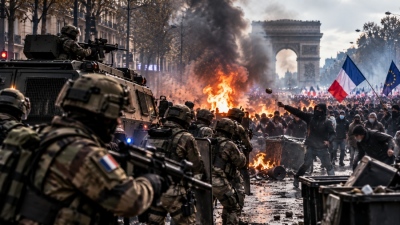
From France and Italy to Spain, Belgium, Portugal, and Albania, the streets are full... The high cost of living, housing crisis, problems in education, and distrust toward governments are fueling a sweeping wave of mobilizations, causing a massive headache for trapped governments that issue orders to send troops into the streets. Military forces reinforce security in Milan, while in France authorities enforce local curfews and prepare for new mass protests. The picture is particularly concerning in France, where extensive protests were accompanied by clashes, looting, and destruction across major cities. The government admitted shortcomings in planning and the deployment of security forces, while moving forward with local traffic restrictions and preparing for new mobilizations. At the same time, in Italy the government decided to deploy 500 troops to Milan to bolster security, while pushing a stricter framework to tackle clashes. From Lisbon to Brussels and from Madrid to Tirana, social unrest assumes different forms without, however, forming a unified, organized European movement.
New "lockdown" in France
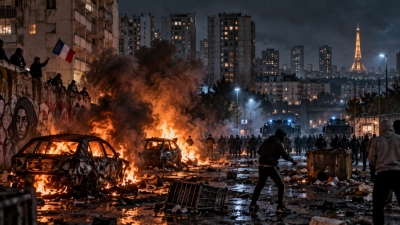
France stands on the front line of unrest following extensive mobilizations and severe clashes in cities. Protests were accompanied in certain areas by clashes with police, vandalism, and the looting of shops. The government attempted to curb tensions with local and partial curfews in areas hit by the riots. Measures contributed to maintaining calm overnight, with authorities considering their extension where deemed necessary. Concurrently, the French government prepares for new mobilizations with an enhanced security forces presence. Approximately 60,000 internal security officers were deployed nationwide during crisis management, while authorities search for ways to avoid repeating scenes of chaos. Investigations into the riots continue, with around 200 investigators tasked with examining cases linked to the unrest and destruction.
Students, schools, and "Yellow Vests" on the streets
Social tension in France is not restricted to a single group of protesters. Student mobilizations connect, among other things, to the condition of school infrastructure, teacher shortages, and the degradation of public services. Youth express concern regarding their prospects during a period in which the cost of living and difficulty accessing basic services weigh on households. At the same time, the "Yellow Vests" announce new, scattered protest actions over rising fuel prices. The movement, which had caused severe disruption in France since 2018, resurfaces at a juncture where economic pressure reignites social unrest. Notably, French Minister of the Interior Laurent Nuñez announced the deployment of military forces onto French streets as part of preparations for new demonstrations on Saturday, October 24.
Italy deploys 500 soldiers
In Italy, violent clashes in Milan and other northern cities led Giorgia Meloni's government to decide to bolster security with 500 troops, who will support police forces through the end of 2026. Weekend incidents included clashes with police officers, store looting, arson, and extensive damage to public and private spaces. Beyond Milan, incidents were recorded in cities such as Bologna, Turin, Brescia, and Bergamo. Tensions caused disruption even in Milan's commercial heart. Shops along luxury commercial avenues lowered shutters, covered storefronts, or removed merchandise out of fear of fresh clashes and looting. The Italian government also approved stricter security measures. Among other things, a harsher framework is enacted against participation in violent acts during protests, featuring sentences reaching up to five years in prison and fines up to 20,000 euros under stipulated conditions. Penalties increase when injuries occur or when perpetrators conceal their identity. Concurrently, provisions enable seeking compensation for damages, while parents of minors may bear financial responsibility for vandalism caused by their children. Authorities also gain the capacity for preventive detention of youth aged 14 to 17 when indications exist that they pose a threat, even if no specific offense has been committed.
Spaniards hit the streets as well
In Spain, the housing crisis constitutes a primary driver of social discontent. Surging prices and rents, particularly across major urban centers, complicate housing access for young workers, students, and low-income families. Mobilizations express reaction against a housing market becoming increasingly unreachable for large segments of the population. For many young people, gaining independence and establishing a stable household turn into an increasingly difficult objective. Simultaneously, protests over working conditions and pay within the education sector add fresh pressure on the government. Housing, wages, and the quality of public services compose a broader framework of discontent transcending any single demand.
Clashes in Brussels and Liège
In Belgium, mobilizations likewise feature a social and educational backdrop. In Brussels, students have been protesting for weeks over increases in university registration fees, with demonstrations accompanied by clashes with police forces. Police utilized tear gas and water cannons to disperse gatherings, alleging that certain protesters threw objects and set fires. Similar riot-control operations were conducted in Liège. The situation highlights the discontent provoked by economic hardships and the rising cost of accessing education. For students, educational expenses add to an already challenging reality, with high living costs and housing constraining possibilities for financial independence.
Housing prices more than doubled in Portugal
In Portugal, thousands of citizens took to the streets of Lisbon to protest against the cost of living, low wages, and difficulty finding affordable housing. The housing crisis sits at the center of mobilizations, as home prices have more than doubled since 2017, while rents on new leases have likewise risen significantly. Tents were pitched in central parts of the capital as a symbolic protest against the lack of affordable shelter. Protesters demand better pay, boosted pensions, and measures enabling residents to remain in their cities without expending a disproportionate share of income on housing. The government signaled it will not yield simply due to pressure from protests. However, the housing problem evolves into one of the country's most critical social issues, bearing severe consequences for youth and lower-income households.
Political crisis in Albania
In Albania, protests in Tirana continue for consecutive days, with the participation of pupils, students, and citizens expressing broader discontent toward Edi Rama's government. Initial demands concerned university conditions, education spending, and tackling corruption. Gradually, however, mobilizations linked to broader issues, such as living costs, housing access difficulties, and allegations concerning government practices. Tension also connects to reactions against a controversial luxury tourism project on the Albanian coast, which has been linked to business ventures involving the Trump family and Jared Kushner. The issue has fueled debate surrounding the utilization of public land, investments, and transparency. Demonstrations have evolved into a broader challenge to the government, with segments of protesters calling for the prime minister's resignation.
www.bankingnews.gr








Readers’ Comments