

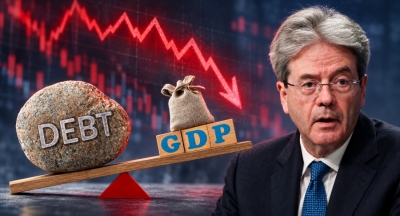
The nightmarish scenario of unprecedented economic asphyxiation is brought to the forefront by the resounding intervention via Project Syndicate of the former European Commissioner for Economy and current member of the UN expert group on debt, Paolo Gentiloni.
Swelling debts and uncertain prospects are pushing states and markets into a dangerous zero-resilience zone.
Faced with the specter of a historic collapse, margins are narrowing and the need for an immediate change of course is now becoming a matter of survival.
According to Gentiloni, the world is moving closer and closer to a global debt crisis.
The war in Iran may have provided the spark, but the combustible material had been accumulating for quite some time.
Following a decade of debt accumulation, higher interest rates and growing refinancing needs have rendered the global economy increasingly vulnerable to shocks.
At the same time, ongoing conflicts are driving Energy prices upward, while fresh inflationary pressures test the limits of the existing debt architecture.
The outlook is particularly alarming for developing nations, where public debt totaled 35 trillion dollars in 2025, recording an increase of 10.5% within a single year.
According to the United Nations Development Programme (UNDP), «the median developing country now spends approximately 9.5% of its government revenues on interest payments, the highest share in 25 years».
Thirty-two low-income countries are already in debt distress or face high risk of falling into it.
However, debt restructurings with private creditors take an average of 2.5 years, twice as long compared to the process prior to the pandemic.
The core problem is not the level of country liabilities, but the cost and lack of access to new financing.
The real cost of interest is rising faster than the ability of many nations to service their debts through export revenues and fiscal resources, and this divergence threatens to widen further.
Even countries whose underlying debt-to-GDP metrics have stabilized may confront severe liquidity strains if forced to refinance large debt volumes at much higher interest rates.
This problem is not confined to developing nations.
Total interest expenditures of OECD member countries have surpassed 2 trillion dollars.
The United States is absorbing vast quantities of capital through its expanding reliance on sovereign borrowing, while artificial intelligence infrastructure giants (AI hyperscalers) turn increasingly to bond markets themselves.
At the same time, heightened defense spending and massive new fiscal commitments threaten to intensify upward pressures on interest rates.
When the largest borrower in the world borrows almost without limits, countries with far smaller financing requirements may end up paying the price.
This feature of the global debt architecture is unfair and unsustainable.
Countries that borrowed prudently can still find themselves under suffocating pressure because of decisions taken elsewhere.
Developing economies face an agonizing dilemma: either pay more to refinance existing debt or slash expenditures on healthcare, education, infrastructure, and productive investments.
The solution cannot consist exclusively of austerity policies.
Debt sustainability ultimately depends on the productive capacity that generates the growth, revenues, and foreign exchange reserves of tomorrow.
Fiscal discipline matters, but equally important is protecting the public investments needed to make debt sustainable.
The good and the... bad news
The good news is that the international community is not starting from scratch, notes the former commissioner.
Several reforms agreed upon last year in Seville, at the 4th International Conference on Financing for Development, have already proven their feasibility and effectiveness in practice.
Debt service suspension clauses are being standardized; innovative debt swaps for development financing have been tested; the International Monetary Fund and the World Bank just approved changes to their debt sustainability assessment framework; collective action clauses are being applied ever more widely; and a new Borrowers Platform provides debtor nations with a stronger voice.
Markets are beginning to pay attention to these developments.
The rating agency Moody’s now views the option of debt service suspension as credit-positive, indicating that triggering a contractual suspension clause will not be treated as a default.
With this change alone, one of the primary reasons policymakers hesitated to make use of such clauses was eliminated.
However, our expert group has identified a critical gap in implementing the Seville reforms: the necessary tools exist, but they do not yet constitute standard practice, as analyzed in the October 2026 implementation report of the Expert Group on Debt.
This could develop into a serious problem given current macroeconomic conditions.
In an emergency, countries cannot wait years for new provisions to be incorporated into contracts or legislation.
They urgently need a temporary debt service suspension procedure, modeled after the Debt Service Suspension Initiative (DSSI) of the G20 established during the pandemic.
This facility should be available to all countries confronting acute financing pressures, while the participation of multilateral development banks (MDBs) should be encouraged.
By providing immediate liquidity relief, we can prevent today’s refinancing problem from turning into tomorrow’s solvency crisis.
At the same time, concessional financing must increase substantially and become more predictable.
Given that additional sources of borrowing and refinancing represent a decisive factor for debt sustainability, multilateral development banks must increase resources allocated for concessional funding, guarantees, and countercyclical financing.
The wider network of public development banks, now united under the Finance in Common initiative, should also be mobilized to help address the situation.
Where and whenever feasible, countries should also diversify the currencies in which they borrow, strengthen national public debt management and precautionary liquidity buffers, as well as devise financing strategies that better account for foreign exchange and refinancing risks.
Finally, debt sustainability analyses must distinguish liquidity pressures from insolvency and factor in higher interest rates maintained for longer periods, volatile export receipts, fiscal constraints, and the value of investments that enhance resilience and productive capacity.
According to Gentiloni, the recently approved revision of the Low-Income Country Debt Sustainability Framework (LIC-DSF) of the IMF and the World Bank constitutes a step in the right direction.
It will encourage both institutions to adopt assessments with a long-term horizon, integrate domestic debt into the analysis, and introduce liquidity indicators (gross financing needs and interest payments as a percentage of revenue) in order to separate signs of liquidity stress from those of insolvency.
However, these changes will only take effect from mid-2027 and will not cover countries that typically have access to international capital markets.
This means that institutions responsible for advancing critical reforms face a choice.
The G20, especially under the presidency of the United Kingdom next year, can turn its stated commitment to facilitating coordination among low- and middle-income countries on debt into concrete reforms of the Common Framework for Debt Treatments.
The IMF and the World Bank can accelerate the rollout of the revised LIC-DSF and extend its application to market-access countries.
Creditors and debtors can transform debt swaps from isolated innovative initiatives into repeatable, widely applicable tools.
And debtor nations can evolve the Borrowers Platform into an established, permanent institution.
The architecture agreed in Seville was designed to address global shocks.
The shocks have now arrived, but implementation of the agreed measures has not kept pace.
Countries already bearing the heaviest financing burdens do not have the luxury of waiting for reforms to catch up with developments, concludes the former commissioner.
www.bankingnews.gr










Readers’ Comments