

A new flashpoint is taking shape in the Pacific as China announced it deployed forces to monitor an American warship that, according to Beijing, entered disputed waters in the South China Sea without authorization. At the same time, a second incident involving a Chinese Coast Guard vessel and Taiwanese forces in the Pratas Islands heightens concern over regional escalation. With territorial claims remaining unresolved and confrontation playing out across different fronts, these new developments bring back into focus the fragile balances between China and the US, the Philippines, and Taiwan. At the center lie disputes over sovereignty and navigation rights in strategically vital maritime areas.
Chinese forces monitored USS Charleston
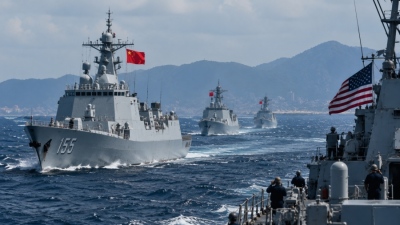
The Southern Theater Command of the Chinese military announced on Tuesday (10/20/2026) that the American warship USS Charleston entered, according to the Chinese side, illegally into the waters around Sabina Shoal in the Spratly archipelago without the approval of the Chinese government. The incident reportedly occurred during the early morning hours. According to Beijing's statement, the Chinese Navy deployed forces to track and monitor the American vessel. The Chinese military command argued that the US action violates China's sovereign rights and interests, jeopardizes maritime security, and undermines regional peace and stability. Concurrently, it called on the American side to immediately cease such activities. The US Navy had not responded to a request for comment prior to the publication of this report. Washington typically characterizes similar missions as freedom of navigation operations, through which it challenges maritime restrictions it considers unsubstantiated by international law. According to the report, the last known similar US operation in the South China Sea took place more than a year earlier.
The Philippines contest the Chinese version
The confrontation surrounding Sabina Shoal is directly linked to the dispute over control of strategic maritime areas in the South China Sea. A spokesperson for the Philippine military maintained that the American vessel did not enter Chinese territorial waters, emphasizing that no state possesses the authority to demand prior permission for lawful transit through international waters. China claims almost the entirety of the South China Sea, despite overlapping claims from Brunei, Malaysia, the Philippines, Taiwan, and Vietnam. Tensions have been particularly acute in recent years between Beijing and Manila. Sabina Shoal, located in the Spratly Islands, constitutes one of the locations where the claims of both sides collide. China and the Philippines contest sovereignty over both the specific area and the broader archipelago. Indeed, according to the Philippine Coast Guard, last month a Chinese Coast Guard vessel rammed a Philippine vessel executing a resupply mission near the same shoal. The Chinese side attributed responsibility for the collision to the Philippines. The confrontation assumes even greater significance due to the mutual defense treaty binding the Philippines with the US, reinforcing the strategic dimension of regional disputes.
New episode with Taiwan in the Pratas Islands
On the same day, a second incident was recorded in the northern portion of the South China Sea, near the Pratas Islands, which are controlled by Taiwan. Taiwan's Coast Guard announced that a Chinese Coast Guard vessel entered a restricted maritime area near the islands. In response, the Taiwanese vessel Taichung was deployed to the area to warn the Chinese ship to depart. The two sides exchanged messages via radio, with the confrontation continuing according to the announcement by the Taiwanese Coast Guard. The Chinese vessel reportedly broadcast that "the so-called Republic of China does not exist," challenging Taiwan's official name. For its part, the Taiwanese vessel responded that "the Republic of China, Taiwan, is a sovereign and independent country." The Taiwan Affairs Office of the Chinese government had not immediately responded to a request for comment. Last week, however, the same office had warned that Taiwan would have to "bear the consequences" because its Coast Guard utilized a water cannon against a Chinese fishing vessel near the Pratas Islands. These specific islands sit roughly between southern Taiwan and Hong Kong. They possess limited military defenses, with responsibility for their security held by Taiwan's Coast Guard.
China intensifies pressure around Taiwan
The incident at Pratas fits into a broader surge in activity by the Chinese Coast Guard around Taiwan, including to the east of the island, a development causing concern in Western capitals. Beijing considers Taiwan, which possesses a democratically elected government, part of Chinese territory. Taipei, for its part, rejects China's sovereignty claims. The disagreement is not limited to the island's political identity, but extends to maritime rights and control of the waters surrounding it. Speaking Tuesday at a forum in Taipei, the head of an advisory commission appointed by the US Congress characterized Chinese Coast Guard patrols east of Taiwan as "particularly destabilizing." At the same event, the secretary-general of Taiwan's National Security Council, Joseph Wu, argued that China possesses no legitimate claim over the waters east of the island.
Two maritime fronts, one broader geopolitical confrontation
The incidents involving the American warship and the Taiwanese Coast Guard highlight multiple flashpoints in the wider region. In the South China Sea, China's claims conflict with those of neighboring states, while the American military presence constitutes a constant point of friction with Beijing. At the same time, around Taiwan, increased Chinese patrols and challenges to Taiwanese sovereignty keep the region on high alert.
www.bankingnews.gr







Readers’ Comments