

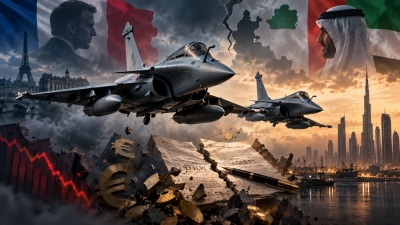
A critical clash over the technological secrets of the Rafale F5, a 3.5 billion euro funding deal that fell through, and a difficult dilemma for Paris regarding its know-how and the development cost of its next fighter. The disagreement with the United Arab Emirates reveals the tensions that a country's effort to maintain control over its most advanced defense technologies can provoke, even when billions of euros are at stake. At the center lies the Rafale F5, the new version of the French fighter aiming to integrate advanced sensors, artificial intelligence, new weaponry, and collaborative capabilities with unmanned combat aerial vehicles. Abu Dhabi was reportedly willing to cover a large share of the development costs, but demanded substantial program participation and access to technologies France was unwilling to share. The result was the collapse of negotiations in late 2025 and Paris's decision to proceed autonomously. The question now is to what extent maintaining technological autonomy will burden the French defense program and affect the fighter's development trajectory.
The 3.5 billion euro funding gap
According to reports from the French newspaper La Tribune, the United Arab Emirates was set to contribute up to 3.5 billion euros toward the remaining development costs of the Rafale F5, which were estimated at approximately 5 billion euros. Abu Dhabi's participation would therefore have covered the greater part of the remaining financial need for the program. Negotiations between the two sides remained deadlocked for months throughout 2025. The visit of French President Emmanuel Macron to the United Arab Emirates in December of that year was intended to clarify the intentions and demands of both sides. Macron met with UAE President Sheikh Mohamed bin Zayed in an effort to overcome disagreements surrounding the financing and development of the new fighter. However, according to information published by La Tribune and reproduced by EurAsian Times, the meeting did not yield the outcome Paris expected.
The UAE leader was reportedly particularly dissatisfied with French proposals, as Abu Dhabi did not wish to be limited to the role of financier without corresponding technological benefit. The Emirates wanted to participate as actively as possible in F5 development. The French side, on the other hand, was unwilling to grant access to critical program elements, placing special emphasis on advanced optronic systems. The disagreement thus concerned not only the funding amount, but also the scope of technology the Emirati defense industry could acquire in return. According to the report, Macron reportedly expressed his dissatisfaction to France's Directorate General of Armaments (Direction Générale de l’Armement – DGA) and the military leadership following the collapse of talks. The UAE's departure left France facing the entirety of development costs. Program financing must now be covered from the French defense budget as part of the country's military programming review.
Why the Emirates insisted on technology transfer
Behind the disagreement lies the ambition of the United Arab Emirates to strengthen their domestic defense industry and acquire know-how enabling them to assume more complex roles in the design and development of advanced weapon systems. At the center is the EDGE group, which is owned by the Abu Dhabi government and seeks to strengthen its position in the international defense industry. An anonymous source from the group, speaking to EurAsian Times, described EDGE as a particularly ambitious company operating with strict targets and high demands. As noted, the Emirates anticipated that technology transfer would grant the group a substantial advantage in the defense sector.
The same source estimated, however, that Emirati demands may have exceeded what France was willing to concede. For Paris, maintaining control over sensitive technologies is tied to the autonomy of its defense planning. Conceding know-how to a foreign partner can boost their industrial capabilities, yet simultaneously limits the original manufacturer's exclusive control over critical systems. This exact contradiction appears to lie at the core of the dispute: the Emirates sought to convert funding into a technological advantage, while France wanted to retain control over the program's most sensitive aspects.
Optronic systems that became a point of friction
Optronic systems constitute one of the key technologies of modern fighter jets. They enable target detection and tracking via optical and infrared sensors, complementing radar capabilities. Unlike radar, which emits electromagnetic signals, passive optical and infrared sensors can gather information without emitting radar signals themselves. This makes them particularly useful in operations where limiting electromagnetic emissions is required. The Rafale utilizes Thales's Front Sector Optronics (FSO) system, which combines a long-range infrared sensor, a high-resolution camera, and a laser rangefinder. The aircraft can also carry the TALIOS targeting pod, which is being upgraded with artificial intelligence capabilities for automatic target detection and identification. Optronics do not operate in isolation. They combine with radar data, electronic warfare sensors, and other intelligence sources, creating a more comprehensive battlefield picture for the pilot. Artificial intelligence is expected to further enhance these capabilities by assisting in processing massive data volumes, recognizing potential threats, and tracking targets. Access to such technologies therefore carries significance exceeding the purchase of an aircraft. It can contribute to developing know-how, improving domestic industrial capabilities, and future evolution of sensor and electronic systems. This explains why the optronics issue reportedly constituted one of the main obstacles in negotiations between Paris and Abu Dhabi.
France proceeds alone
Following the collapse of negotiations, France decided to continue autonomous development of the Rafale F5, shouldering the financial burden originally meant to be shared with the Emirates. Dassault Aviation Chairman and CEO Eric Trappier stated in August that "today there is no joint development with foreign countries" for the F5, while mentioning the aircraft will be offered for export starting in 2035. The French side, however, does not rule out procurement of the new version by the United Arab Emirates. Minister of Armed Forces Catherine Vautrin has characterized the Emirates as an important customer for the future F5, leaving open the possibility of purchasing the aircraft despite the failure of their development partnership. The distinction is essential: participating in the design and development of a weapon system is one thing, acquiring it as a customer is another. The French Ministry of Armed Forces announced in September 2026 that preparatory work contracts for the next Rafale version had already been awarded, targeting certification around 2033. The F5 version is designed to significantly enhance the fighter's capabilities for both conventional operations and nuclear deterrence missions.
The order of 80 Rafale F4s from the Emirates
The F5 dispute does not negate the importance of existing defense relations between France and the United Arab Emirates. In 2021, Abu Dhabi signed an agreement to purchase 80 Rafale F4 fighters along with 12 military helicopters. The aircraft agreement constituted the largest Rafale export order Dassault Aviation had secured up to that point. The total deal value was reported at approximately 19 billion dollars, with fighter deliveries scheduled to begin in late 2026. The F4 constitutes the previous major evolution of the Rafale, featuring upgrades in communications, data management, and systems networking. The F5 aspires to go much further, integrating new technological systems and collaborative combat capabilities. France therefore has a strong incentive to keep the Emirates as a customer, even if it does not wish to include them as a partner in developing the new version.
ASN4G missile with nuclear mission
The Rafale F5 is destined to constitute a major element of future French airborne nuclear deterrence. Central will be the ASN4G, the fourth-generation cruise missile with a nuclear warhead developed by MBDA. On June 2, 2026, the French Directorate General of Armaments notified the company regarding the relevant framework agreement and system development contract. The missile is designed to replace the upgraded ASMPA currently in service. Its integration into France's arsenal is projected around 2035, and it is intended to equip both Strategic Air Force aircraft and naval Rafale-Ms. Development of the ASN4G is tied to efforts to maintain the credibility of French nuclear deterrence against evolving modern threats. Its hypersonic speed and program technological requirements constitute core characteristics of the new weapon generation France is designing. Simultaneously, the F5 is expected to leverage developments in the engine sector. Current Rafales utilize Safran's M88, while for the new version, the M88 T-REX is being evaluated, a higher-thrust evolution presented at the Paris Air Show in June 2025. Integrating a more powerful engine could help boost aircraft performance, yet final F5 capabilities will depend on completing development and certifying individual systems.
Artificial intelligence on the battlefield
The next version of the French fighter is not designed simply as an aircraft with upgraded electronics. The goal is to function as part of a broader network of manned and unmanned systems, with artificial intelligence contributing to data management and operational coordination. According to Dassault Aviation, developments in artificial intelligence algorithms will help pilots manage increasingly complex missions in environments where threats become harder to detect and counter. The company estimates the offensive and defensive capabilities of the Rafale F5 will allow it to maintain operational value beyond 2060. This ambition connects with integrating new sensors, upgrading electronic warfare systems, better utilizing data, and cooperating with unmanned combat aerial vehicles. The objective is for the Rafale to confront more advanced air defense systems by leveraging intelligence from multiple sources and coordinating different assets within a common operational environment.
The drone that will function as an "extension" of the Rafale
One of the most significant elements of the F5 program is cooperation with a new unmanned combat aerial vehicle known as UCAS, developed by Dassault Aviation. The aircraft will be designed with low observability technologies, autonomous control capabilities, and internal weapon bays. It will operate as an extension of the manned Rafale, undertaking reconnaissance, intelligence gathering, electronic warfare, and strike missions. In practice, the unmanned aircraft will fly ahead of the Rafale, gathering data and contributing to target identification while executing missions in more hazardous areas. Its missions include suppression and destruction of enemy air defense systems, known as SEAD/DEAD. These operations hold special importance on a modern battlefield where fighters must confront integrated networks of radars, missiles, and anti-aircraft systems.
Through this approach, the Rafale can maintain greater distance from the most dangerous zones and focus on mission coordination and control. The program leverages know-how acquired from nEUROn, the European low-observability technology demonstrator drone. However, Dassault Aviation head Eric Trappier has stated the new aircraft will likely be more than twice the size of nEUROn to accommodate weaponry and greater range. "We are going to a size more than double so it can carry weapons and possess specific range. It will be large," he stated. The French Ministry of Armed Forces has described the UCAS as an asset operating discreetly as an extension of the Rafale F5, creating significant operational advantages via networking. Its contribution is considered particularly vital for countering modern medium- and long-range anti-aircraft defense systems.
The price of technological autonomy
The Rafale F5 case captures the dilemma major defense industries face when seeking foreign funding to develop advanced weapon systems. Partner participation can limit financial burdens and boost industrial cooperation. Concurrently, however, it generates demands for technology access, design participation, and a greater role in decision-making. In the F5 case, France apparently judged that maintaining control over sensitive technologies outweighed the advantages of a funding agreement with the United Arab Emirates. Paris is now called upon to independently cover the funding gap while maintaining the development timeline of a program it considers critical for the future of French air power. For the Emirates, the deal's failure means they did not secure the role they sought in developing the new fighter. It does not mean, however, that acquiring it as a customer in the future is ruled out.
www.bankingnews.gr





Readers’ Comments