

The international index provider requests more time to evaluate reforms in the Turkish market
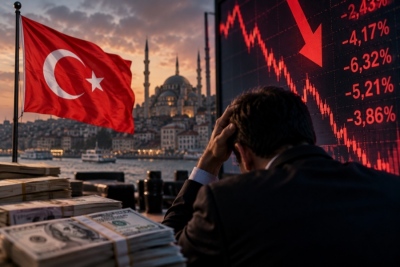
Heavy losses are recorded on Friday, 10/16, by the Turkish stock exchange, as MSCI's decision to temporarily suspend certain changes concerning Turkish equity indices heightens investor concern. The international index provider is requesting additional time to evaluate reforms in the Turkish market, while leaving open the prospect of a category downgrade if sufficient progress is not demonstrated by mid-2027. This development adds another factor of uncertainty during a period when Turkish equities face intense pressure and investor confidence is severely tested. Concerns surrounding market operations and conditions prevailing in equity investments sit firmly at the forefront. In statements that followed, Minister of Treasury and Finance Mehmet Şimşek argued that interventions aimed at improving capital market operations are underway. As he noted, competent authorities are proceeding with the implementation of significant regulatory measures to boost transparency and restore investor confidence.
Investment fund crisis at the epicenter
The MSCI decision arrives during an exceptionally difficult juncture for the Turkish stock market, which is confronting turmoil that originated in the investment fund sector and expanded across a broader range of equities. In September, Turkish authorities ordered the liquidation of 131 investment funds, which had accumulated assets exceeding $20 billion in just three years. The crisis was linked to liquidity bottlenecks, massive share redemption requests, and valuation concerns regarding smaller-capitalization stocks. Pressures had already pushed Istanbul's benchmark index into a bear market, representing a drop of more than 20% from its previous historical peak. September proved to be the worst month for the Turkish stock exchange since 2008, with the BIST 100 falling by 16.65%.
Why MSCI is concerned - The risk to foreign investments
Beyond fund turmoil, MSCI has expressed reservations regarding the calculation method for free float shares—the percentage of a company's shares available for market trading. Concurrently, institutional investors have voiced concerns over potential coordinated transactions via funds closely connected to certain smaller listed firms. MSCI demands more substantive and timely disclosure of beneficial owners, more effective supervisory and enforcement mechanisms, and a clear framework for handling cases where free float may appear artificially inflated. The suspension of index changes took effect immediately and will remain active until further notice.
For now, Turkey retains its status as an emerging market. However, if sufficient and credible progress is not recorded by June 2027, MSCI may consider reclassifying it to a lower category, such as frontier markets or standalone markets. Such a development could carry major implications for capital flows, as investment funds tracking MSCI emerging market indices might be forced to reduce or rebalance their Turkish equity positions. This creates the risk of additional valuation pressure and greater difficulty in attracting international investment capital. For the BIST 100, the environment is already burdened: the index is heading toward its fifth consecutive weekly decline and remains over 20% below the all-time high recorded in May. Its trajectory in the coming period will depend, among other factors, on how the investment fund crisis evolves, the efficacy of supervisory interventions, and MSCI's assessment of market transparency and credibility in Turkish equities.
www.bankingnews.gr












Readers’ Comments