

With the latest polls recording a lead for the governing coalition and the student movement seriously challenging SNS's dominance for the first time, the October 25 elections evolve into a critical test for the future of the Serbian power model.
Nine days prior to the Serbian parliamentary elections of October 25, opinion polls continue to grant a lead to the governing coalition led by the SNS, without however ruling out reversals. For the first time in over a decade of political dominance by Aleksandar Vučić, a movement born on university campuses appears capable of challenging the regime's hegemony. Under this light, the electoral contest concerns not only who will govern the day after, but also whether the political model that shaped modern Serbia will preserve its legitimacy and resilience.
A political system facing its most serious challenge
Serbia is heading toward early parliamentary elections on October 25, 2026, within a political juncture fundamentally differing from previous contests. For the first time after more than a decade of dominance by the Serbian Progressive Party (SNS) and President Aleksandar Vučić, a new opponent emerges from the student movement—a movement of protest and demonstrations triggered by the roof collapse at the Novi Sad railway station in November 2024 and reinforced by subsequent episodes of repression and restriction of freedoms. This movement expresses the discontent of a significant segment of Serbian society and has now evolved into a formidable political actor. The upcoming elections are already being presented, according to analysts at the Belgrade Centre for Security Policy (BCSP) and the International Institute for Middle East and Balkan Studies (IFIMES), as a form of referendum on the power model constructed over the past decade, while their outcome is expected to demonstrate the level of support for the existing system and the momentum of new socio-political actors.
The resilience of the Vučić model and the limits of the opposition
The political framework within which the contest takes place is characterized by intense concentration of power. The ruling party has consolidated centralized control over institutions, the state apparatus, the media, and local structures, while "managed instability"—a controlled state of tension allowing the regime to maintain political control and exhaust the opposing camp—functions as a steady method of governance. Repression of anti-government demonstrations is selective yet real, and institutional counterweights—such as an independent judiciary and parliamentary oversight mechanisms—remain limited. Despite a decline in support for the SNS in recent municipal elections (late 2025 and March 2026), its electoral base continues to maintain significant cohesion. Nevertheless, students have evolved into new political actors with growing influence, and the university community now constitutes a factor of political momentum. In this environment, the deep socio-political polarization of the Serbian people comes as no surprise, a fact that directly impacts the climate of the pre-electoral period.
The electoral contest as an existential stake for the regime
Under this light, the possibility of defeat for President Vučić is viewed by the regime as an existential threat, since—as analysts point out—an electoral reversal would not merely signify a change of power, but could pave the way for investigations regarding the method of governance, suspected scandals, abuse of institutions, and political accountability for events that have shocked Serbia. Within this context, the government tends to treat its opponent not as a "normal" political competitor, but as a threat to its own political survival, a fact that reinforces the narrative of foreign interference, the conduct of "hybrid warfare," and the organization of a "color revolution"—a narrative that has been used in the past to rally the electoral base by instilling fear. Furthermore, the concentration of power and constant polarization create an environment in which the ruling party utilizes time as a tool to exhaust the opposition, which remains fragmented and struggles to translate diffuse discontent into organized political change.
After the ballot box: Scenarios of contestation and institutional trial
The day after may prove equally demanding. If the opposition or the student movement challenges the process—especially in the case of a razor-thin result or allegations of pressure, intimidation, and irregularities such as those recorded in recent local elections—a resurgence of mass demonstrations cannot be ruled out. Analysts warn that such a scenario could lead to the creation of two parallel political realities: one side proclaiming victory through official institutions, while the other challenges the legitimacy of the result in the streets. Even a weaker-than-expected result for the ruling party could prompt power structures to frame any post-election public pressure as an attempt to overthrow the constitutional order or as a "hybrid threat." In any case, the country's institutional stability will be tested, as the electoral process will function as a critical test for the power model that has taken shape in Serbia.
What polls show nine days before the elections
The uncertainty surrounding the contest is also reflected in the opinion polls of recent months, which present notable discrepancies regarding the actual balance of forces. Despite their differences, the majority of the most recent measurements continue to show the governing coalition led by the SNS and President Aleksandar Vučić in first place, with percentages hovering around 44%-45%, compared to approximately 36%-37% for the student list and the forces supporting it. This picture suggests that, despite the wear and tear of recent years and continuous mobilizations, the power mechanism constructed by Aleksandar Vučić still possesses significant social and electoral footholds.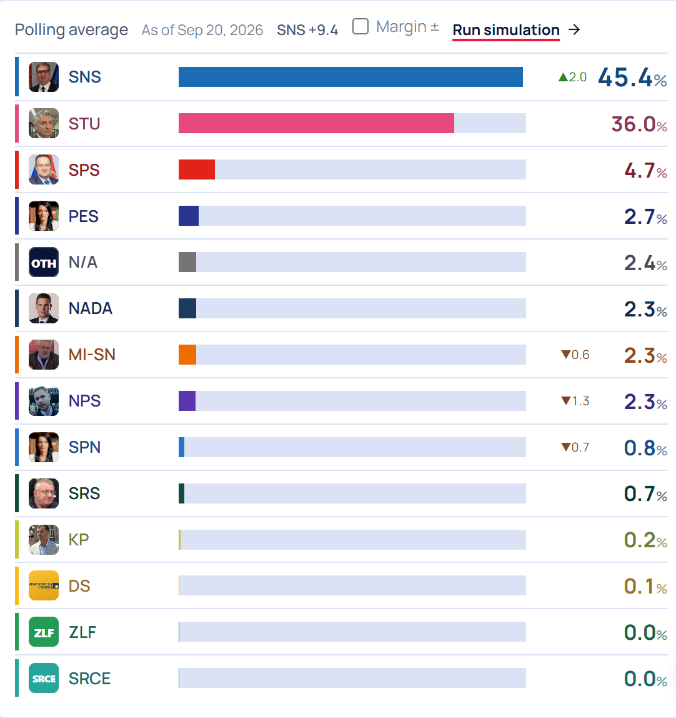
At the same time, other polls published during the summer and early autumn recorded a lead for the student bloc, a fact demonstrating both the high degree of political liquidity and the difficulties in capturing an electorate that appears intensely polarized. Regardless of the final ranking of the two main contenders, the very capability of the student movement to challenge SNS dominance at a national level constitutes a development of special political significance. In this sense, the elections of October 25 do not represent merely another electoral contest, but a trial of the resilience of a political system that for over a decade relied on the unquestioned electoral superiority of the ruling party.
The geopolitical dimension: Between Europe, Russia, and China
The stake, however, is not confined domestically. In recent years Serbia has developed a multi-level foreign policy, attempting to balance between its strategic commitment to European integration and its traditional relations with the Russian Federation, while simultaneously strengthening its cooperation with the People's Republic of China (PRC) through investments and infrastructure projects. This balancing policy has functioned as a core mechanism stabilizing the regime, allowing Vučić to present himself domestically as a leader practicing a sovereign foreign policy guided by Serbian national interests and internationally as an interlocutor maintaining open channels of communication with all key geostrategic actors. This delicate balance explains why the outcome of the October elections is being closely monitored by all international poles of power: Russia seeks to preserve its influence, the PRC views Serbia as a critical hub for its Belt & Road geo-economic initiative, while the EU and the United States are primarily interested in regional stability and Belgrade's alignment with Western policies. Within this complex geopolitical environment, the election result will constitute a critical test for Serbia's ability to maintain its fragile balance among Great Powers. The question is whether the country will be able to reconcile its European ambitions with its relations with Russia and China—and how the new political reality will impact its position in the broader geopolitical environment of the Balkan Peninsula and Europe.
*By Ilias Bratis, Geopolitical Analyst, Slavist, and Philologist
www.bankingnews.gr








Readers’ Comments