

From the Peloponnese and Thessaly to Northern Greece, Crete, and the islands, processes for Antonis Samaras' candidate lists are spreading across the whole country. The gamble is the return of disappointed New Democracy voters seeking an alternative with references to the traditional center-right.
From the inner core to candidate lists across Greece
Antonis Samaras may not have yet revealed the timing of his next moves, but contacts for the political endeavor under formation continue. According to relevant information, former ministers Kostas Tzavaras, Marios Salmas, and Kostas Markopoulos are in the foreground, together with Th. Skordas, Akis Gerontopoulos, Christos Zois, Argyris Dinopoulos, Panagiotis Panagiotopoulos, Manolis Angelakas, Th. Fortsakis, Antonis Bezas, Zoi Roussou, and Ioanna Gkelestathi. The Peloponnese, holding particular importance for the Messenian former prime minister, is at the center. Dimitris Schoinochoritis, Giorgos Magklaras, and Apostolos Kalogiannis are reportedly participating in contacts, while for Lakonia, Fevronia Patrianakou is mentioned. In Arcadia, whether Petros Tatoulis or his daughter, Evi Tatouli, will be a candidate remains open.
Names from Achaea to Northern Greece
In Achaea, Antonis Kounavis, former MP Angelos Tsigkris, doctor Nikos Oikonomopoulos, Vicky Davlourou, and Georgia Datsika are being discussed. Discussions are also reportedly underway regarding the son of Nikos Nikolopoulos. In Elis, beyond Kostas Tzavaras—who according to information is intended for the State candidate list—Odysseas Zoras and Christina Lefkaditi Karagianni are mentioned. In Aetolia-Acarnania, Nikos Kazantzis and Kostas Ploumis are on the table. In Northern Greece, names include Voula Patoulidou, Nikos Karagiannakidis, Veniamin Karakostanoglou, Dimitris Panozachos, Kostas Anestidis, P. Atamian, Nikos Anastasiadis, Kostas Ziogas, Menelaos Vlachveis, Dimitris Christogiannis, and Stathopoulos Sarigiannidis, as well as Ariandi Nouka and Dimitra Bideli. In Kozani, Chrysoula Markousi is mentioned, in Grevena, Dimitris Tsaknakis, and in Florina, Vasilis Tsepas and Pantelis Argyriadis. Whether Zisis Tzikalagias or his son, Agis, will participate remains open.
Thessaly, Epirus, Euboea, and Crete
In Thessaly, where dissatisfaction following the disasters of Storm Daniel and pressure on the agricultural sector constitutes a significant political factor, Kostas Maravegias, Sotiris Kouloktsis, Giorgos Adamoulis, Orestis Psachoulas, Alexandros Polymeropoulos, Valantis Tsioutsias, Stavros Liaskos, and Meni Prantzou are mentioned. In Ioannina, Panagiotis Kolokas and Giannis Karampinas are under discussion, while in Preveza, Stergios Giannakis. In Euboea, Kostas Markopoulos is active, and Giannis Katsiamakas is mentioned. In Boeotia, the candidacy of journalist Loukas Katsonis has reportedly been finalized, while in Phthiotis, Aliki Liaska and Nikos Stavrogiannis are mentioned. In Crete, Grigoris Paspatis is favored for Heraklion, and in Samos, Stratis Kapolis is being discussed. On the organizational side, K. Tsimaras, Sergios Tsiftis, and Serafeim Tsokas are mentioned. From the academic field, interest is attributed to Ioannis Mazis, Giannis Panagiotopoulos, Marios Efthymiopoulos, and Meletis Meletopoulos.
The battle for the traditional right-wing vote
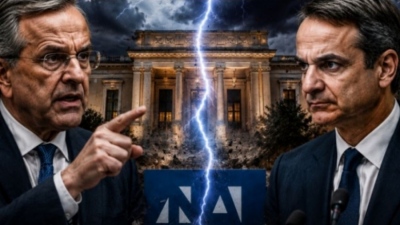
The political stake is not merely the gathering of well-known figures. It is the potential re-mobilization of voters who drifted away from New Democracy without necessarily turning to more extreme or anti-establishment options. These are citizens who for years voted for New Democracy with strong political and emotional identification, but today do not recognize in the ruling party the movement with which they connected. Samaras, however, does not represent an anti-establishment choice in the strict sense. He has served as prime minister and implemented bailout policies. His political capital is connected more to the traditional Right and the promise of a different center-right proposal than to the rejection of the political system as a whole. That is why he can draw voters only from New Democracy and can cause damage only to New Democracy. For Kyriakos Mitsotakis, the challenge is to maintain the cohesion of New Democracy and appeal again to voters who feel they have moved away from its ideological roots. Whether these processes will transform into an organized party with a nationwide presence remains to be seen. Polls do not tell the whole truth; for some, Samaras has a base percentage of 6%-7% and, yes, he can cause massive damage to New Democracy, take seats in critical constituencies, and change the entire course of the next day that would normally make Mitsotakis Prime Minister again, even in a coalition government. But now what?
Sotiris Pikoulas
sotirispikoulas@gmail.com
www.bankingnews.gr


Readers’ Comments