

The situation in the Black Sea enters a perilous escalation, as successive attacks against commercial vessels provoke grave concerns regarding the safety of international maritime navigation. Developments of recent days bring back to the foreground the danger of war fallout between Russia and Ukraine spilling beyond military operations, with direct impacts on crews, commerce, and maritime transport.
Within two days, on October 5 and 6, 2026, three commercial vessels came under attack in maritime areas near Romania and Bulgaria. Two of them sank, while the third suffered extensive damage from fire.
The incidents highlight a particularly alarming development: even merchant vessels navigating outside the territorial waters of warring states can no longer take their safety for granted.
Three attacks within 48 hours
The first attack occurred on October 5, when cargo vessel Royad Mammadov, flying the flag of Saint Kitts and Nevis, was struck while sailing from the Ukrainian port of Izmail toward Italy.
The vessel, under Turkish ownership, was transporting corn and was situated within the exclusive economic zone of Romania. Following the attack, a fire broke out and the ship ultimately sank.
According to Romanian authorities, two crew members lost their lives and eleven were rescued. The Ukrainian side attributed the strike to Russian drones, without however any definitive independent finding regarding their origin having been announced.
One day later, on October 6, two fresh attacks followed within the exclusive economic zone of Bulgaria.
The Alfa Watan, flying the flag of Togo, sank after being struck by unmanned systems. Ten crew members, nine Syrians and one Egyptian, remained missing according to information available on October 8.
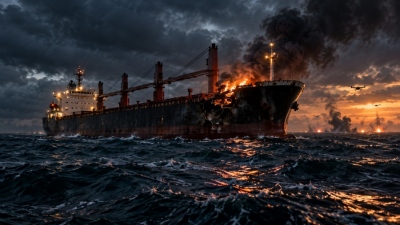
On the same day, the Able, flying the flag of Palau, was also hit. A fire erupted on board, while the 18 crew members were safely rescued. Two seafarers required hospital care.
Syria called for an independent investigation into the sinking of Alfa Watan and demanded explanations for the halt of search and rescue operations before the fate of the missing was established.

European reaction and accusations against Russia
The strikes triggered reactions across Europe, with the political debate focusing both on the security of commercial shipping and on the potential responsibility of Russia.
Ukrainian President Volodymyr Zelensky attributed the attack on Royad Mammadov to Moscow, charging that Russian military operations now directly endanger merchant vessels and the global circulation of agricultural goods.
For its part, the Bulgarian government condemned the attacks near the country's shores, without definitively determining who stood behind the strikes on Alfa Watan and Able.
This distinction carries particular significance: condemning an attack on a merchant vessel does not automatically equate to documented attribution of responsibility to a specific state.
The issue of proof assumes even greater weight when attacks are executed with unmanned systems, whose origin and command chain demand technical and operational investigation.

Russian criticism over «double standards»
On the opposite side, Russian media accuse European governments of selective sensitivity, arguing that strikes attributed to Russia draw instantaneous condemnations, whereas incidents linked to Ukrainian operations are treated differently.
In an article for RIA Novosti, political analyst Vladimir Kornilov criticizes European reactions and contends that corresponding attention is not paid to attacks against vessels carrying Russian cargoes.
Particular reference is made to an alleged attack on a tanker near Sochi, as well as the sinking of the Russian cargo ship Ursa Major in the Mediterranean in December 2024.
The Russian commentator also points to Ukrainian naval drone operations, arguing that European nations avoid assigning blame to Kyiv for actions that potentially disrupt commercial shipping.
Attack on Aframax Rio and reaction from India
On October 6, another serious incident unfolded, this time off the Russian coast near Sochi.
Tanker Aframax Rio, flying the flag of Liberia, was engulfed in flames following an unmanned surface vessel attack, according to the Russian Ministry of Transport.
All 23 crew members, all Indian nationals, were rescued without reported injuries. Ship manager Executive Ship Management confirmed the incident, clarifying that the circumstances of the attack remain under investigation, without attributing blame to any specific party.
The strike imparted a fresh diplomatic dimension to the crisis, as India holds a direct stake in protecting its trade routes and mariners.
New Delhi called for de-escalation of tensions, an end to attacks on merchant vessels, and the restoration of free navigation, underscoring the need to settle the conflict through dialogue and diplomacy.
Risk of a «dead zone» in the Black Sea
The accumulation of incidents has heightened anxiety over the prospect of the Black Sea evolving into an exceptionally high-risk maritime theater.
In the report by RIA Novosti, Bulgarian maritime executive Todor Georgiev is cited assessing that commerce in the area faces severe paralysis, characterizing the Black Sea as a potential «dead zone», with conditions that, in his view, are even harsher than those in the Strait of Hormuz.
This specific assessment does not mean that commercial shipping across the Black Sea has ground to a complete halt. It reflects, however, the alarm sparked by the spillover of attacks into waters near member states of the European Union and NATO.
The problem is not confined to the immediate peril facing ships and their crews. It extends to insurance underwriting, freight rates, transportation costs for commodities, and the reliability of international supply chains.
Elevated risk may prompt insurers to levy higher war risk premiums, while shipping lines may rethink routing or trade contracts.
Already, shipping firms internationally are seeking additional drone defense systems, as attacks on merchant ships heighten the need for technological countermeasures.
International legality and limits of military operations
The new crisis raises serious issues under international law.
The protection of merchant ships does not cease to apply during periods of armed conflict. International humanitarian law mandates the distinction between military targets and civilian objects, while the legality of any strike is assessed on the basis of specific requirements.
The fact that a vessel transports cargo to or from a belligerent state does not automatically render it a legitimate military objective.
Furthermore, conducting an attack within the exclusive economic zone of a third state introduces supplementary issues of security and jurisdiction. The EEZ, however, is not identical to territorial waters and does not constitute a zone of full sovereign state territory.
Therefore, evaluating each incident requires establishing the target, the weapon used, the identity of the attacker, and the factual circumstances.
A conflict with an expanding economic footprint
The Black Sea represents a vital corridor for shipping grain, oil, fuel, and industrial products.
Disruptions to navigation can trigger cascading economic reverberations that are not restricted to the warring nations.
The expansion of strikes against merchant vessels transforms Black Sea security from a regional military issue into a broader problem for international trade.
Russia and Ukraine trade accusations, European governments warn of hazards, and third nations call for safeguarding crews and reestablishing secure maritime routes.
The critical objective is now twofold: deterring new attacks and reliably investigating recorded incidents.
Because, beyond geopolitical confrontations and reciprocal accusations, the steepest price of escalation risks being paid by mariners, commercial enterprises, and economies dependent on the unhindered flow of goods.
www.bankingnews.gr









Readers’ Comments