

How much longer can the world endure the shock in Hormuz — US war on Iran is the mother of all strategic mistakes
The situation in Hormuz remains uncertain and explosive. While the US naval blockade against Iran is maintained, the Iranian military continues to strike tankers that do not follow its directives. To date, 104 tankers have been hit, either by striking sea mines or being hit by missiles and drones. It is evident that media reports—alternating between claims that the US military will soon strike Iran, assertions that attacks are postponed until after the November 3 US midterm elections, and statements that dialogue is resuming—demonstrate that Trump is at an impasse. There is no military solution for the Americans in the Persian Gulf. However, there is something that scares the Iranians in this entire scenario: that the strategic importance of Hormuz may be weakened, leaving the Strait of Hormuz with diminished geostrategic significance in the post-war environment.
Trump: We are having talks with Iran, we will not attack before November 3 — Iran: We do not trust the Americans
We are having constructive talks with Iran and will not attack Iran before the midterm elections on November 3, 2026, emphasized US President Trump. Claiming that there is no longer a threat from Iranian nuclear weapons, the President of the United States clarified that the real problem will arise if major American cities like Los Angeles or San Diego are targeted. In his latest statements, US President Trump presented new positions regarding Iran's nuclear capabilities and threats to American cities. Claiming that "we are hitting Iran hard," he argued: "There is no longer any threat from Iranian nuclear weapons." The US President continued his speech, referring to potential threat scenarios against American territory, stating: "If you want to see the problems, let them attack Los Angeles or a place like San Diego, let them attack one of our big cities, then we can say we have a problem." However, the Iranians consider all these statements by Trump to be nonsense, believing that the Americans say one thing and plan another, and they do not trust them even in dialogue... there is a precedent of American inconsistency.
Ali Mohammadi (Revolutionary Guards): We punish non-compliant ships every night in Hormuz
Ali Mohammadi, deputy head of political affairs for the Islamic Revolutionary Guard Corps Navy (IRGC), stated that Iranian forces conduct operations every night in the Strait of Hormuz against vessels Tehran considers to be violating its rules. Speaking to the Iranian news agency Fars, Mohammadi stated that the Revolutionary Guard Navy maintains "complete and absolute" surveillance of the strait from the first day of the war and will continue both its offensive and defensive operations. At the same time, he dismissed data cited by US President Donald Trump and media outlets regarding the volume of oil passing through the Strait of Hormuz, maintaining that estimates of three to eight million barrels are "incorrect." According to Mohammadi, these specific figures represent "media speculation" aimed at lowering oil prices and influencing the market. He added that the Revolutionary Guard Navy can impose its will "at any point" in the Strait of Hormuz on ships it considers in violation of its rules, while accusing the United States of causing insecurity in the Persian Gulf and the wider region.
How much longer can the world endure the shock in Hormuz — US war on Iran is the mother of all strategic mistakes
"I cannot imagine Trump still enjoying the war with Iran this much. It must be very difficult even for him to continue believing it was a great victory," reports the Financial Times: "The war that was supposed to lead to the rapid collapse of the Iranian regime is now in its 8th month with no end in sight. What happens next?" The initial conclusion is that one should never underestimate either human stupidity or human genius. So far, the scales are roughly equal in the competition between the two. But for how long will this situation continue? That is the question.
Mother of all strategic mistakes, the US war on Iran
In a striking analysis, University of Chicago Professor John Mearsheimer described the war against Iran as "the mother of all strategic mistakes." He says, among other things, that the United States went to war based on the false claim that Iran was on the verge of acquiring nuclear weapons. Washington believed it could achieve regime change relying solely on air power, an approach that has never been successful. The United States also lacked an alternative plan to handle Iran's closure of Hormuz.
Chris Murphy (US Senator) takes fire: Pentagon is hiding the true cost and damage of the war in Iran
US Senator Chris Murphy accuses the Pentagon of a "cover-up" regarding the costs and damage from the war with Iran. Democratic US Senator Chris Murphy accused the US Department of Defense of attempting to conceal the costs and failures of the war against Iran after being denied access to US military facilities in the region. "The justification was fabricated," Murphy said in an interview with CNN. As he noted, officials told him the visit was unsafe; however, he countered that he had previously visited US military positions in Iraq and Afghanistan while combat operations were underway. "It was not a matter of safety. It was a matter of a cover-up," Murphy stated, adding that Defense Department officials in the region also refused to brief him at the US Embassy. Murphy reported that the State Department allowed him to inspect damage at the embassy, which he described as "extensive." "The attack on the US Embassy occurred at night. If it had taken place during the day, many Americans would have been killed," asserted the US Senator.
So far 104 tankers hit in Hormuz by mines or missiles and drones… but what scares Iran?
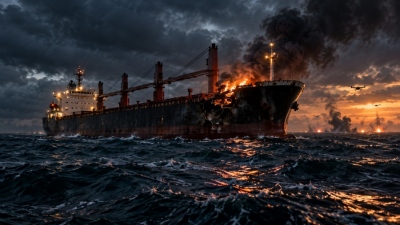
Several powerful explosions occurred in the southern passage of the Strait of Hormuz, caused when oil tankers struck sea mines laid in the water… This is an almost daily phenomenon in Hormuz. Simultaneously, Iran launched overnight attacks on tankers that violated navigation rules set by Iran. Iran's limited but daily attacks undermine Trump's plan to control oil and gasoline prices. Brent crude oil is now above $105, a surge directly triggered by Iran's attacks on tankers in the Strait of Hormuz over recent nights. The Islamic Revolutionary Guard Corps Navy has targeted at least seven "non-compliant" tankers in the strategic waterway of the Strait of Hormuz over the past five days. Iranian media outlets have announced that missiles and drones were used in these attacks, hitting more than 10 oil tankers. According to official statistics, 104 vessels have been attacked since late February 2026. What, however, is the reason behind Iran's escalating attacks on non-compliant tankers?
Why Iran has escalated its attacks… it is a strategic necessity
Analysts believe these attacks are not merely retaliation against the US and its naval blockade, but are rooted in a deeper concern for Iran: the gradual loss of strategic control over the world's most critical oil chokepoint. On February 28, 2026, following joint US and Israeli strikes on its territory, Iran tightened control over the Strait of Hormuz, blocking safe passage for vessels linked to the US and Israel. This forced the US and Israel to back down. Furthermore, limited Iranian attacks undermine Trump's plan to control the price of oil and gasoline. The price of Brent crude has now exceeded $105, and this price increase is a direct result of Iran's attacks on non-compliant tankers in the Strait of Hormuz. On the other hand, the United States is restricting Iranian oil exports by enforcing a naval blockade on Iranian ports since April 2026. Washington has announced it will target Iranian tankers belonging to the "shadow fleet" and help fund various entities of the Islamic Republic of Iran. In return, Iran increases the economic cost of the blockade by targeting tankers connected to US allies in the region. Consequently, Iran's recent attacks on tankers can be interpreted as a strategic necessity, one that could determine the outcome of a war between Iran and the United States or a negotiation and agreement between the two: maintaining control of the Strait of Hormuz.
What is Iran's strategic goal?
Some analysts believe Iran's main objective is to turn the Strait of Hormuz into a primary leverage tool in political negotiations with the United States. US Secretary of State Rubio stated that Iran has turned the waterway into a "leverage tool." The Secretary of Iran's Supreme National Security Council also emphasized that "the Strait of Hormuz will not open through threats or pressure" and that Iran will not back down. Iran is also trying to exert pressure on shipping companies and the global economy by driving up shipping costs. War risk insurance premiums for each tanker voyage have reached $20 million, and crew wages for passing through the Strait of Hormuz have increased up to $100,000 per month, reaching $150,000 with bonuses. This economic pressure is designed to force Washington to retreat from its sanctions policies. This assessment shows that Iran's strategic priority has shifted from its nuclear program to control of the Strait of Hormuz, and control of the Strait of Hormuz is currently Iran's most important military-strategic priority.
Will all this lead… to a full-scale war?
An assessment by US military and intelligence services indicates that any attempt to forcibly open the Strait of Hormuz could drag Washington into a long, costly, and attritional war, the success of which is not guaranteed. However, some analysts believe the escalation of tensions may be a "calculated tactic" to strengthen both sides' positions at the negotiating table, rather than a prelude to full-scale war. The United States, adopting a "tanker for a tanker" doctrine, will respond to any Iranian attack, but has so far avoided a full-scale deterioration of the situation. Iran has also calibrated its attacks, showing that the war in the Strait of Hormuz remains under control and has not, so to speak, slipped out of the hands of the involved parties. However, the risk of "miscalculation" remains severe. Ongoing attacks and counterattacks can quickly spiral out of control, especially if one side suffers heavy casualties. The experience of the tanker wars of the 1980s demonstrates that such conflicts can easily draw foreign powers into a wider war. Analysts believe that under current conditions, the Strait of Hormuz has become the region's "powder keg," and any minor incident could spark an all-out war. What is certain is that the future of this strategic waterway will have a decisive impact not only on the global economy, but also on the peace and security of the entire Middle East.
Iran: The US lies, they did not lose only 42 American aircraft, the count reaches 100
The Iranian Foreign Minister stated that the real number of US military aircraft shot down by Iran is "much higher" than what the US reports. The US Congressional Research Service admitted in May that Iran's armed forces had shot down 42 US military aircraft. However, that figure has now risen to 81 including drones. "But the real toll is much higher; nearly 100 aircraft were hit." As evidence of a cover-up, the top Iranian diplomat pointed to CENTCOM's refusal to allow a sitting US senator to inspect bases claimed to be undamaged, without providing further details. "You can fool all the people some of the time, and some of the people all the time, but you cannot fool all the people all the time." A report by the Congressional Research Service (CRS) published on Monday states that the United States lost or suffered damage to at least 81 military aircraft and drones during Trump's war in Iran, with total replacement costs estimated between $1.9 billion and $3.3 billion. The tally covers manned aircraft, helicopters, and unmanned systems, incorporating combat losses, alleged accidents, and aircraft damaged or destroyed on the ground. MQ-9 Reaper drones account for more than half of the total. The list also includes high-value platforms such as an F-35A fighter jet and an E-3 Sentry, as well as up to 12 F-15E Strike Eagles, 7 KC-135 refueling tankers, and 7 helicopters. Meanwhile, CNN has estimated the total cost of the war at over $45 billion, noting that "the figure does not include infrastructure damage at US bases in the region, including those where some of the aircraft losses occurred."
www.bankingnews.gr






Readers’ Comments