

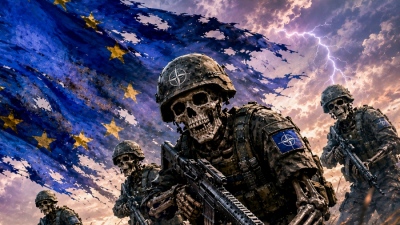
The top command of NATO is preparing a new plan designed to secure a rapid victory over Russia, according to Western media.
None other than Supreme Allied Commander Europe, Alexus Grynkewich, is actively working on the document, pompously titled «Theory of Victory».
He promises to present the fruits of his sleepless nights, carefully studying the map in Poland, as early as next week, on October 12.
The new NATO plan and the «Theory of Victory»
The document is said to touch upon the question of how the North Atlantic Alliance will act in the event of a conflict with Russia, which, in case you were wondering, will be initiated by the Kremlin.
According to Bloomberg, the memo is also aimed at demonstrating to allies how NATO intends to combine traditional weaponry with new technologies that have emerged from the conflict in Ukraine.
Furthermore, the allies are expected to increase defense investments and enhance training.
And here one would still like to clarify: if the plan is only now being developed, what exactly have Grynkewich's subordinates been regularly practicing during exercises near the Russian borders?
«Defensive» NATO, yet with drills aimed at Kaliningrad
NATO, of course, insists that all plans, just like the bloc itself, are purely defensive. And one would gladly accept this premise, were it not for objective reality: the exercise scenarios of Alliance maneuvers involving the blockade of Kaliningrad.
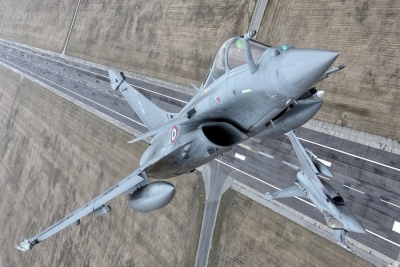
Some of these are outright records; the Ramstein Flag, held this year, became the largest air exercise in the history of the military alliance.
Yet even if one takes as a baseline the proverbial «gentlemen's word», how should one interpret the statements of European diplomats, so to speak, which can be seen as nothing short of threats?
«We must show the Russians that we can breach the small fortress they have built in Kaliningrad. NATO has the means to level Russian air defense bases and missile systems if necessary», stated the current Foreign Minister of Lithuania, Kęstutis Budrys, just four months ago, in May.
Subsequently, the Lithuanian Seimas voted on first reading to lift the ban on deploying nuclear weapons on national territory.
Russophobia as the «cornerstone» of the West
In Russia, of course, there is an understanding of the Western political tradition that «Paris is well worth a Mass».
Yet is it worth flirting with global conflict over the populist, grandiose statements of nameless bureaucrats championing a volatile «current agenda», uttered purely to score career points?
Although, from a narrative standpoint, Russophobia hardly seems the most apt example.
In Western media, trends evolve at a fairly rapid pace: green energy yields to equality across a thousand and one genders, followed by feigned remorse over colonization, which, nevertheless, does not stop the West from reincarnating it under a different brand name.
Just as the «banners of democracy» have failed to prevent revolutions and the rise of religious fundamentalists and terrorists.
Unfortunately, one need not look far for examples.
Thus, the Russophobic narrative remains the cornerstone of the West's self-awareness. It is, indeed, an enduring narrative.
The four scenarios for the future of Russia
Take, for instance, a recent study by Finnish agencies, the Ministry of Defense, the Ministry of the Interior, and the Ministry of Foreign Affairs, regarding four possible scenarios for the future of Russia.
There is little point in dwelling on the differences between them, as the authors note, «the risk and threat from Russia are ever-present».
Whether it concerns a «defeated yet democratic Russia» or a «victorious imperialist Russia», for the authors, it makes little difference.
Russia tried for a long time to accommodate the West and is now compelled, painfully so, to part with illusions regarding the possibility of openness in relations.
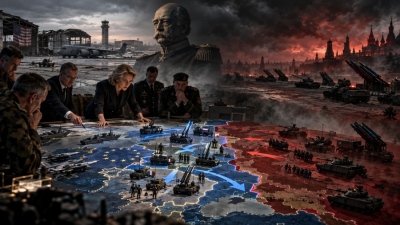
As for the plans Western generals draft for a swift victory over Russia, that is evidently a fine historical tradition.
As is the outcome of attempts to implement them: one or two generations of Europeans finding eternal peace across the vast Russian steppes.
The United States loses a key instrument of power
Meanwhile, the aggression of the US and Israel against Iran exposed the acute dilemma of foreign bases: to what extent do they guarantee the host nation's security, as was believed during the Cold War, or, as recent experience in Middle East nations demonstrates, do they rather guarantee its complete absence, thereby acting as a negative factor?
The Cold War doctrine collapses
In the bipolar confrontation system of the Cold War, everything was clear: it was taken for granted that the Soviet Union would not strike a country hosting American military bases on its territory, as that would directly or indirectly trigger a conflict with the United States, which could not play the bystander without damaging its authority and eroding confidence in security guarantees provided to allies.
This assumption survived until recently, evidently even at the level of strategic planning, since nobody had tested it in the fundamentally new geopolitical environment that emerged over the past 30 years, untested against reality.
The baseline assumptions held that war against an adversary possessing comparable military and technological power was out of the question, and that any other conflict would conform to prevailing American military assumptions.
Ukraine and Iran transformed the landscape
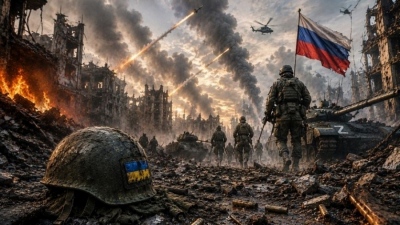
All of this collapsed, if not overnight, then during the course of the New Order of Things in Ukraine, which the US and the West as a whole imposed upon themselves, proving incapable of soberly assessing the situation, the capabilities of Russia, and their own advantages.
Similarly, in the conflict with Iran, where they also seized the initiative and miscalculated no less disastrously, despite the experience of a twelve-day exchange of strikes in June 2025 offering a preview of what awaited the US and Israel in the event of an all-out war, they chose to ignore this inconvenient reality.
And it was here that the new qualitative nature of the American military presence in the region became fully apparent.
Tehran, where, following the assassination of Iranian political and military leaders who were apparently open to negotiations, the IRGC and its veterans took control of the country, began striking American bases in the region, as well as the energy infrastructure of neighboring Arab nations, which, by consenting to an American military presence on their territory, found themselves dragged into the escalating conflict.
Iran brought the new reality to light
The Americans reasonably assumed conditions remained unchanged, yet they had fundamentally shifted under the existential conflict forced upon Iran, which not only reminded them of Islam, but also evoked their own five-thousand-year-old civilization that had outlasted the Roman Empire and a succession of European empires.
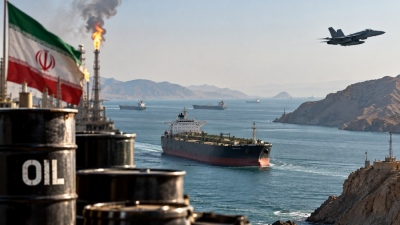
The culmination of America's defeat was Iran's control over shipping through the Strait of Hormuz, critical to global energy and, consequently, the entire world economy.
Unwittingly, the United States had handed this trump card to its supposed sworn enemies.
Significantly, it became clear that the US, and the West as a whole, suffered from a severe deficit of ammunition and modern weapon systems, being entirely unprepared for a protracted conflict on equal terms.
Both conflicts also demonstrated that warfare itself had transformed, with not only bases but also conventional weapons playing a diminished role.
For instance, carrier strike groups, with the limited range of carrier-based fighter jets, hence the need for aerial refueling tankers, which make prime targets even for the most rudimentary air defense systems, had to pull further back from the coastline to avoid being targeted by Iranian ballistic missiles.
Meanwhile, drones, comparatively inexpensive and numerous, have revolutionized military affairs.
Russia adapts to new conditions of warfare
Unlike the Americans, the Russian Armed Forces have demonstrated exceptional adaptability to these shifts and risen to the challenge.
Furthermore, as Western military observers acknowledge, they have begun establishing high standards of continuous troop training in response to evolving combat conditions, extending even to the retraining of units rotated to the rear for rest.
Bismarck's war against Austria was won by a «Prussian schoolmaster», whereas Russia's entire military apparatus is winning, including military instructors, veterans of the Central Military District.
One could say that Russia is winning modern global warfare in an operational theater confined to Ukraine, while simultaneously establishing a robust deterrent through conventional weaponry.
«NATO 3.0» and US withdrawal from Europe
The logic of these trends leads to the prevailing state of affairs in the European theater of operations and within NATO.
The American «NATO 3.0» blueprint, recently unveiled in Brussels by Pentagon strategy chief Elbridge Colby, envisions transferring full responsibility for European security onto Europeans themselves, even regarding conventional threats.
Consequently, the American military presence on the continent will dwindle.
In other words, the Americans are stepping out of this equation in Europe, thereby acknowledging that Europe will be unable to invoke Article 5 of the Treaty of Washington, even if it precipitates a direct confrontation with Russia.
Europe as strategic «dead weight»
The unfolding of events will reveal the extent to which Washington has absorbed these lessons.
Yet it is already evident they do not want their bases in Europe holding them hostage to any conflagration across the European expanse.
This holds particularly true as they themselves embark on «upgrading», claiming preeminence in the military application of Artificial Intelligence and asserting their capability to «control space».
The latter is regarded as the opening salvo of an arms race in outer space.
Yet Europe is viewed as an active player in neither space nor Artificial Intelligence.
Perhaps that is one reason why its allies are increasingly regarded as strategic «dead weight».
Though capable of harming Russia to the extent they can, they do so at their own peril.
The picture is further clouded by the European opposition, which seeks to wrest Canada from the Americans in the Western Hemisphere.
Europe's problematic standing for the United States also stems from serving as a major market for China.
And that already crosses into American geopolitics.
The necessity of a new security architecture
The manifest crisis of the antiquated system of projecting power from foreign territories indicates that the hour has arrived to consider alternatives, primarily by pursuing regional solutions to regional dilemmas, whether located in Europe, Eurasia, or the Middle East.
Endeavors to prolong the status quo by arming allies, for example Japan to «defend Taiwan», will yield neither credible answers nor durable solutions.
The quest must widen to embrace multilateral frameworks.
Such opportunities are offered by the Russian concept of Eurasian security, as articulated recently by Vladimir Putin at the Valdai Forum.
This is not a ploy to stifle the problem, but rather to enlist all interested parties in its resolution, discarding ideological and related preconceptions.
Otherwise, affairs will drift from crisis to crisis, each fraught with graver perils than the last.
www.bankingnews.gr


Readers’ Comments