

There are, he said, projects involving "sensitive situations" that also implicate other countries, referring directly, even without naming it, to Turkey.
Through... private initiative!
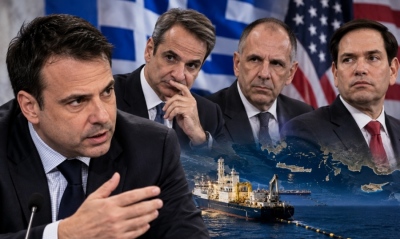
The question was specific: can Greece rely on American support for the vertical energy corridor, ExxonMobil's drilling, Chevron's explorations south of Crete, and the electrical interconnections of Greece – Egypt and Greece – Cyprus – Israel? Rubio answered that energy security is directly linked to national security and that the crisis with Iran proved the need for diversified energy routes. "We have great commitment" to energy cooperation with Greece, he said, calling Athens an "excellent partner". So far, so good for the Greek side. Then came the "but". The US Secretary of State noted that some of the projects involve "sensitive situations" with the participation of other countries, adding that such issues are better handled through private initiative and diplomacy rather than in a press conference. In simple terms: support for energy cooperation, but no blank check on matters where Turkey enters the frame.
Samaras' warning bells
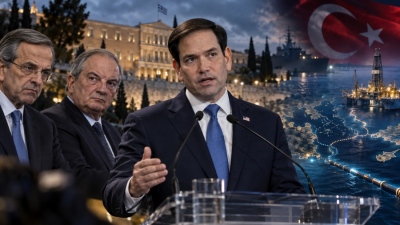
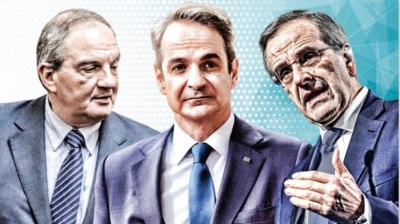
The timing hardly goes unnoticed. At the very moment the government attempts to present the Rubio visit as proof of Greece's upgraded geopolitical standing, Antonis Samaras, just one day earlier, had warned of "signs of decline," political responsibilities, and complacency. The former prime minister targeted a political mindset that, as he argued, is limited to management and remaining in power, insisting on the need to return ideas, visions, and political strategy to national issues. He made special reference to Thrace. And Samaras' message aligns with the critique he has leveled recently against the government's foreign policy, which he has characterized as subservient to Turkish revisionism. Along his broader stance, he has demanded a more active European reaction to Turkish provocations and "equal standards" for Turkey.
Karamanlis sweeps in...
And as if Samaras' intervention were not enough, Kostas Karamanlis spoke yesterday from Tsinghua University to open an even more difficult discussion: what does Greek foreign policy mean in a world that is no longer unipolar? The former prime minister emphatically defended the strategic choice of Greek-Chinese cooperation and COSCO's investment in Piraeus. He recalled that the relationship between Athens and Beijing was built as a conscious strategic choice and not as a opportunistic economic deal. The political message, however, lies elsewhere. Karamanlis described a world more unstable, multipolar, and competitive, where the return of realpolitik is changing the landscape. And he stressed the need for a "more complex" and multidimensional foreign policy, with Greece remaining in the West while simultaneously maintaining open channels with other major powers.
"Bombs" on Turkey, Cyprus, and the West
He became even sharper when transitioning to Turkey and the stance of the West. Karamanlis referenced Turkish revisionist claims, the threat of war against Greece, and the occupation of Cyprus, raising the issue of the West's "double standards". At the same time, he criticized Western policy in Ukraine, arguing that the West is not devoid of responsibility regarding previous efforts to integrate Ukraine. And here lies the political paradox of the day. Rubio came to Athens to confirm the Greece – US strategic relationship, but before the cameras he recalled the limits of American commitment when sensitive energy projects and Turkey are on the table. Samaras spoke of complacency and the need for a more decisive national policy. And Karamanlis, a few hours later, brought into focus the need for a multidimensional foreign policy. The Maximos Mansion may hold onto the positive outcome of the Rubio visit and invest in the close relationship with Washington.
New intervention
Of course, according to information, a new hit is coming to the established foreign policy of the Maximos Mansion, which was seeking a communications... Messiah in Athens through the Rubio visit, but likely fell into the "trap" it set for others. Specifically, Kostas Karamanlis is preparing a new intervention toward the end of October focused on foreign policy. A topic that "hurts" the government and serves as a springboard for Samaras' endeavor. Naturally, everything will be answered in the field and by what happens at the end of the day regarding the cable laying in Kasos.
The Piraearchis
www.bankingnews.gr


Readers’ Comments