

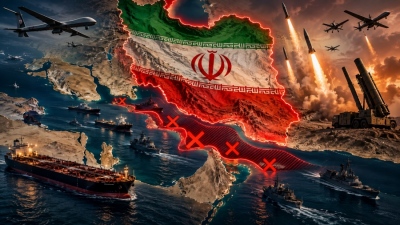
In a harsh new warning to the West, Iran announces that it is ready to proceed with a complete blockade of the Strait of Hormuz, closing all maritime routes used illegally for oil transport. A senior official of the Islamic Revolutionary Guard Corps (IRGC) claims that Iran has full control over the strategic maritime passage and that it will remain closed until Tehran's "legitimate demands" are met. At the same time, messages are coming from within the Iranian Armed Forces regarding a broader shift in the country's military posture, with an emphasis on longer-range missiles, new unmanned aerial vehicles, and the capability for preemptive strikes. Tehran thus appears to link control over Hormuz with a more aggressive strategy toward US forces in the region, while keeping open the possibility of a faster and stronger military response in the event of a new conflict. In the wake of these statements, oil prices recorded a new rise, with Brent December futures strengthening by 1.62% to $102.21 and US crude (WTI) futures increasing by 1.05% to $90.38.
"We will close all illegal routes"
Mohammad Reza Naqdi, senior advisor to the commander of the Revolutionary Guards, claimed in an interview with the Fars News Agency that Iran is set to soon close all "illegal" maritime routes in Hormuz. According to him, some of these routes were created following explosions and interventions in rocky passages of the Strait and are used by small vessels for oil trafficking. Naqdi did not stop, however, at the issue of illegal navigation. He claimed that Iran maintains complete control of Hormuz and that the Strait will remain closed until Tehran's demands are satisfied. The statement carries particular weight due to the strategic significance of Hormuz for the global energy market, as a substantial portion of international oil and natural gas shipments passes through this specific sea passage.
From deterrence to preemptive strikes
The message regarding Hormuz comes alongside statements from the Iranian Military describing a wider shift in Tehran's military strategy. Iranian Military spokesman Brigadier General Mohammad Akrami-Nia claimed that during the recent conflict, the Iranian Armed Forces gained new operational experience and significantly reinforced their readiness. According to him, Iran's military command has transitioned from an exclusively defensive model to a more aggressive doctrine that includes even the capacity for preemptive operations. Akrami-Nia claimed that Iran has already carried out such operations against bases that, according to Tehran's assessment, were preparing attacks against the country. He invoked the right to self-defense and Article 51 of the UN Charter, arguing that preemptive actions can take place when, under Iranian assessment, the criteria of necessity, urgency, and proportionality are met.
Longer-range missiles
Of particular interest is the Iranian official's reference to the conclusions drawn from recent operations. As he claimed, Iran concluded that it must further extend its missile range, as well as improve their speed and precision. The reason, according to him, is the greater distance at which certain hostile forces are now located relative to Iranian shores. Akrami-Nia made special reference to distances that could reach up to 1,000 kilometers. He further claimed that the upgrade applies to all missile systems of the Iranian Military, while the production of new weaponry continues. This specific reference is particularly significant, as it shows that Tehran views extending range not as an isolated upgrade to a single missile, but as a broader direction for developing its future missile systems.
New drones and "hidden" weapon systems
At the same time, the Iranian Military spokesman claimed that during the conflicts, new offensive and defensive missile systems were deployed, as well as new drones. He hinted that not all systems utilized have been presented yet, leaving open the possibility that more information will be revealed in the future. According to his assertion, the production of weapon systems continued even during the war, resulting in the Iranian Armed Forces now possessing substantial stockpiles.
US bases in the "target database"
A central point of Akrami-Nia's statements is also the reference to American military facilities in the region. The Iranian official claimed that US bases form part of Iran's continuously updated "target database" and that missiles and drones were used against American positions during the conflict. He also claimed that Iranian aircraft conducted attacks against US bases in Kuwait and Qatar, while speaking of operations against facilities protected by multiple layers of air defense. According to the Iranian version, the "target database" is not static but is constantly updated to include new military facilities and infrastructure.
"More destructive and faster" response
The final message from the Iranian Military is that a new attack will not be handled in the same manner. Akrami-Nia claimed that the Iranian Armed Forces are stronger today than at the beginning of the conflict, both in terms of equipment and in experience, confidence, and morale. In the event of a new attack, according to him, the Iranian response will be "far more destructive, broader, decisive, and faster".
www.bankingnews.gr







Readers’ Comments