

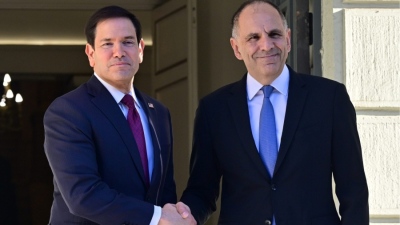
Greece is being led into increasingly dangerous waters, remaining tied to the US chariot. Indeed, the scenario of the country's involvement in the Middle East war is on the table, with the Minister of Foreign Affairs signaling that "we are ready to assist the US in the Strait of Hormuz." Specifically, Giorgos Gerapetritis, during joint statements with his American counterpart, Marco Rubio, for the 6th Strategic Dialogue between the two countries, referred to the possibility of Greece providing naval assistance to the US in the Strait of Hormuz.
Furthermore, he highlighted Greece's pivotal role in maritime security and the energy and supply chain, while Rubio sent a new tough message to Iran, declaring that Tehran will never acquire nuclear weapons as long as Donald Trump is president of the US. Mr. Gerapetritis's position adds Hormuz to the already active Greek presence in the Red Sea, where Greece plays, as he stated, a leading role in Operation Aspides. At the same time, he highlighted Athens's position as a security provider, linking the protection of maritime routes with Europe's energy security and the transport of American LNG via the Vertical Corridor.
Gerapetritis: Greece ready to assist the US in Hormuz
"If necessary, then we are in a position to collaborate with the United States to provide the necessary naval assistance in the area of the Strait of Hormuz, provided conditions allow and provided there is a sustainable peace process," stated Mr. Gerapetritis in response to a relevant question. The Minister of Foreign Affairs pointed out that the operations in which Greece already participates in the Red Sea, the Mediterranean, and the Indian Ocean are complementary to American initiatives, emphasizing the country's leading role in protecting freedom of navigation. Answering a question regarding the possibility of supporting US operations against Iran from the Souda naval base in the event of new American strikes, Mr. Gerapetritis reiterated Athens's stance in favor of respecting international law and supporting the defender against the aggressor, while stressing that Greece has now become a security provider in the broader region.
"Greece now has the capacity, thanks to its advanced defense systems and its very strong geopolitical position, to be able to provide security, export security, and serve as a pillar of stability," he noted, referring to security provision in Cyprus, Bulgaria, and Gulf nations. The Foreign Minister placed particular emphasis on the Greek presence in international naval operations, referring to Operation Aspides in the Red Sea and Operation Atalanta as elements demonstrating that Greece is not merely a consumer but a provider of security. In the same direction, he underlined Greece's status as a member of the UN Security Council and the European Union, as well as the fact that the country will assume the presidency of the Council of the EU in the second half of 2027.
Rubio: "Iran will never acquire nuclear weapons"
In the same context, Marco Rubio reiterated the American position that Iran cannot acquire nuclear weapons. "Iran cannot have nuclear weapons," he characteristically stated, adding that whatever the US agrees to must lead to the result that Iran does not acquire nuclear capabilities. The American Secretary of State further argued that US President Donald Trump has destroyed Iran's capabilities to manufacture drones and operate with its navy, while making it clear that as long as Trump is president of the US, Iran will not acquire nuclear weapons.
"How we achieve this, we will see," he noted characteristically, leaving open the question of the method by which Washington will pursue this specific goal. Rubio also referred to the state of the Iranian economy and the Strait of Hormuz, maintaining that the flow of oil has returned to levels similar to those prior to the conflict. "The Strait of Hormuz is open, and the quantities of oil passing through now are exactly the same as the quantities passing before their closure," Rubio stated characteristically. The crisis around Hormuz holds particular significance for international energy markets, as it is one of the most important maritime transport routes for oil and natural gas. The US and Iran are simultaneously in negotiations for the reopening of the Strait, with Tehran linking its opening to specific conditions.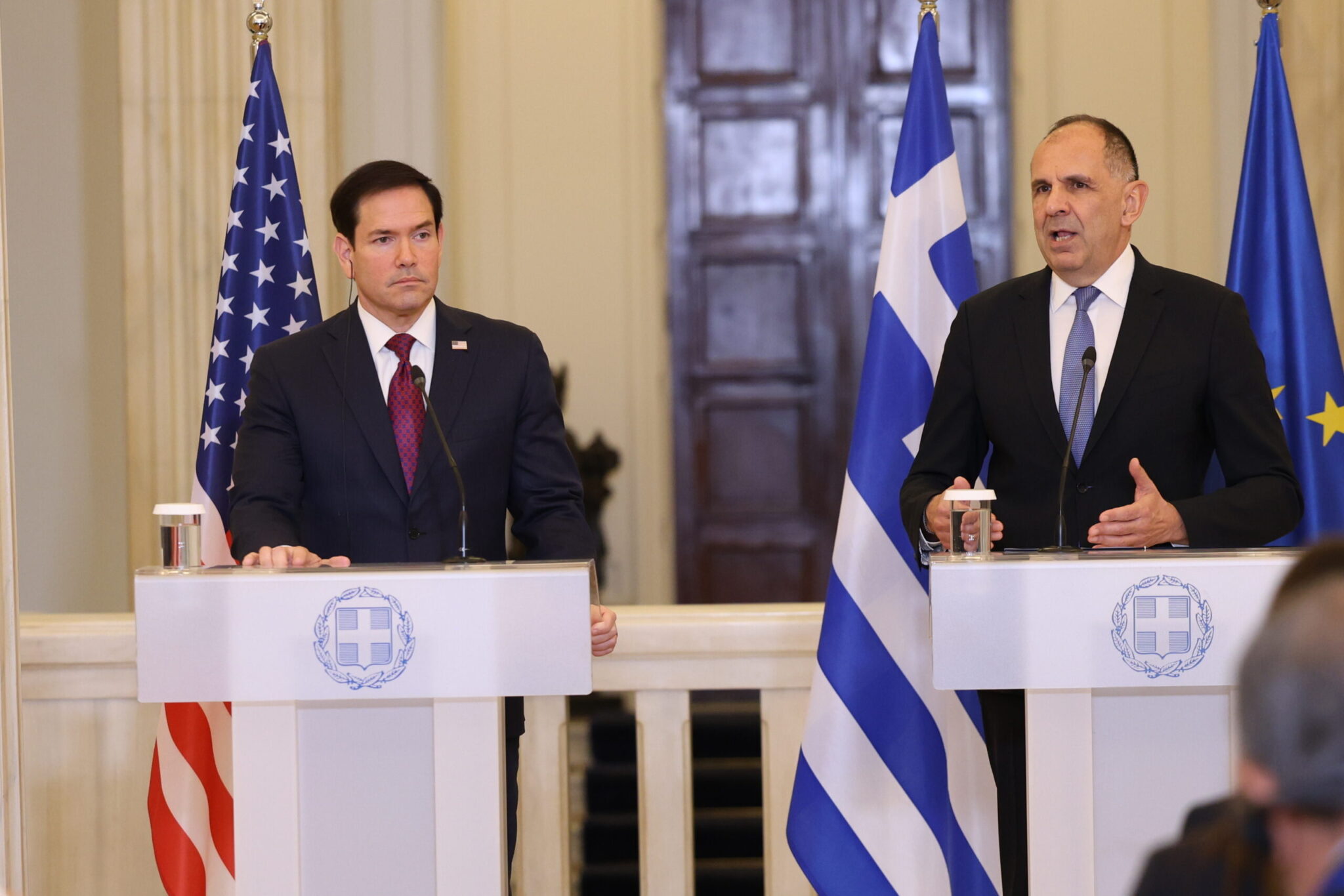
Greece as a "security provider"
Meanwhile, Giorgos Gerapetritis presented Greece as a country that has now evolved from a consumer to a security provider in the region. As he noted, with defense spending above the NATO limit, Greece has become a security provider, while actively participating in all European operations that complement American initiatives. In the same context, he included Souda and Alexandroupoli, which, as he highlighted, showcase Greece's pivotal role in security strategy and the American presence in the region. He also made reference to the F-35s, noting that their acquisition highlights the stable defense cooperation between Greece and the US. For his part, Rubio underlined that European states must assume a greater share of responsibility for Europe's security, noting that Greece is already doing so. "We are grateful that Greece remains a stable and great ally," stated the American Secretary of State, emphasizing the two countries' historical ties and shared perception of global threats.
Eastern Mediterranean and Cyprus issue
At the same time, Mr. Gerapetritis referred to the need to ensure conditions of stability in the Eastern Mediterranean. Regarding the European perspective of the Western Balkans, he stressed that it is important to highlight the region's importance with respect for international law and good neighborly relations. He made special reference to the Cyprus issue, emphasizing the necessity of finding a solution for the reunification of Cyprus based on UN Security Council resolutions, while preventing any revisionist threat. The Greek Foreign Minister also mentioned that developments in the Middle East and Israel were discussed, highlighting the strategic relationship between Greece and Israel and the importance of the "3+1" initiative involving Greece, Cyprus, Israel, and the US. As he said, the perception of Athens and Washington regarding Middle East issues is aligned, and the second phase of the 20-point plan for Gaza must proceed, while calling for an end to actions in the West Bank that hinder peace efforts.
Counter-terrorism cooperation
The American Secretary of State further referred to cooperation between Greece and the US in security, counter-terrorism, and migration. In fact, he maintained that Greece serves as a joint ally of the US against terrorist threats and massive migration flows, announcing a new memorandum of understanding on security and counter-terrorism. Concurrently, both sides placed emphasis on protecting cultural heritage and tackling the illegal trade of artwork. Within the framework of the 6th Strategic Dialogue, provisions are also made for signing a Letter of Intent for cooperation between the Greek Armed Forces and the Florida National Guard, as well as an intergovernmental agreement on the mutual recognition of maritime certificates of competency. The themes of the Dialogue also cover security and law enforcement, energy, shipping, technology, trade, investments, and defense.
www.bankingnews.gr

Readers’ Comments