

European bond and currency markets are signaling growing investor concern over the political crisis in France and its deteriorating fiscal condition, as rising budget deficits under President Emmanuel Macron erode confidence in the government's ability to stabilize public finances. French bond yields surged on Monday, October 5, before reversing course sharply on Tuesday, October 6, with the 10-year yield dropping to around 4.75% after right-wing presidential candidate Marine Le Pen proposed major deficit cuts.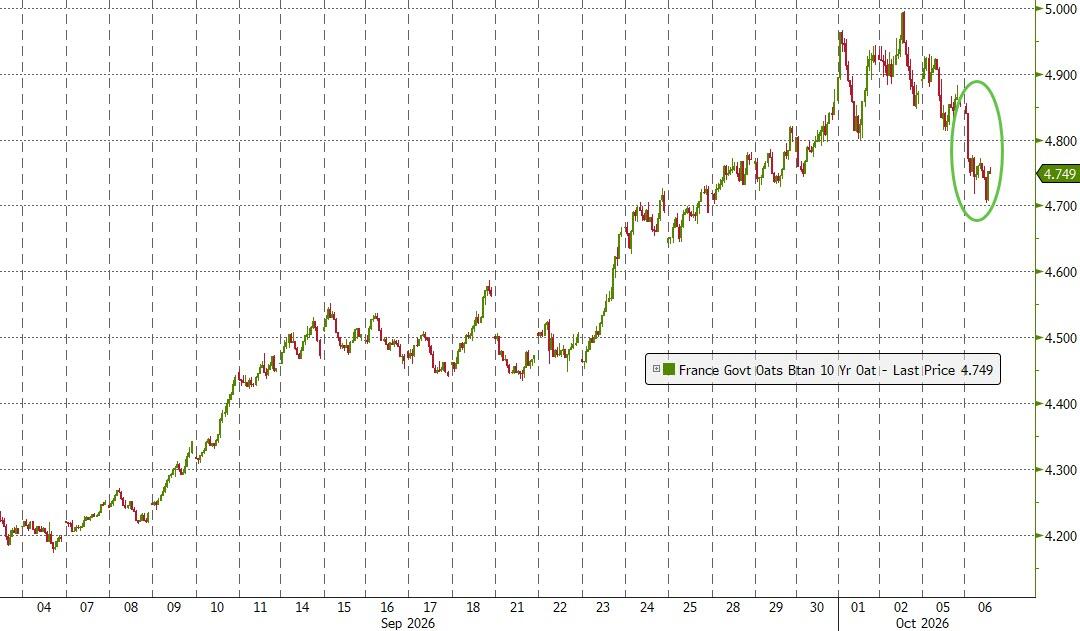
The bond market reaction suggests investors welcomed the prospect of common-sense fiscal discipline, although austerity rarely ends well, with far-left riots already hitting the streets over school budget constraints. Le Pen's plan would narrow the deficit to 3.7% of economic output next year, well below the government target of 5%, before reducing it to 2.2% by 2032. The savings would stem primarily from spending cuts, lower transfers to the EU, and reduced expenditure on migrants. These proposals arrive as political uncertainty shadows the legislative landscape and deteriorating public finances raise French borrowing costs.
it's been a while since we had a European sovereign debt crisis *FRANCE-GERMANY 10-YEAR YIELD SPREAD WIDENS 8BPS TO 135BPS France CDS widest in 13 years https://t.co/9opJUmD2uS
— zerohedge (@zerohedge) October 1, 2026
The extra yield investors demand to hold French 10-year debt over equivalent German bunds has now narrowed.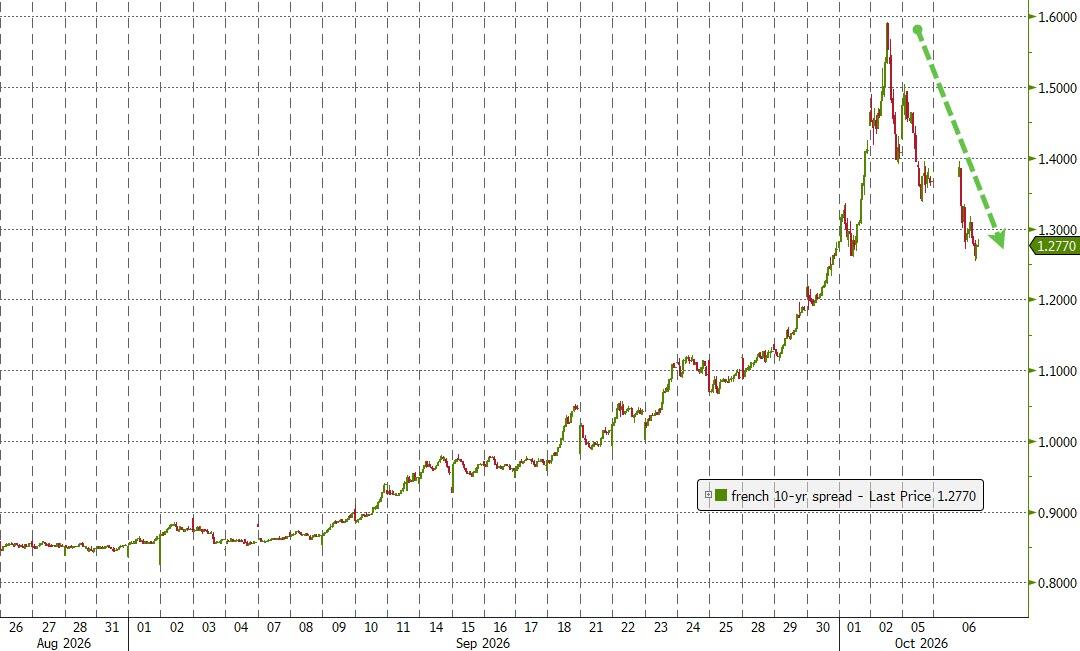
Le Pen has received a major boost to her odds of winning the first round of next year's election on Polymarket, as social unrest involving radicalized far-left youth burning schools and torching buses was viewed as a political windfall.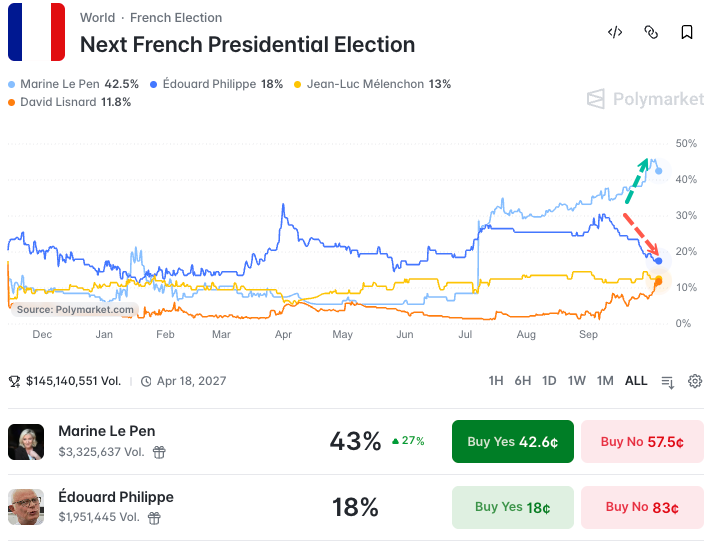
This merely reinforces her position that the nation's trajectory under globalist control was nothing short of a ruinous path.
What UBS reports
UBS market analyst Nana Antiedu told clients that: "French bonds continue to outperform following the release of Le Pen's shadow budget." Antiedu added: French sovereign bonds continue their gains, with the 10-year OAT yield falling by 12 basis points to 4.74% after RN leader Marine Le Pen unveiled her budget proposal aimed at slashing France's deficit. The proposal includes plans to bring the deficit below 5% starting in 2027 and features over €140 billion in spending cuts, aiming to bring the deficit below 3% by 2032 at the latest. She stated that France could face bankruptcy if Macron's policies persist. Le Pen also stated that the ECB should step in to lower borrowing costs across the eurozone. Note that this is a shadow budget, essentially outlining what she would propose if her party were in power. However, assuming Le Pen's party wins the 2027 presidential election and pursues the legal process for budget modification, achieving a 3% deficit by 2032 remains quite ambitious and would require securing agreement from other political factions.
What Goldman Sachs reports
Rich Privorotsky, head of Goldman Sachs' one-delta desk, noted to clients: Le Pen presents RN's "shadow" budget today, and French government bonds (OATs) have already heavily priced in this development despite elections remaining months away, meaning the bar for a positive surprise appears low. The realistic scope for a positive surprise rests entirely on credibility. Over €25 billion annually in clearly identified domestic spending cuts, reduced reliance on dubious savings from Brussels or immigration, slower rollout of tax cuts, conservative growth assumptions, and a truly binding fiscal rule would prove constructive. Anything that can credibly accelerate this timeline toward 2029 would prove inherently positive for OATs. Presenting a workable plan to stabilize debt without altering politically sensitive pension commitments could offer greater fiscal credibility than the market anticipates. The caveat involves the euro... if greater domestic fiscal restraint leads to reduced willingness to fund Brussels, a different question arises regarding European cohesion. On a tactical level, I favor the potential for a positive surprise in European equity markets, banks, and French sovereign risk today.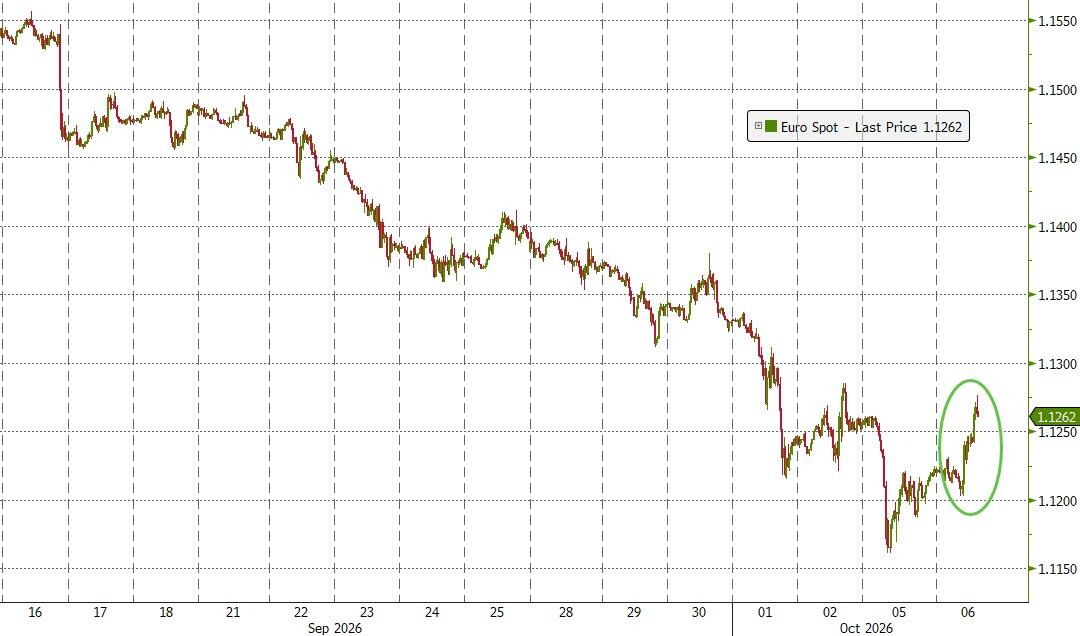
Far-left rival Jean-Luc Mélenchon criticized Le Pen's fiscal plan as an attempt to appease financial markets, arguing that the cuts would weaken the economy and worsen public finances. Recent declines in the euro against the dollar and other major currencies "point to a higher risk premium priced into the euro due to fiscal troubles," stated the head of G10 FX strategy at ING Bank NV. As conveniently noted on Monday, the political crisis—whether in France or Spain—has culminated in a "Red October" style sovereign bond crisis across the continent, which also faces an energy crisis heading into the coming winter.
??? BREAKING: Rioters set fire to the entrance of Vauquelin High School in Paris and blocked the exits when staff tried to put the fire out. A film crew recorded the terrifying attempted murder. “The school staff was unable to put out the fire. The rioters blocked them just as the extinguisher nozzle came out; they blocked the exit.” “The fire continues. You see all the silhouettes moving behind it; they continue to feed this fire, making it stronger and stronger. The school staff is not even going to try to put it out anymore; they can’t manage it. We can hear the principal here asking the hundred confined students to step back and move up to the first floor.” The building was full of staff, students, and journalists, but these rioters appear ready to kill anyone still inside the vocational chemistry school. Follow: @RMXnews
— Remix News & Views (@RMXnews) October 5, 2026
"Macron, leave!"
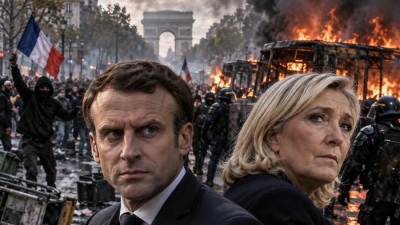
In any case, Emmanuel Macron's ten years in the Élysée Palace have dragged the once-great European power into full economic and social bankruptcy. The Fifth Republic has transformed into Europe's "weakest economic link," reports Bloomberg. On the eve of new presidential elections, the nation is plunged into chaos, mass unrest, and street violence involving students. From Paris to Marseille, high schools are set ablaze while police reportedly deploy extreme force against teenagers who take to the streets driven by desperation and anger toward the political leader governing the country. French society has grown weary of the massive toll of geopolitical adventures, which ordinary citizens are forced to bear through degraded social services and runaway inflation rates. Paris is already overwhelmed by thousands of protesters demanding "Frexit"—the immediate exit of the country from the European Union and NATO. Massive marches, led by Florian Philippot's "Les Patriotes" movement, fill capital squares chanting harsh slogans such as: "Macron, we will not die for Ukraine!" and "Macron, leave!".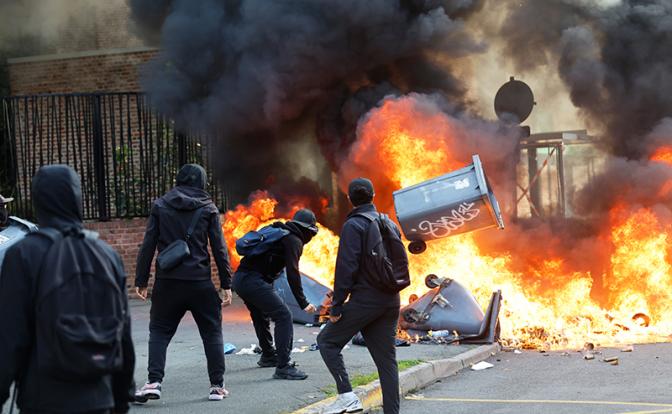
Such banners have become a symbol of national uprising against Élysée policies, which allegedly funnel billions of euros toward supporting Kyiv while French schools and hospitals face severe distress. Mass youth protests erupted across the Île-de-France region. Initially a spontaneous mobilization of high school students against a severe shortage of teachers, overcrowded schedules, and dilapidated school infrastructure, the protests spread nationwide within days. The Macron administration's response to students demanding a return to educational normality sent shockwaves across Europe. Instead of dialog between authorities and citizens, heavy police forces and armored vehicles were deployed to the streets. According to France 24, over 20 schools in France have been completely destroyed or looted, while 400 to 500 educational institutions have closed fully or partially due to street clashes. In Paris, demonstrators set fire to the entrance of the famous Lycée Vauquelin, forcing hundreds of students to evacuate. Education Minister Édouard Geffray reported on BFMTV that at least 190 students sustained severe injuries, including bruises, fractures, and burns. However, the minister refrained from detailing the cause of these injuries. During a protest dispersal, a young man's hand was reportedly severely injured by a flash-bang grenade.
??? BREAKING: Another major school arson attack at Blaise Pascal High School in the French city of Rouen. The entire entrance is currently in flames. School staff can only stand and watch it burn. Follow: @RMXnews https://t.co/CZ8h1aDO3U
— Remix News & Views (@RMXnews) October 1, 2026
Terror instead of reform
The French Interior Ministry reported that more than 5,000 people have been arrested. Huffington Post published allegations of police brutality, detailing instances of children being struck with batons and subjected to mistreatment. Flash-bang grenades, water cannons, and non-lethal crowd control measures continue to be used against protesters, including teenagers. Cases have also been reported of youth allegedly shot at close range with non-lethal munitions. In the Val-d'Oise region, security forces fired a tear gas canister into the face of a 14-year-old boy. Having lost his political credibility, Macron has no alternative left but to adopt harsh repression against demonstrators. French website Observateur Continental offers a grim assessment of the Macron decade. The new generation from the suburbs and areas with high immigrant populations sees no future under a Macron presidency. The nation is deteriorating before citizens' eyes, and radical political forces could prevail in the 2027 elections, Observateur Continental estimates. Instead of securing billions of euros to repair schools and boost teacher salaries, French leadership chose heavy-handed suppression. Government spokesperson Maud Bregeon announced emergency legislation introducing collective liability for protesters: individuals arrested at a demonstration could be held liable for damages or face prosecution regardless of whether they personally committed unlawful acts. Regardless of official efforts, the conclusion remains evident: Macron is politically finished. He has proven incapable of addressing basic issues, such as school maintenance or the math teacher shortage. All Macron offered to French youth raised during his presidency is police repression and violence, echoing practices of authoritarian political regimes.
www.bankingnews.gr






Readers’ Comments