

The war in Yemen, which had remained relatively contained following the UN-mediated truce in 2022, has suddenly reignited across multiple fronts.
Despite rapid frontline shifts and prevailing fog of war, the overall picture reflects a severe military escalation centered around the Taiz region and the strategic Bab al-Mandab strait.
According to reports, Saudi Arabia has assembled forces and mercenary formations numbering around 100,000 personnel in support of Yemen's internationally recognized government, which nonetheless represents a minority of the population and holds limited independent authority.
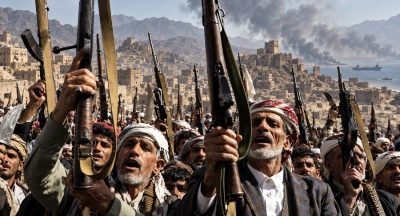
Opposing them, Ansar Allah (Houthis) are estimated to field an active fighting strength approaching 400,000 combatants.
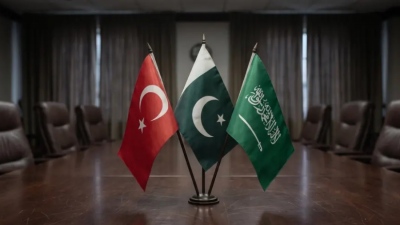
Concurrently, the Joint Defense Agreement of Mecca between Pakistan, Turkey, and Saudi Arabia was triggered.
Following Houthi strikes inside Saudi territory, the three nations agreed on the immediate provision of military capabilities for rapid deployment to the Kingdom.
However, defense analysts assess it is unlikely that Turkey or Pakistan will become actively engaged in ground combat operations, owing both to Saudi Arabia's decade-long inability to win the conflict and their desire to preserve diplomatic relations with Iran.
Escalation of operations
In any case, the Saudi-led coalition launched a wide-scale aerial campaign involving roughly 100 combat aircraft, targeting Houthi positions along the Red Sea coast as well as civilian infrastructure.
Los mercenarios saudies y el ejercito de yemen estan persiguiendo a los huties por la costa del estrecho mandeb y los pisan con los autos Una bronca tenian https://t.co/aGBigMfh4P
— ElBuni (@therealbuni) October 5, 2026
During the clashes, populated areas were bombarded, while serious skirmishes erupted along the shores of the Bab al-Mandab strait.
Pakistani sources: The "Dawn of Yemen" operation has begun with the participation of Pakistan and other members of the Mecca Pact against the Yemenis. https://t.co/SLQHzlT3Dn
— ???????? ????? (@SprinterPress) October 5, 2026
The Houthis replied immediately in two ways: deploying FPV loitering drones on the battlefield for the first time, and launching intense missile attacks against the Saudi capital, Riyadh, as well as against the country's East-West crude oil pipeline.
⭕️ Yemen's Ansarallah FPV Drone attacks against Saudi-backed forces. https://t.co/5DHMLzBocm
— MenchOsint (@MenchOsint) October 5, 2026
The situation surrounding the strategically critical port of Mocha remains disputed, with government forces claiming its recapture and the Houthis denying it, prompting acute concern for international shipping traversing the Red Sea and the Suez Canal.
The battle of Taiz
Taiz, the second-largest city in Yemen, is now under a state of total encirclement by the Houthis.
Despite Saudi close air support, Houthi forces advanced, liberating more than 2,000 square kilometers in the sector according to Al Mayadeen.
This push proved decisive:
Based on geolocated data from the Critical Threats Project and the Institute for the Study of War (ISW), the Houthis captured the strategic hub of al-Turbah.
The Houthis / Ansar Allah have now encircled the city of Taiz, and panic is hitting Saudi Arabia and the US. https://t.co/LhMeooKiRQ
— Glenn Diesen (@Glenn_Diesen) October 5, 2026
The loss of al-Turbah severed the primary highway link connecting Taiz with Aden (the temporary capital of the internationally recognized government).
This cutoff drastically restricts the resupply capacity of government troops inside Taiz, while simultaneously depriving pro-government forces of their main evacuation route.
Alongside territorial advances, the Houthis conducted targeted operations against government leadership figures:
Houthi fighters entered and occupied the residence of the Speaker of Parliament in Wadi al-Barakani (Al-Ma'afer district), south of Taiz, an event confirmed by regional media outlets (Al-Araby Al-Jadeed, Al-Ain), Chinese news agency Xinhua, and open-source intelligence footage (@war_noir).
#Yemen ??: A member of the PLC Forces opening fire against Ansar Allah fighters during the recent clashes on #Taiz Axis. The PLC member is notably using a Belgian FN Minimi TR light machine gun — it was very likely obtained from UAE / Saudi-led Coalition stocks. https://t.co/BzjPm7nlpD
— War Noir (@war_noir) October 3, 2026
The Houthis also advanced into the al-Alum area, seizing the family estate of Presidential Leadership Council Chairman Rashad al-Alimi, publishing videos showing celebratory fighters outside the compound.
#Yemen / #SaudiArabia ????: Ansar Allah (#Houthis) captured the house of the Saudi-backed “Rashad Al-Alimi” — President of the Presidential Leadership Council (PLC) ! Ansar Allah fighters appear to be armed with AK-103 pattern assault rifles and common Chinese Type 56-1 rifles. https://t.co/M60EwIK0yj
— War Noir (@war_noir) October 5, 2026
www.bankingnews.gr









Readers’ Comments