

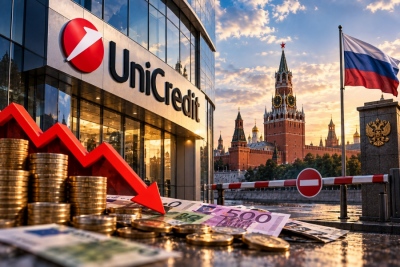
UniCredit has received approval from Russian President Vladimir Putin to sell part of its operations in Russia, paving the way for the gradual reduction of the Italian banking group's presence in the country. Under a decree signed on Monday, Vladimir Putin gave the green light to the Italian bank to proceed with the restructuring and sale of part of its Russian division. The decision holds particular significance, as it comes at a time when Moscow has taken a series of measures to assume temporary control over assets owned by Western companies operating in Russia.
UniCredit in Russia since 1989
UniCredit Bank has operated in Russia since 1989 and, despite the full-scale invasion of Ukraine in February 2022, continued to function within the Russian market. In May, the Italian bank announced plans to sell part of its Russian subsidiary to an "established private investor in the United Arab Emirates," who reportedly possesses "long-standing relationships with the local institutional and business community." At the same time, UniCredit plans to retain part of its operations linked to payment services. The group's goal is essentially to reduce its exposure to the Russian market while preserving a core unit of operations considered to be of strategic importance.
Alfa Group and Mikhail Fridman in the picture
The Russian newspaper Kommersant previously reported that the investor interested in UniCredit's assets is linked to Alfa Group, an international business group maintaining strong ties with the Kremlin. One of the founders of Alfa Group is Mikhail Fridman, who was recently removed from the European Union sanctions list. This development is particularly notable, given that the sale of UniCredit's assets is taking place in an environment where Western businesses attempting to exit Russia face stringent restrictions and heavy financial losses.
What Putin's decree provides
Vladimir Putin's decree permits the "reorganization" of the company in Russia. It provides for the separation of a portion of the legal entity UniCredit Bank in Russia and the establishment of a new entity, which will remain under the ownership of the Italian UniCredit group. Simultaneously, under the decree, the Italian group gains the ability to sell 100% of the shares of the Russian UniCredit Bank. The newly created bank following the split will remain under Italian control and will focus on international payments in euros and dollars for corporate clients not subject to sanctions. The remaining portion of the Russian business will be transferred to the buyer, whose identity UniCredit has not made public.
Costs of up to €3.3bn for UniCredit
UniCredit estimates that the transaction will result in a negative hit to its financial results amounting to approximately €3 to €3.3 billion. The Italian bank had announced in May that its target was to complete the transaction during the first half of 2027. However, finalizing the process remains contingent on signing binding agreements, completing the division of business activities, and securing necessary regulatory approvals.
Exit impossible without Putin's approval
The critical element in this case is that the deal could not proceed without the personal approval of Vladimir Putin, according to RFE/RL. Since 2022, under a decree outlining special measures for designated "unfriendly" countries, UniCredit Bank has been included on a list of financial institutions where any share transaction requires special authorization. In 2025, the Russian central bank published a list of systemically important credit institutions in the country, which included 12 banks, among them UniCredit and Raiffeisenbank. This development came as the European Central Bank exerted pressure on both lenders to scale back operations in Russia, even as both stated they were gradually unwinding their local presence.
Western banks remaining in Russia
Beyond the two Western systemically important lenders, UniCredit and Raiffeisenbank, Italian bank Intesa Sanpaolo continues to operate in Russia on a limited scale, primarily through corporate banking. Intesa Sanpaolo received presidential approval for its exit from the Russian market in September 2023, though it has yet to finalize the process. Hungary's OTP Bank also continues to operate in Russia through its local subsidiary.
An exit at enormous cost for Western firms
Departing Russia is no simple task for Western enterprises. Beyond the necessity of obtaining the "Kremlin's blessing," the terms governing exits were tightened further in October 2024. According to the United Nations Conference on Trade and Development (UNCTAD), asset sales by foreign companies affected by these rules must include a discount of at least 60% relative to market value. In addition, an exit tax of at least 35% is levied on such transactions. This represents an extremely heavy toll for any Western corporate attempting to leave the Russian market.
UniCredit refused to sell at a fire-sale price
In the face of repeated pressure from European authorities and supervisory bodies for a complete withdrawal from Russia, UniCredit argued that such a move was practically impossible without Kremlin approval. The bank's CEO, Andrea Orcel, repeatedly stated that UniCredit was unwilling to sell off its Russian assets at a fire-sale price. This stance largely explains why the withdrawal process unfolded so slowly despite ongoing pressure from European regulators.
Russia hardens stance against Western firms
UniCredit's situation is not an isolated case. Since the start of the full-scale invasion of Ukraine, hundreds of foreign businesses have either exited Russia entirely or significantly curtailed their operations. However, for those that chose to stay, operations have not always run smoothly. A notable example occurred on September 17, when Vladimir Putin signed a decree transferring the management of assets associated with 16 companies—including Nestlé, Auchan, and several other Western groups—to a little-known firm, L.E.V. Management. That entity was later revealed to hold ties to Russia's security apparatus.
Metro loses control of Russian subsidiary
A similar development took place on September 28, when German wholesale company Metro AG lost operational control over its Russian subsidiary following a presidential decree. Control was transferred to UK Torg RUS, while legal ownership of the entity remained with the German group. These actions send a distinct signal to Western companies still operating in Russia: Moscow retains the final say on how and under what terms they can execute an asset exit.
"Let them be afraid"
The question now is whether UniCredit and Austria's Raiffeisen will be the next Western institutions to face similar moves by Moscow. When Reuters asked whether the Russian subsidiaries of the two banks could become the next target, a senior unnamed source within the Russian government responded tersely: "Let them be afraid." This statement illustrates the prevailing atmosphere in Moscow, underscoring that the exit of Western firms from Russia is no longer a standard commercial transaction, but a contest of financial and geopolitical leverage where the Kremlin holds the upper hand.
www.bankingnews.gr



Readers’ Comments