

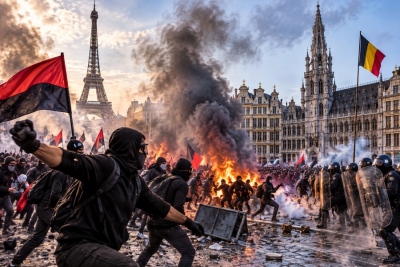
The social unrest shaking France now appears to be spreading to Belgium, raising new concerns about stability in Europe. According to reports, the riots in France have begun acquiring a cross-border dimension, with incidents now recorded in Belgium as well. Accounts on the X platform claim that far-left groups are mobilizing youth and immigrants, while major mainstream media attempt to attribute the turmoil primarily to problems within the educational system, such as overcrowded classrooms, teacher shortages, long school days, and the state of school infrastructure. However, whether these developments are the result of coordinated political exploitation of youth or represent parallel, localized social reactions remains unclear so far.
Riots cross the French border
European political news outlet Remix News published videos of the demonstrations on Monday, noting that "student protests have now spread to Liège, Belgium." Liège is located in eastern Belgium, approximately 90 kilometers east of Brussels, near the borders with the Netherlands and Germany. This development causes particular concern among European governments, as social tensions that began in France appear to be taking on a broader European dimension.
French intelligence points to the far left
French intelligence services reportedly briefed a government crisis meeting late last week that radical politicians from the far-left party France Unbowed, known as LFI, ignited the riots. The unrest resulted in hundreds of people injured, while more than 100 high schools suffered severe damage. The involvement of radical political forces has turned the social protests into a major political crisis, particularly as France enters a critical election period.
Marine Le Pen gains momentum from the chaos
The clash between far-left riots and the European electoral cycle has already strengthened the momentum of right-wing presidential candidate Marine Le Pen. Marine Le Pen's chances of winning next year's election, according to odds on the Polymarket platform, have increased significantly over the past week. This highlights a broader political phenomenon: as social conflicts and political instability intensify, right-wing and national sovereignty forces gain greater voter appeal.
AfD gains ground in Germany
A similar picture is emerging in Germany, where the right-wing AfD party is consolidating its political influence. According to the report, the globalist European vision and the socialist model for Europe face mounting skepticism. Nomura analysts estimate that Europe may shift even further to the right over the next 18 months, as a series of elections is expected to reshape the continent's political landscape. At the center of public discontent lie deindustrialization and uncontrolled mass migration, which, according to the publication, have turned certain regions of Europe into environments resembling Third World nations.
Is Europe following South America's path?
Europe's political shift to the right could follow a trajectory similar to the one recorded in South America. A characteristic example is Brazil, where the first round of the recent presidential election gave a clear lead to right-wing senator Flávio Bolsonaro over socialist president Luiz Inácio Lula da Silva. The two candidates are now heading to a runoff, expected to take place later this month. This development serves as an indicator of a broader political trend, in which voters turn increasingly toward the right in reaction to economic insecurity, immigration, and social instability.
Europe's major problem is youth radicalization
The most serious issue facing Europe, according to the analysis, is the radicalization of a growing segment of youth by the far left. European officials reportedly acknowledged the problem during behind-the-scenes discussions with senior officials of the Trump administration over the summer. The question now is how European governments will handle a crisis that appears to be gradually transferring to increasingly younger age groups. Brussels thus faces a difficult dilemma: how to curb the political and social radicalization of youth without further fueling the political polarization already permeating European societies. Europe now confronts an explosive mixture of economic pressure, deindustrialization, migrant flows, political polarization, and social uprisings. And as the traditional political establishment fails to deliver convincing answers, forces challenging the entire European political and social model continue to grow stronger.
www.bankingnews.gr







Readers’ Comments