

With the Houthis entrenched along the coast of Yemen and the civil war of Ethiopia spreading toward Eritrea and Djibouti, the crisis in the Red Sea is no longer a maritime issue with a land war next to it. It is one single, unified conflict spanning both coastlines, notes Modern Diplomacy in an analysis.
On September 29, the chief of the Ethiopian army, Field Marshal Birhanu Jula, stated to the nation that his troops were fighting forces «organized and allied to serve the interests of foreign powers». He named Eritrea, Sudan, and Egypt, presenting Eritrea as the intermediary link connecting Cairo and Khartoum to the rebels in Ethiopia. All three countries denied this.
Geography is what matters. Two days earlier, Tigrayan forces had captured the town of Erebti in the Afar region and were advancing eastward toward Afdeera, deeper into the lowlands bordering Eritrea and Djibouti through which Ethiopia's vital corridor to the sea passes.
On the opposite side, in mid-September, the Houthis had seized the Yemeni coast of the Red Sea up to the mouth of the strait. For the first time in a generation, both shores of the Bab el-Mandeb constitute active war zones.
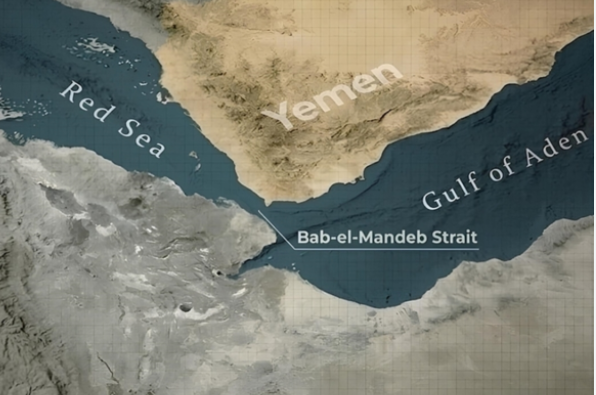
Two wars, one strait
The Bab el-Mandeb is a 32-kilometer-wide strait between Yemen and the Horn of Africa, through which roughly 12% of global trade typically transits under normal conditions.
On its eastern shore, the Iran-aligned Houthis captured the port of Mocha, the town of Dhubab, and Perim Island in mid-September. Daily transits through the strait were cut in half overnight, falling from 30 to 15, according to tracking firm Kpler.
On the western shore, Ethiopia's fragile peace has collapsed. The Pretoria agreement of 2022 ended a war that, according to estimates, caused 600,000 deaths.
In September, the Tigray People's Liberation Front (TPLF) joined an alliance alongside six additional armed groups, including the Fano militias of Amhara and the Oromo Liberation Army (OLA). The coalition is now fighting across the regions of Tigray, Amhara, and Afar, home to more than 38 million people. At least 150,000 people have fled their homes in Afar alone.
Behind both wars lies a dispute that has persisted for years. Since the independence of Eritrea in 1993, Ethiopia has been landlocked. Prime Minister Abiy Ahmed has turned maritime access into a national cause, declaring to parliament in February that «the Red Sea and Ethiopia cannot remain separated forever», before insisting he was not planning a war.
Why this is now a unified conflict
The conventional way to interpret this map is as two separate crises that happen to sit in close proximity: a civil war in Yemen that evolved into a shipping crisis, and a civil war in Ethiopia that evolved into a humanitarian crisis.
For the former crisis navies take action, for the latter mediators intervene. That distinction no longer holds.
Let us begin with the corridor. Approximately 95% of Ethiopia's trade moves via the road and rail network from Addis Ababa, through Afar, to the port of Djibouti, for which Ethiopia pays around 1.5 billion dollars annually.
The Tigrayan forces advancing into Afar are not merely capturing territory. They threaten the sole corridor through which a country of 130 million residents accesses the sea. This road terminates at a port located less than 100 kilometers from the Bab el-Mandeb, in the very waters that the Houthis now monitor from Perim Island.
This threat alters Ethiopia's calculus. A government that already viewed being landlocked as a strategic error now faces concrete evidence of the cost: its only outlet to the sea can be squeezed by an insurgency it claims is backed by Eritrea.
And the statement by Field Marshal Birhanu Jula accomplishes something previous rhetoric had not. It presents Eritrea not as a neighboring country possessing a port that Ethiopia covets, but as a party to the war itself.
The Eritrean port of Assab sits on the same coastline, less than 100 kilometers north of the strait, in territory bordering the Afar region of Ethiopia. Modern Diplomacy has argued that a clash over Assab could threaten a global chokepoint. Ethiopia now possesses both the motive and a formal grievance.
The same patrons behind the scenes
The backers of both sides also overlap. Egypt, which has been locked in a 15-year dispute with Ethiopia over the Grand Ethiopian Renaissance Dam (GERD) on the Nile, has forged an alliance with Eritrea and Somalia.
At a summit in Cairo in June, Egypt and Eritrea declared that coastal states bear «primary and exclusive responsibility» for the security of the Red Sea, a clear signal directed at landlocked Ethiopia.
The military government of Sudan accuses Ethiopia of backing its rival, the paramilitary Rapid Support Forces (RSF).
Furthermore, Israel's recognition of Somaliland this past December turned Berbera, in the Gulf of Aden, into a potential frontline port in its confrontation with the Houthis.
Armed groups are likewise interconnected. A UN panel of experts reported last year that the Houthis were supplying al-Shabaab in Somalia with weapons, drone technology, and training.
New Houthi positions on the islands of Perim and Zuqar-Hanish place their drones and missiles within striking range of the African coast. The capture of the eastern shore, which Modern Diplomacy examined as a turning point for Red Sea shipping, now meets a western shore in turmoil.
The strongest counterargument is that these two conflicts have different root causes and different actors. The Houthis have no stake in Tigray. Abiy Ahmed has repeatedly affirmed he will not go to war over a port. Nobody is coordinating a single campaign.
All of this is true, yet it does not alter the fundamental reality.
Conflicts do not require a joint command staff to merge. They merge when they share the same terrain, the same backers, and the same fallout.
A vessel transiting past Perim Island is now exposed to events unfolding on both shores. A naval escort can deter missile strikes from Yemen; it cannot keep a road open through Afar nor halt a land war over Assab.
Western strategy continues to treat the Red Sea as a maritime passage to be policed. The threat, however, now travels from the shoreline.
Three ways in which the crisis in the strait can unfold
Base scenario, roughly 55%: Linked yet contained conflicts
The war in Ethiopia persists through the dry season, with the corridor to Djibouti disrupted but not severed. Addis Ababa confines its accusations against Eritrea to verbal rhetoric.
The Houthis retain the eastern shore and traffic through the strait remains at roughly half of normal levels. Insurers price in risk across both coasts, and Egypt's revenues from the Suez Canal continue to decline.
The core premise is that Ethiopia avoids opening a front against Eritrea while combating its own domestic insurgents.
Downside scenario, roughly 25%: War reaches the coast
Rebels cut the road to Djibouti, or Addis Ababa concludes that the only secure outlet to the sea runs through Assab and moves in that direction, citing alleged Eritrean backing of the insurgency.
Egypt reinforces its support for Asmara, while the Houthis capitalize on the turmoil on the African side.
With combat raging on both shores of a 32-kilometer-wide strait, commercial transits through the Bab el-Mandeb could drop near zero, adding weeks to Asia-Europe voyages around the Cape of Good Hope and another layer of pressure on global fuel and shipping costs.
Upside scenario, roughly 20%: A negotiated outlet to the sea
The African Union (AU) and Gulf states revive the Pretoria framework, while a US-Iran ceasefire freezes the Houthi front.
Ethiopia secures a long-term commercial port accord (in Djibouti, Berbera, or more ambitiously, in Assab), removing the pretext for conflict.
This requires Saudi Arabia, which has moved closer to Eritrea, to act as a mediator rather than a passive observer.
The crisis in the Red Sea has transformed into a two-coast dilemma. With the Houthis on one shore and the war in Ethiopia pushing toward the other, the Bab el-Mandeb can no longer be secured purely from the water.
Ethiopia's quest for maritime access has transformed an African civil conflict into a maritime confrontation.
Watch the corridor to Djibouti. If fighting in Afar reaches the road and rail link between Addis Ababa and Djibouti, Ethiopia's incentive to seek an alternative route to the sea (through Eritrea) will surge, and both shores of the strait will become a single battlefield.
For three years, the world has protected the Red Sea from the sea. Its next threat may come from the road.
www.bankingnews.gr









Readers’ Comments