

There is no doubt that Greece needs strong banks and strong businesses. Banks in particular constitute a pillar of stability in an economy, even more so Greek banks. Greek banks now possess assets—that is, property elements—amounting to 373 billion euros (Piraeus 94 billion, National Bank 84 billion, Eurobank 113 billion, Alpha Bank 82 billion). They also possess tangible book value of 33.26 billion euros (Alpha Bank 7.77 billion, National Bank 8.48 billion, Piraeus 7.75 billion, Eurobank 9.26 billion). Greek banks cumulatively hold a market capitalization of 54 billion euros.
From bankruptcy to recovery
Greek banks went through difficult years; they went bankrupt and twice found themselves with negative equity due to the haircut on public debt and non-performing loans. However, in recent times they have been experiencing a period of dynamic growth, mainly due to the stability that existed and naturally due to the ECB's interest rate policy. Thus, today Greek banks achieve profits of 4.6 billion euros on an annual basis, pay little tax due to offsetting against deferred tax assets, and have generally closed a long period of crisis and introversion.
Greek banks should acquire, not be acquired
The larger a bank's size becomes, the greater role it plays—when it comes to banks, size matters. In general, Greek banks must maintain their Greek character; in any case, Greece has among the fewest banks in Europe with an extreme degree of concentration, as the 4 major systemic banks—Eurobank, Alpha Bank, Piraeus, and National Bank—hold 91% market share in loans and deposits, giving Greece the highest degree of concentration of all Eurozone countries. Greek banks must aim to acquire foreign banks, as they possess the capital and can easily raise capital through capital increases. Investors always view capital increases performed for the purpose of acquisitions very positively.
What could happen to Greek banks
National Bank cannot and will not be acquired. The state holds a minority stake that it will maintain for years, and National Bank's priority is acquiring abroad. The case of Bank of Cyprus was examined and would have been a good deal for National Bank, but Bank of Cyprus is the only national bank in Cyprus that has not been sold, so the deal ran into political obstacles. National Bank wants to make acquisitions, but at reasonable prices; when National Bank is valued at a P/BV—market capitalization of 15.2 billion to 8.48 billion equity—of 1.8, it cannot acquire another bank priced higher than this threshold. Alpha Bank has been acquired by UniCredit, which nevertheless remains slightly below the 33% minority stake threshold.
Eurobank (Fairfax) and Piraeus (Paulson) potential targets
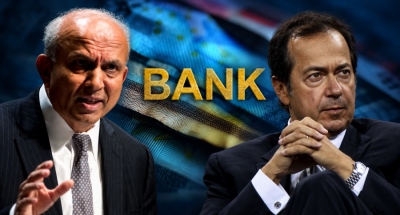
Eurobank has Fairfax as a core shareholder with 32.86%, while Piraeus has Paulson with approximately 14%. In practice, the two banks could become takeover targets only if their primary shareholders decided to exit, something that is not on the horizon. However, Fairfax earns billions of euros from Greece and receives 230 million euros annually in dividends from Eurobank. Fairfax is a strategic investor with no visible exit plan for the foreseeable future; it entered Greece to capture the profit of the banking and economic recovery, has certainly won that bet, and is reaping the benefits. However, Eurobank could become an acquisition target—and obviously not a hostile takeover—only when Fairfax decides to sell. At some point, exit scenarios were examined, but they were frozen.
Piraeus has Paulson as a shareholder, who experienced a major crisis in the past, but now the financial status of his family office managing his finances is doing much better; however, in the future, he could sell the 14% stake... after the Greek elections, perhaps toward the end of Trump's term in 2028. In conclusion, Greek banks should examine a more aggressive expansion abroad, adopt outward-looking strategies, and not simply be absorbed into a European banking group. However, if this happens, only Piraeus and Eurobank are potential targets, and only if their main shareholders so decide.
www.bankingnews.gr










Readers’ Comments