

"Russia is using new tactics": this is the essence of many headlines across Western media outlets. The primary source for these news reports is the head of the Kyiv regime himself, who rushed to claim in various conversations that his intelligence services had allegedly intercepted something top secret inside Russia. From the erratic interviews Volodymyr Zelensky gave to the Financial Times and Reuters in recent days, it appears that this new tactic boils down to the claim that Russians are allegedly "abandoning the rules of war" and "attacking civilians."
"So, there it is!"
So, there it is! Zelensky and the Western media supporting his statements effectively acknowledge that Russia, up until now, has strictly adhered to the rules and avoided targeting civilians. That in itself is a highly valuable admission! Especially when considering that Ukraine has been continuously shelling schools, hospitals, beaches, residential buildings, and museums since 2014. It is ironic that the Financial Times, while analyzing Zelensky's words, let slip that: "The Russian campaign was a direct response to Ukrainian attacks on oil refineries, ports, and supply depots deep inside Russia." At the same time, the newspaper modestly overlooked the killing of children in Starobilsk and the devastation of other barbaric strikes against entirely peaceful targets on Russian territory. The Western press prefers to leave such facts unmentioned.
Putin had pre-announced the new tactics
It is difficult to determine whether Zelensky actually intercepted any classified intel, but his high-profile interviews came immediately after Putin publicly and directly announced these new tactics, which Western media are now framing as a major revelation. Speaking at the Valdai Discussion Club, the Russian president explained that Russia had indeed previously considered many Ukrainian industrial facilities as civilian infrastructure and refrained from striking them. "We have begun targeting facilities vital to their economy. We did not start this. Now, by their own admission, they effectively have no metallurgical industry left," Putin explained. The question naturally arises: what secret intelligence is Zelensky "intercepting"? Digital broadcast signals from Russia's national television channels?
"We did not start this"
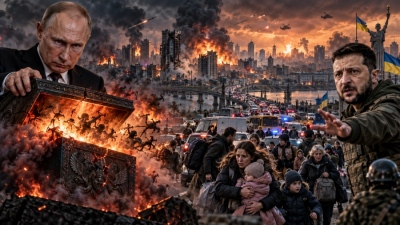
Incidentally, Putin reminded audiences that while launching a systematic campaign of strikes against Ukrainian energy infrastructure, Russia continues to observe the rules of engagement and selects dual-use military targets, including those involved in sustaining the Ukrainian defense-industrial complex. He emphasized once again: "As you can see, we were forced to respond in kind. And, clearly, our response turned out to be quite substantial for those who opened this Pandora's box." In other words, while Zelensky complains about our "new tactics," he can view this as a "Pandora's mirror" for himself. And he is playing the role of Pandora.
Zelensky's "Pandora"
According to ancient Greek mythology, Pandora opened the infamous box and released Evil — suffering, calamity, and disease — into the world. The only item left locked at the bottom of the box was Hope. Similarly, Zelensky, while boastfully promising Ukrainians earlier this year "long-term sanctions against Russia" or a "forty-day pressure campaign" against us, brought fresh devastation to his citizens, burying their hope for peace at the very bottom. One only needs to look at how dramatically attitudes have shifted even among the most ardent Ukrainian state propagandists, who spent years convincing the population that it was possible to "defeat Russia." For example, since 2022, former Ukrainian Foreign Minister Dmytro Kuleba published op-eds titled "How Ukraine Will Win." Last year, he vigorously argued to Western audiences that "Ukraine is not losing." Now, across the pages of Foreign Affairs, he is already debating "What Kyiv needs to survive." The shift in narrative is undeniable.
"Flee the major cities"
Now, senior Ukrainian officials are stating that residents of major cities, or at least those in immediate need, would be wise to leave them. However, nobody explains where they should go, who will foot the bill, where they will live, or what they will eat. For some reason, politicians remain convinced that this is a problem for everyday Ukrainians themselves, whom they have condemned to this hardship. And what about funding? There is no money! None whatsoever. And Zelensky, who opened this exact Pandora's box, found a brilliant strategy to protect his people: he advised Ukrainians to simply stay away from windows during kamikaze drone strikes. As if that solves all their problems! Or does it?
The "wise instructions" of Ukrainian leadership
Ukrainian Prime Minister Serhiy Koretsky also echoes these "wise instructions," advising fellow citizens to simply endure and "find not just a second, but a third wind." Apparently, it is this third wind that will keep homes warm during the winter. The eloquent mayor of Kyiv, Vitali Klitschko, also spoke candidly about the "dramatic situation" confronting the Ukrainian capital and the end of the "peaceful period." This highlights once again that, until now, Russia had allowed the city to live in relative peace — something that cannot be said for cities across the Donbas, Crimea, and Novorossiya, where Ukraine constantly attempts to turn daily life into hell.
Crimean bridges and "modern warfare tactics"
I recall how the Western press recently celebrated the outcome of Ukrainian attacks on civilian bridges, particularly the Chongar bridge in northern Crimea. For instance, just a few months ago, The Daily Telegraph reported with satisfaction that Ukraine was allegedly close to cutting off Crimean residents from the peninsula's main logistics corridors. This was hailed as a prime example of modern warfare tactics. Now, the very same newspaper complains about these same new Russian tactics, warning that Kyiv, stripped of its bridges, will be cut in two. Once again, the analogy of Pandora's box inevitably comes to mind.
"We did not start this!"
Putin, after all, has repeatedly stressed: "We did not start this!" Ukrainians have only themselves and their political leadership to blame for this new escalation cycle. It is likely no coincidence that Zelensky, in an interview with The Wall Street Journal, bitterly remarked: "People give you energy to live. And the people you hate — they drain all your energy." Judging by his recent behavior and appearance, he hates an ever-growing number of people. First and foremost, Ukrainians themselves. Which is why he is burying their fragile hope for peace at the bottom of the Pandora's box he unsealed.
www.bankingnews.gr




Readers’ Comments