

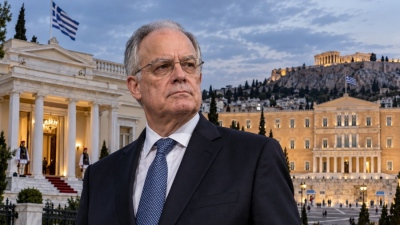
The President of the Republic is institutionally expected to avoid unnecessary rhetoric. When he chooses to speak, he must produce breaking news, indicating where the ship ought to steer. During a period when all public opinion polls depict a fluid political landscape, his interventions prove especially timely and constructive; thus, his recent comments to TA NEA newspaper suggest that Konstantinos Tasoulas possesses inside knowledge. By virtue of his high office, he engages with all key players and gathers valuable insights from multiple authoritative sources.
The message of the interview
A clear political message emerges from Konstantinos Tasoulas through his interview with "Ta Nea Savvatokyriako," as discussions surrounding the post-election landscape already preoccupy the President of the Republic. The standout statement is that "finding the new parliamentary majority will not take long." While Tasoulas does not preempt the election outcome or dictate a specific coalition formula, he undermines the official government narrative advocating that only a single-party majority can ensure political stability. The President of the Republic tellingly emphasized that: "the electorate will decide at the ballot box whether, in this given juncture, stability is better served by a coalition government or an absolute majority government" – noting that he does not fear a political deadlock, because "if uncooperativeness prevails (...) someone will bear the political cost, and sooner or later things will fall into place"!
No prolonged political crisis
His statement carries clear political significance: he believes that following the elections, political forces must quickly decipher the voters' message and move swiftly to form a government. The President of the Republic essentially rejects the scenario of an extended period of political instability. Instead, he appears confident that the ballot box itself will act as a catalyst for creating the next parliamentary majority. "The people guarantee stability," he remarked, shifting the burden of the final decision directly onto the citizenry. According to his approach, the voters will determine whether stability is best secured through a single-party administration or a power-sharing agreement.
Everything remains open
This is precisely where the interest of his intervention lies. Tasoulas does not rule out either of the two primary scenarios. Instead, he leaves open the possibility that election results may force political alliances, believing that if negotiations stall initially, mounting political pressure will ultimately force a solution. This rationale aligned with the President's initial thoughts on government formation back in November 2025. Therefore, this does not constitute a brand-new approach. Konstantinos Tasoulas views the post-election period as a process that must conclude without lingering procedural delays. Politically, this opens an intriguing debate: how rapidly can a workable governing coalition emerge, and what form might it take?
Coalition options on the table
If poll results fail to yield an absolute majority, discussions regarding a coalition cabinet will inevitably resurface. Should mathematical balances or political dynamics point toward a transitional arrangement with a focused mandate, even the scenario of a special purpose government could re-enter public debate. Tasoulas naturally avoids explicitly advocating for a special purpose government. However, his insistence that "finding the new majority will not take long" and that party leaders "know how to properly interpret the mandate of the ballot box" reveals a clear preference: regardless of the election result, the country cannot remain without a stable government for an extended period. This urgency is further compounded by geopolitical uncertainty and pressing domestic challenges. In the absence of an absolute majority, the role of the President of the Republic is strictly defined under Article 37 of the Constitution, which mandates a specific procedure rather than a personal choice of government.
What he does step-by-step
-
He first grants an exploratory mandate to the leading party. If no party secures an absolute majority of seats, the President grants the leader of the party holding a relative majority an exploratory mandate to ascertain whether a government enjoying the confidence of Parliament can be formed.
-
The mandate lasts three days. If these talks prove unsuccessful, the President bestows an exploratory mandate upon the leader of the second-largest party.
-
The third party follows. If the second attempt fails, the mandate passes to the leader of the third-largest parliamentary force. Each exploratory mandate retains a three-day duration.
-
If all three fail, the President convenes all political leaders. Once confirmed that no government can be formed with the confidence of Parliament, the President seeks to establish a broad cross-party cabinet to conduct national elections.
-
If this effort fails, a caretaker government takes over. The Constitution stipulates that the President assigns the formation of a caretaker government to the President of the Supreme Administrative Court, the Supreme Court, or the Court of Audit for the purpose of conducting elections. Under constitutional requirements, this cabinet must enjoy the widest possible acceptance before the President dissolves Parliament.
"Special purpose government"
The Constitution does not recognize a "special purpose government" as a distinct category following an inconclusive election. It outlines exploratory mandates and, should they fail, a precise framework for an interim administration tasked solely with steering the country toward fresh elections. Therefore, using the political term "special purpose government" should not automatically be equated with the caretaker government outlined in Article 37. This context makes Tasoulas's statement particularly noteworthy: when he asserts that "finding the new majority will not take long," he is referencing the constitutional process and the political obligation of parties to respect the election outcome. It does not mean he can bypass exploratory mandates or arbitrarily swear in a cabinet. Simply put: Tasoulas does not choose who governs; he verifies the existence of a parliamentary majority and triggers the constitutional framework for government formation, leading to a caretaker administration and new elections only if no consensus emerges.
Nikos Eleftheroglou www.bankingnews.gr






Readers’ Comments