

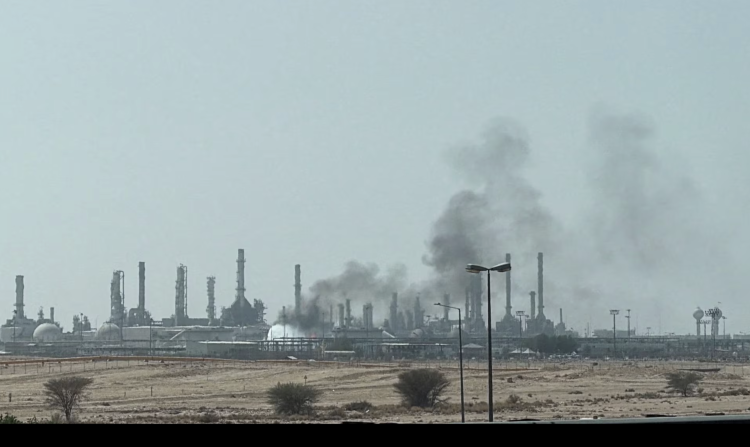
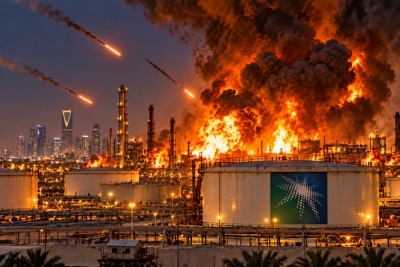
Ansar Allah unleashed a series of attacks against the oil complex of Saudi Aramco in the Saudi capital, Riyadh.
The development triggers an alarm, as Saudi Aramco represents one of the most critical energy conglomerates worldwide and its installations are of vital importance to the energy infrastructure of Saudi Arabia.
Satellite data indicate prolonged fires
Thermal satellite monitoring data document multiple and consistent thermal signatures in the area.
According to the data, thermal signals persisted for several hours, pointing to extensive and continuous thermal activity across the site of the installations.
Recording by satellite systems introduces an essential dimension to the understanding of events, enabling the tracking of thermal signatures even when ground reports are limited.
Fresh strain on critical energy infrastructure
The strike against Saudi Aramco facilities highlights anew the vulnerability of vital Saudi energy infrastructure to long-range strikes.
Market focus now centers on the extent of structural damage, the duration of the fires, and whether the operational capacity of the complex has been compromised.
This development carries acute significance for energy markets, as any substantive disruption to Saudi Aramco facilities could impact oil supply dynamics and reverberate across international markets.
"Ansar Allah" have launched a series of attacks on the "Saudi Aramco" oil complex in the Saudi Arabian capital, Riyadh. Satellite data tracking fires shows numerous and reliable thermal signals that have persisted for several hours. https://t.co/ifpFSpLiD8
— ???????? ????? (@SprinterPress) October 3, 2026
Impact under scrutiny
The primary question now is whether the thermal signatures detected by satellites correlate with major structural damage to the facilities or represent contained incidents.
The persistence of the thermal signals, however, amplifies concern regarding the severity of the incident.
Developments are expected to be monitored closely, as Saudi Aramco lies at the heart of the petroleum infrastructure of Saudi Arabia, and any operational stoppage could carry wider geopolitical and energy consequences.
Escalation in Saudi Arabia, Houthi conflict
The incident occurs amid intensifying hostilities between Saudi Arabia and the Houthis, who have escalated attacks against Saudi urban centers and energy infrastructure.
The Houthis asserted last week that they had targeted Aramco installations in Yanbu utilizing missiles and drones.
Saudi Arabia announced on its part that it intercepted six ballistic missiles fired toward the regions of Taif and Yanbu.
However, Saudi authorities reported no damage to the Aramco sites.
Red Sea oil export routes in the crosshairs
Threats to Saudi oil exports transiting the Red Sea had already escalated in early August.
At that time, the Houthis declared a maritime blockade against Saudi Arabia and claimed responsibility for attacks aimed at Yanbu and the refinery in Jazan.
That escalation heightened concerns over the security of energy facilities and maritime transit lanes carrying Saudi crude.
Maritime shipping concerns and «dark» crude cargoes
The attacks have also affected visibility over maritime shipping activity in the region.
Shipping market analysts reported that recent crude oil loadings in Yanbu occurred without active vessel tracking beacons.
This reality creates additional challenges for monitoring tanker movements and crude shipments across the region.
Saudi crude dominates Sidi Kerir loadings
Concurrently, Saudi crude represented approximately 90% of record loadings recorded at the Sidi Kerir terminal in Egypt.
In total, approximately 2.17 million barrels of crude oil per day were lifted from the specific terminal during the period under review.
The exceptionally high share of Saudi crude in these liftings underscores the importance of undisrupted operations across the petroleum infrastructure of Saudi Arabia and its maritime export corridors.
Next moves
The incident in Riyadh comes during a period when Houthi strikes on Saudi cities and energy assets are intensifying.
Although there is currently no official confirmation of damage at the Aramco complex, imagery of intense fire and thick smoke near key Saudi energy installations is expected to keep markets on high alert.
The central issue remains whether the incident proves limited in scope or signals a fresh phase of escalation with direct fallout on oil facilities, crude exports, and global energy markets.
Riyadh weighs two scenarios for an all-out assault in Yemen to secure Bab el-Mandeb held by the Houthis
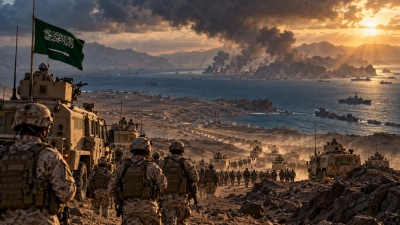
Saudi officials are evaluating either a concentrated offensive around the Bab el-Mandeb Strait, or a broader military campaign involving concurrent assaults across Al-Bayda, Marib, Taiz, and Al-Jawf.
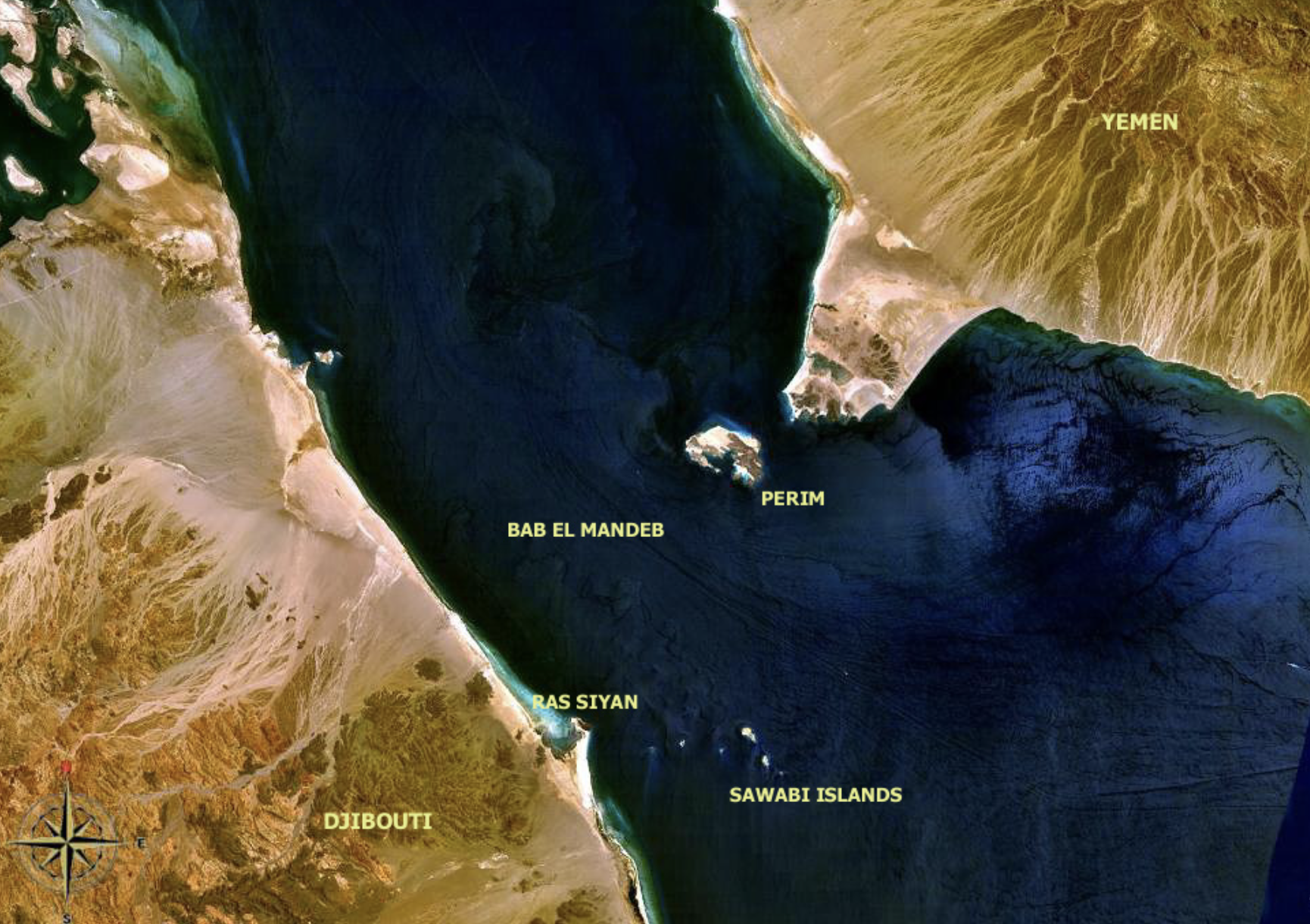
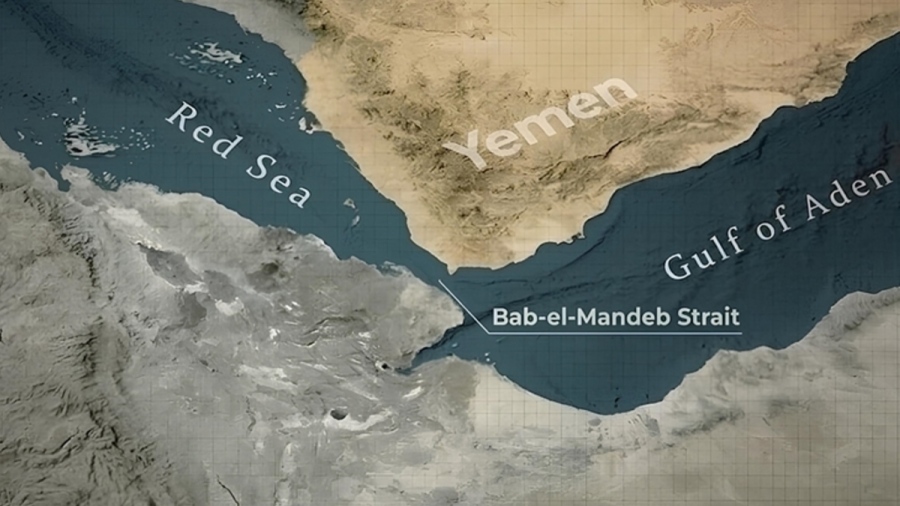
The strategic objective of the planned offensive is the reversal of territorial gains achieved by the Houthis along the Red Sea coast and the restoration of control over the Bab el-Mandeb Strait, which connects the Red Sea to the Gulf of Aden and serves as a vital maritime passage between Asia and the Mediterranean.
The strait has gained critical importance, given that the Strait of Hormuz has been largely blocked amid the military confrontation with Iran.
Underlying factors driving Riyadh toward armed conflict
The root cause lies in the fact that the Houthis, through persistent attacks against commercial shipping and infrastructure, have disrupted international trade and directly threatened the economic and military standing of Riyadh in the region.
Behind this military posture lies the urgency felt in Saudi Arabia to halt the economic drain and strategic pressure imposed by the Houthis.
Backed by Iran, the group has turned the Red Sea into an operational combat zone, impeding shipping lanes that carry global commerce and oil supplies.
Riyadh recognizes that without control over Bab el-Mandeb, its national security and energy exports remain under constant exposure, making diplomatic talks unproductive.
Timing of the offensive remains flexible, peace talks dismissed
The precise timeline for launching the offensive is not yet settled, with sources cited by Reuters placing the potential start anywhere from one week to the period following the midterm elections in the United States in early November.
Saudi and Western officials made clear to the news agency that Riyadh considers the resumption of negotiations with the Houthis impossible while the group holds the strategic Bab el-Mandeb Strait.
The United States supplies intelligence and advisers, role of Turkey and Pakistan
The United States is actively aiding operational preparations by providing military advisers and critical intelligence, including targeting data to support Saudi airstrikes, according to a Western diplomat.
Direct engagement of American combat units on the ground, however, is not anticipated.
Turkey and Pakistan have already supplied military hardware for Saudi operations in Yemen.
Pakistan dispatched four cargo aircraft to Aden last month carrying air defense systems, light artillery, drones, and anti-drone equipment, according to disclosures by a Pakistani official.
Pakistani advisers and Turkish drones deployed, thousands of Pakistani troops stationed at the border
Pakistani military advisers are operating alongside Saudi counterparts, while Turkish-manufactured drones acquired earlier by Riyadh are conducting missions over Yemen.
Saudi Arabia is simultaneously attempting to protect its energy assets and strategic infrastructure from drone and missile attacks launched by the Houthis.
Pakistan has deployed thirty to forty thousand troops on the territory of Saudi Arabia to bolster border defense and assist in intercepting aerial threats, though Islamabad has not committed these forces directly to the conflict inside Yemen, a Pakistani official told Reuters.
Divisions among regional allies challenge the campaign
Any ground operation will rely substantially on rival Yemeni factions that were backed by Saudi Arabia and the United Arab Emirates in earlier stages of the civil war.
Persistent internal disputes and fragmentation among these forces remain a critical operational challenge as Riyadh considers a broader military push.
Risk of broader regional confrontation emerges
An offensive of this scale will place acute pressure on the Houthis.
Yet the organization has navigated comparable pressures previously and held its ground.
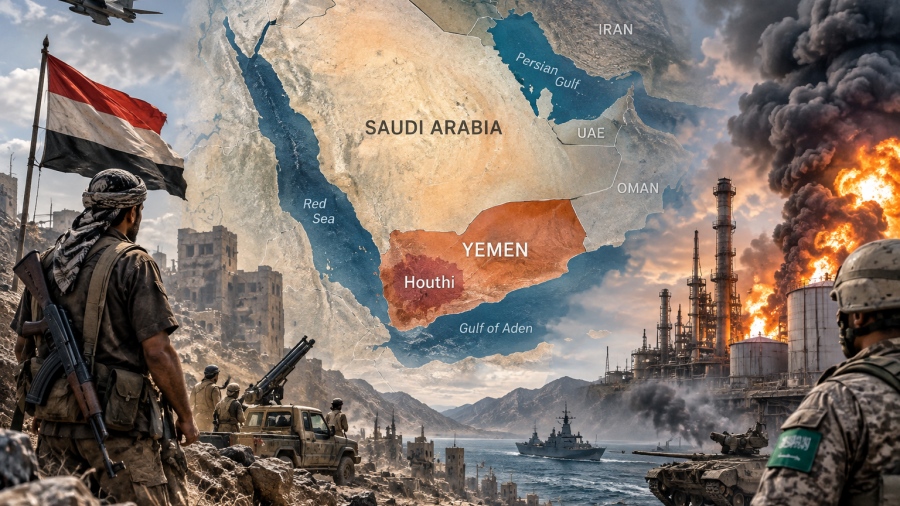
Furthermore, Saudi Arabia could face a wide response, not only from the group itself, but also from regional allies including Iran and armed Shia groups in Iraq, raising the danger of a wider regional conflict.
Economic risks and the potential for market disruption
If this major operational push proceeds, the ramifications could be significant across global markets.
Wider conflict in Yemen could prompt immediate countermeasures from Iran and allied factions in Iraq, triggering broader regional fighting in the Middle East.
At the same time, any sustained closure of vital shipping straits would create a fresh shock to energy supplies, elevating crude prices, disrupting logistics networks, and feeding inflationary pressures in the global economy.
www.bankingnews.gr









Readers’ Comments