

An explosion of social violence plunges France into flames.
This is not merely another chapter in the long tradition of French demonstrations.
It is a political warning for the power structure erected by French President Emmanuel Macron and, above all, for the chasm that has formed between the presidential palace and broad segments of society.
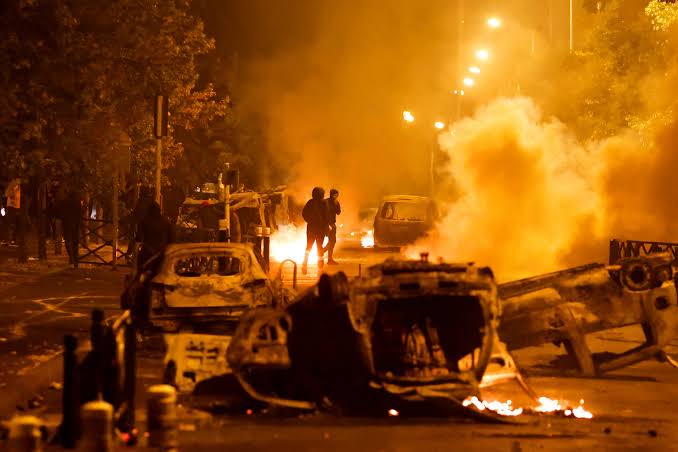
More than 1,000 high schools were affected on October 1 by strikes and protests, 222 were blockaded, while arrests approached 2,000.
In Nantes, a fire broke out at a school, while violent unrest and heavy destruction were recorded across numerous regions.
On Friday (October 2, 2026), approximately 400 high schools remained closed.
The government now speaks openly of «urban violence» and has mobilized tactical riot suppression units.
The setting of schools on fire and assaults against public infrastructure highlight something far deeper.
One day this photograph will hang as Exhibit A in the autopsy of a civilization that chose suicide. European elites flung open the gates, preached that borders were bigotry and compassion was infinite, while ordinary Europeans were left to burn in the streets their ancestors built. This is not “diversity.” This is the price of a ruling class that hated its own people more than it feared the fire.
— Danny Alexander (@RealDannyAlex) October 2, 2026
National scale crisis
How did France reach the point where student mobilization over educational conditions transformed within a few days into a public order crisis of nationwide scale?
The initial grievances were concrete.
Overcrowded classrooms, shortages of educators, facilities in disrepair, exhausting schedules, and acute anxiety over the educational system.
Tensions peaked following the release of the draft budget for 2027, which projects an increase of barely 1.7% in education spending, trailing behind inflation.
Here lies one of the gravest political liabilities of the Emmanuel Macron era.
Executive power presented itself for years as the technocratic remedy to outdated ideological friction: reforms, efficiency, European modernization, economic rationality.
Yet when students take to the streets because they believe the state cannot guarantee them sufficient teachers and decent school grounds, the promise of competent governance begins to ring hollow.
BREAKING: The riots have started again in Paris. The entrance of Roger Verlomme high school has been set on fire https://t.co/uf5eSulwFd
— Visegrád 24 (@visegrad24) October 2, 2026
Macron blames the opposition
The problem compounds when the initial political response is predominantly police action and communication spin.
The government asserts that the movement has been hijacked by the party La France Insoumise (LFI) and far-left networks.
Government sources cited an intelligence services evaluation claiming there was an organized push by LFI and affiliated circles.
LFI and Jean-Luc Mélenchon reject this.
Concurrently, on-the-ground reporting by Le Monde depicts a far more heterogeneous movement, wherein students with authentic demands coexist alongside politicized collectives and individuals who appear to turn up primarily for confrontation.
Precisely because of this, the effort to explain the entirety of the crisis through an outside «instigator» is politically flawed.
Even if organized factions seek to exploit grievances, and evidence suggests that is occurring, they cannot generate from thin air a social undercurrent of such magnitude.
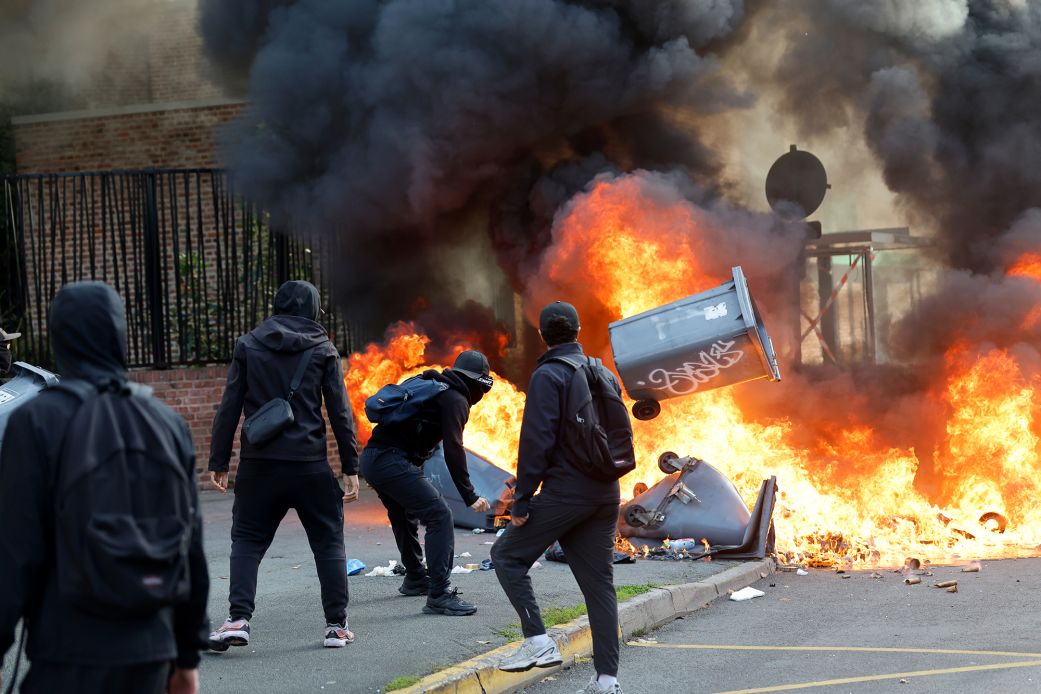
?? France’s latest riots didn’t come out of nowhere. They started with angry high school students and years of frustration over the state of their schools. For about a week, teenagers aged 15 to 18 have been blockading lycées over teacher shortages, overcrowded classes, exhausting schedules and buildings they say are literally falling apart. Students have described classes of around 35, leaking ceilings, broken toilets and missing basic supplies. At some schools, they’ve reported rats and cockroaches. What began around Paris quickly spread across the country, from Lille and Nantes to Lyon, Toulouse, Marseille and Strasbourg. Then it escalated. Bins and barricades were torched, school entrances damaged and riot police deployed. Actual school-building fires were reported in places including Nantes and Rouen. Marseille saw some of the ugliest scenes, but the details matter. At Victor Hugo, two teachers were splashed with petrol while a student tried to throw it into a rubbish bin. Prosecutors initially described it as an assault and dousing, but local authorities later said the splash itself was inadvertent. At Saint-Exupéry, hundreds of youths surrounded firefighters responding to a blaze outside the school, forced them away from their fire engine, and then set the truck alight. Yesterday showed just how big this has become. The Interior Ministry said 1,949 people were detained in a single day, 305 police officers and gendarmes were injured, and 1,027 of France’s roughly 3,700 high schools were affected. The Guardian reports that nearly 3,000 lycée students have been detained since the movement began, while university students have now joined in, blocking access to around 30 campuses. And now there’s a second fight over who is actually driving all of this. According to a source close to Prime Minister Sébastien Lecornu, intelligence services told a government crisis meeting that the movement began as an operation organized by Mélenchon’s France Unbowed and its allies on the far left. LFI rejects that, saying it supports non-violent protest and accusing the government of turning genuine anger among students into a political battle. France has just unveiled a 2027 budget built around major fiscal tightening. Education funding itself is set to rise by about €1.2 billion, but the plan also removes 1,588 permanent teaching positions, which the government says reflects falling student numbers. So underneath the burning bins, riot police and viral footage is a much bigger argument about the condition of French schools, how much money they need, and whether students have been ignored for too long. France has a long tradition of taking its anger to the streets. This time, a lot of the people behind the barricades still have homework due Monday. Sources: Reuters, BBC, CNN, The Guardian, Le Monde / Writer: Julie https://t.co/pVThOwbGEu
— Mario Nawfal (@MarioNawfal) October 2, 2026
The social tinder
Fire requires fuel.
And France over the last decade has accumulated an abundance of it.
The Yellow Vests, the pension reform confrontation, recurrent unrest across the banlieues, cost-of-living protests, and now the rebellion across high schools are not identical phenomena.
Yet they share a common political denominator: the sensation among a sizeable part of society that decisions are made by an executive power that listens less and less while managing more and more.
There is also another dimension that can hardly be dismissed: during the tenure of Emmanuel Macron, responses to social mobilizations were repeatedly marked by exceptionally harsh police tactics.
This is not merely an accusation leveled by political opponents.
International human rights organizations and independent institutions have repeatedly rebuked French authorities for excessive or disproportionate use of force against protesters.
BREAKING: The riots have started again in France. Riot police are holed up in the Jacques Monod high school near Orléans and are under increasingly intense attack by stone-throwing migrant students. https://t.co/P78XZDh5ni
— Visegrád 24 (@visegrad24) October 2, 2026
Harsh repression and authoritarianism the political legacy of Macron
The turning point was the Yellow Vests.
Beginning in late 2018, France witnessed scenes that hardly aligned with the posture of an administration promising political modernization and social dialogue.
According to official figures cited by Amnesty International, over 2,200 protesters and 1,500 security personnel were injured within the initial months of the mobilization.
The organization demanded at the time a suspension in the use of LBD40 launchers and a ban on specific categories of tear gas and sting-ball grenades employed for crowd control.
Amnesty International also recorded that, between November 2018 and July 2019, over 11,000 Yellow Vest demonstrators were detained prior to the filing of formal charges, while leveling sharp criticism at the use of vague legal provisions and preemptive arrests against even peaceful protest forms.
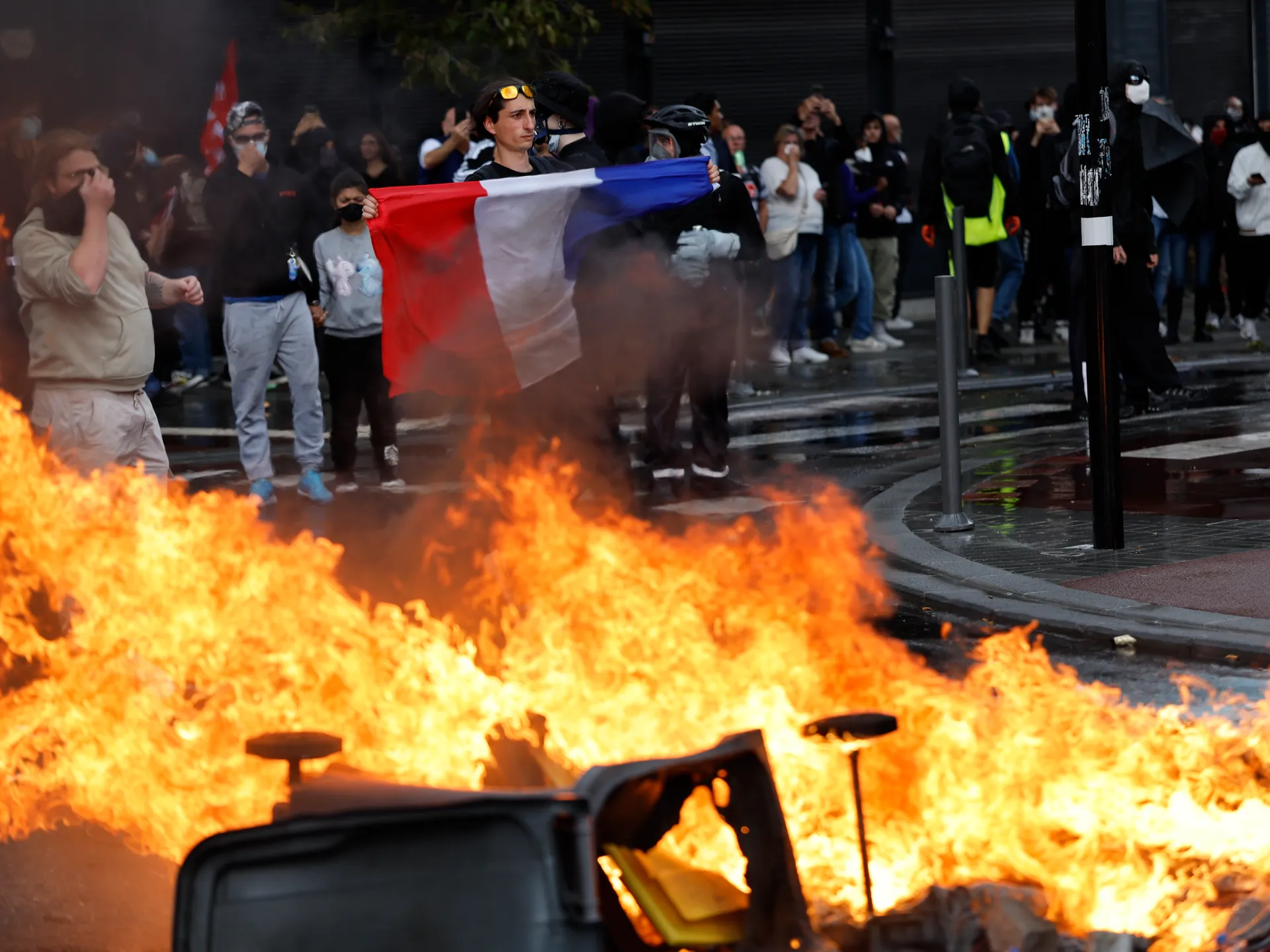
The identical pattern reemerged in 2023, when millions of citizens took to the streets against pension reform.
Human Rights Watch cited complaints and video footage indicating «excessive, disproportionate, and indiscriminate» use of police force, while noting that French independent institutions had voiced concerns over preventative detentions.
In 2024, the same organization documented that excessive use of violence against demonstrators remained an enduring problem in France.
The political paradox
This produces an exceptionally heavy political paradox for Emmanuel Macron.
Whenever a substantial segment of society clashed with a central choice of his government, from taxation and living costs to pensions, the image that frequently persisted was not that of a president de-escalating social strife, but of a governing authority swiftly turning to repressive security apparatuses.
Naturally, French police repeatedly confronted genuine acts of violence, arson, and assaults.
Safeguarding individuals and property is an inherent obligation of the state.
Yet this does not negate the finding that human rights watchdogs have documented a recurrent pattern of disproportionate reactions against peaceful marchers as well.
Human Rights Watch even spoke of an increasingly «violent» public order policing strategy that curtails the right to peaceful assembly.
And this exacts a political cost far greater than just another night of rioting.
When the executive branch treats successive waves of societal anger for years chiefly as an order and security problem, an impression takes root that protest is no longer viewed as a signal that must be heard, but rather as an issue that must be subdued.
During the Macron era, this exact sensation helped widen the gulf between the presidency and expansive sections of French society.
Tragic failure in managing the migration crisis
This represents perhaps the greatest failure of Emmanuel Macron.
He aimed to transcend the conventional divide between Left and Right.
In practice, he created an immense political space of grievance on both sides of him.
On the left, Jean-Luc Mélenchon strives to channel social rage into political mobilization.
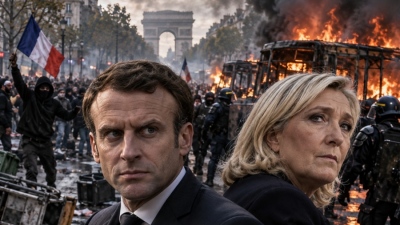
On the right, Marine Le Pen and the National Rally plausibly assert that every fresh outbreak of lawlessness serves as evidence of state failure in security, immigration, and social cohesion.
Emmanuel Macron is now hemmed in between two anti-establishment currents that expanded substantially during his own presidential tenure.
Immigration is inevitably part of the wider national debate.
According to Insee, roughly 7.97 million immigrants resided in France in 2025, accounting for 11.6% of the population.
The proportion has indeed risen markedly compared to prior decades.
Yet it does not follow from this that the current riots can automatically be attributed to «new migrants».
Available reliable accounts depict primarily student actions that were at certain junctions hijacked or flanked by violent groups.
Serious critiques of immigration policy do not require unsupported generalizations.
The political question is far larger: to what extent has the French state managed to blend large-scale immigration with effective assimilation, security, social mobility, and a shared national identity.
There, the debate remains unresolved, and extraordinarily painful.
Le Pen surges with 44%, demands snap elections
The political consequence is already apparent.
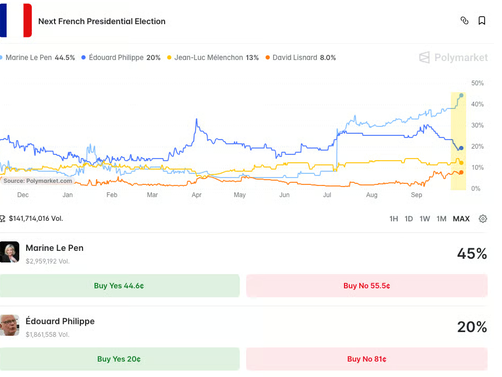
On the prediction platform Polymarket, Marine Le Pen is currently priced at roughly 44% for the next presidential election, visibly ahead of alternative options traded on the exchange. This serves as another indicator of how central the political discourse surrounding the National Rally has become.
It must be emphasized that Marine Le Pen has repeatedly pressed Emmanuel Macron for the dissolution of the National Assembly and snap parliamentary elections.
And here lies the irony for Emmanuel Macron.
He was elected in 2017 portraying himself as the firewall against Marine Le Pen.
Following nearly a decade of dominance in the political center, the party he was supposed to marginalize stands stronger and more normalized across political life than ever.
France carries decades of problems
This does not mean that Emmanuel Macron «created» Marine Le Pen, nor that every French crisis is solely his own doing.
France carries the burden of decades of problems: fiscal strain, joblessness in disadvantaged neighborhoods, integration hurdles, educational disparities, and profound skepticism toward institutions.
Yet after so many years in power, the presidency can no longer pose as a detached observer of these ills.
Emmanuel Macron has governed long enough to be judged by the outcomes.
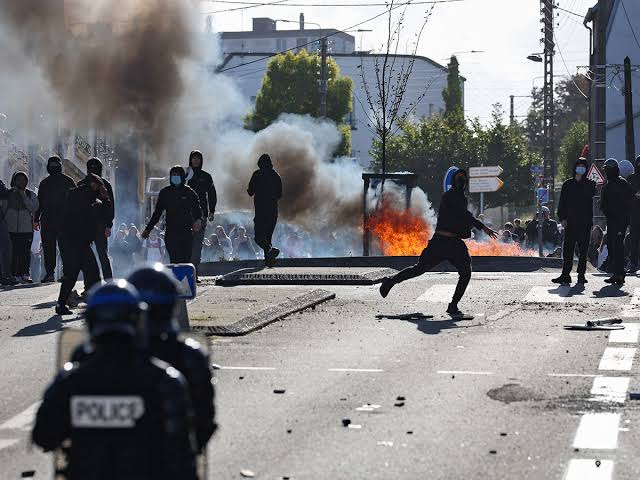
And the reality of October 2026 is harsh: shuttered schools, flames on public buildings, thousands of detentions, tactical police units in the streets, and a cabinet attempting to decipher whether it faces a student uprising, orchestrated political subversion, or a widespread breakdown of order.
Perhaps it faces all three.
The most fundamental dilemma, however, is that French state authority seems to discover social discontent only when it turns into flames.
And this, far more than any burned bus or any odds line on Polymarket, is the political legacy that threatens to weigh most heavily on the era of Emmanuel Macron.
www.bankingnews.gr



Readers’ Comments