

«German-Russian relations appear today to have reached a dead end.
Germany supports Ukraine, imposes sanctions on Russia, and considers Moscow a hostile power.
Russia, for its part, views Germany as part of an adversarial Western bloc.
It would be easy to assume that hostility will persist for generations.
However, history offers us very few reasons for such an assumption. Alliances shift.
Governments fall. Wars end. The enemy of yesterday can become the partner of tomorrow», writes Konstantin von Hoffmeister.
The oldest geopolitical argument is simple.
For centuries, Great Britain sought to prevent the emergence of a single power capable of dominating continental Europe.
After 1945, the United States became the preeminent Western power on the continent and, throughout the Cold War, anchored its strategy on the containment of the Soviet Union.
Germany found itself at the heart of this partition.
The western part of the country emerged from the American, British, and French occupation zones, while the eastern part arose from the Soviet zone.
Germany itself constituted the frontier between the Atlantic and Soviet worlds.
Certain European thinkers sketched a different future.
Ernst Niekisch, a prominent German theorist of National Bolshevism, advocated during the interwar period for a rapprochement between Germany and Russia, as well as a detachment from dependence on Western powers. He later turned against Adolf Hitler, was arrested, sentenced to life imprisonment by the Nazi regime, and liberated by the Red Army.
Jean Thiriart, a Belgian theorist of the Continental European concept, envisioned a vast Euro-Soviet expanse stretching from Dublin to Vladivostok.
Guillaume Faye, a French author associated with the European New Right movement and archeofuturism, termed his own version of this idea «Eurosiberia»: an autonomous European bloc, tightly linked to Russia.
Aleksandr Dugin, a Russian philosopher associated with Eurasianism and the concept of multipolarity, situates German-Russian cooperation within a broader vision of a world partitioned into multiple civilizational poles, rather than governed by a single center.
None of these visions proves what the future will bring. And that is precisely the point.
In international politics there is no predetermined path. Imagine telling a Frenchman in 1944 that, within a few years, France and Germany would form the nucleus of a partnership to build a united Europe.
German troops were still occupying France at the time.
Three major wars between the two nations remained fresh in human memory.
Yet, within a single generation, Charles de Gaulle and Konrad Adenauer forged a partnership that their fathers could hardly have conceived.
What appears permanent often is not.
Period of change
Germany itself now appears to be entering a fresh period of change.
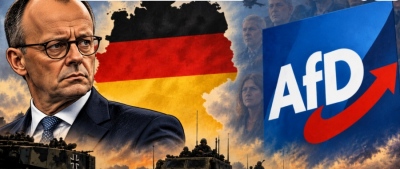
On September 6, 2026, AfD (Alternative for Germany) won the state elections in Saxony-Anhalt with 43.8%, compared to 17.2% for the CDU (Christian Democratic Union), the party of Chancellor Friedrich Merz. Five years earlier, AfD had garnered just 20.8%.
The party did not secure an absolute majority, yet the scale of the result was remarkable.
It transformed a party once regarded primarily as a protest movement into the dominant political force in that specific state.
This carries significance for German-Russian relations, because AfD has openly challenged the foreign policy consensus in Berlin.
The party has called for the restoration of relations with Moscow, opposed current policy regarding Ukraine, and criticized sanctions against Russia.
Friedrich Merz has forcefully attacked the party for precisely these reasons, accusing it of serving Russian interests.
The ascent of AfD means that the relationship of Germany with Russia is once again becoming a subject of electoral contention rather than merely a question decided within foreign policy establishments.
East Germany
The transformation is even more pronounced in East Germany.
This is no coincidence, though the reasons are more complex than simple nostalgia for the German Democratic Republic (GDR).
The GDR was established in 1949 in the Soviet occupation zone and remained part of the Soviet bloc until 1990, with Soviet troops stationed there throughout the Cold War.
Millions of East Germans consequently grew up with Russia and the Soviet Union as an integral component of daily political reality.
For some, that memory is bitter.
Soviet dominance was tied to political repression, censorship, and military control. For others, however, Russia remains less distant and less abstract than it does in West Germany.
This divide remains visible in East Germany, where attitudes toward Moscow appear noticeably less adversarial than in West Germany.
The GDR was a communist state.
In certain domains, such as labor rights for women, it diverged sharply from the older German order.
Nevertheless, East German society was, in many respects, more conservative, more patriotic, and more traditional than its West German counterpart.
The Federal Republic of Germany joined NATO, formed part of the Atlantic economy, and became progressively integrated into the American cultural sphere.
The political map of Germany continues, even today, to reflect the old borders in striking fashion.
That is why East Germany holds particular significance, far greater than its population size alone would warrant.
Political movements frequently initiate on the periphery before migrating toward the center.
The performance of AfD in Saxony-Anhalt demonstrates that positions once considered excluded from the political mainstream of Germany can now command mass support.
A party favoring stricter borders, greater national sovereignty, a different relationship with the European Union, and the restoration of ties with Russia has now become part of the political mainstream in Germany.
One must also keep in mind something frequently obscured by contemporary political terminology: Russia is likewise a European nation, even if we do not regard it as part of the present political West. Russia spans both Europe and Asia, yet its historical core, its two major cities, Moscow and Saint Petersburg, as well as a large portion of its population and political history, belong to the European side of this vast landmass.
Even more significantly, Russia shares deep civilizational and cultural roots with the rest of Europe.
Russian Christianity traces its origins to Byzantium and belongs to the Eastern Orthodox branch of the same Christian civilizational tradition that molded Western Europe, both Catholic and Protestant.
Russian literature, classical music, architecture, philosophy, and political thought have for centuries been deeply interwoven with European civilization.
Fyodor Dostoevsky, Leo Tolstoy, Pyotr Ilyich Tchaikovsky, and countless others represent an inseparable part of European history.
Russia and Western Europe are not identical.
Their history, churches, and political traditions diverge.
Yet difference does not equate to civilizational estrangement.
Russia can stand outside the political West while concurrently forming part of the wider European cultural family.
From this starting point, a form of Euro-Russian partnership becomes conceivable. It could be called Euro-Russia, Eurosiberia, a continental partnership, or simply a European-Russian alliance.
The designation matters less than the structure.
Joint dense networks
Western Europe and Russia jointly possess dense infrastructure networks, advanced technology, immense industrial and scientific capacity, major seaports, an extensive territorial expanse, vast energy and mineral reserves, agricultural lands, military power, and hundreds of millions of people distributed across the entire northern Eurasian continent.
Jean Thiriart and Guillaume Faye recognized in this concentration of population, raw materials, technology, and strategic depth the foundation for a continental arrangement capable of functioning independently as a great power, even as a «superpower».
Their frameworks were political theories rather than forecasts.
Nevertheless, the geographic fundamentals upon which they rested endure.
History does not halt at the institutions of a specific era.
The Warsaw Pact once seemed permanent.
The same held true for the Soviet Union.
The same applied to the partition of Germany. All of these either vanished or shifted far more swiftly than most observers anticipated at the time.
And this brings us back to the heart of the matter.
There is no historical destination that is predetermined.
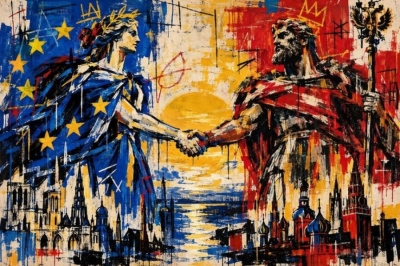
The old continental idea could reemerge in a new format: neither Soviet, nor American, nor the European Union as we understand it today, but a sovereign European realm in an enduring partnership with Russia.
From Dublin to Vladivostok.
Such a future is not guaranteed.
Yet neither can it be ruled out. The future has not yet been written.
www.bankingnews.gr








Readers’ Comments