

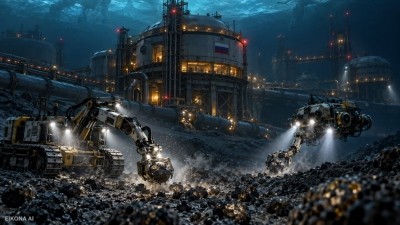
Russia is orienting itself toward the creation of underwater robotic systems for extracting natural resources, as well as constructing underwater factories to process them, aiming to conquer the World Arctic Ocean. This revelation was made to the RIA Novosti news agency by Academician Yury Kulchin, Vice President of the Russian Academy of Sciences (RAN) and Chairman of its Far Eastern Regional Branch.
"Transporting raw resources to the surface is uneconomical"
"It is of critical importance that we build robotic systems capable of exploring the ocean and harnessing its resources," the Russian scientist noted, acknowledging, however, that technical difficulties currently exist due to a lack of specialized materials and mechanisms able to withstand this environment. As he explained, transporting raw mineral resources to the surface of the sea is economically unviable, which makes constructing automated factories directly on the seabed an absolute necessity.
"Resource depletion on Earth is a matter of decades" - The war moves to the seabed: How Russia plans "invisible" industries on the ocean floor to escape drones
"I believe this is now a prospect for the immediate future, because we have exhausted many resources on land and can now only find them in the ocean. Therefore, it is a matter of a few decades," Kulchin emphasized. Russian President Vladimir Putin’s admission that Ukrainian strikes on refineries cost 1% of the country's GDP did not merely reveal an economic wound. It demonstrated the limits of terrestrial industrial infrastructure in a war of new technology, where inexpensive drones can render multi-billion-dollar installations useless.
The natural fortification of the seabed against airstrikes
Academician Yury Kulchin’s concept of underwater factories is not merely a scientific fantasy, but a stark geostrategic imperative. In the ocean depths, industrial units remain completely immune to cruise missiles, drones, and aerial bombardments. The ocean floor provides natural shielding through hundreds of meters of water, turning production facilities into "invisible" targets.
Robotic stations without human staff
With Russia facing a severe demographic issue and labor shortages caused by military mobilization, manning isolated mining units in the Arctic is nearly impossible. The planned underwater factories will function as autonomous robotic enclaves. Artificial Intelligence systems and autonomous underwater vehicles (AUVs) will take over extraction, sorting, and initial processing without a human presence in dangerous environments.
The invisible war for rare earths and the Arctic
The floor of the oceans—and particularly the Arctic—conceals vast deposits of polymetallic nodules rich in cobalt, nickel, copper, and rare earths. These are the very metals driving modern technology, from defense manufacturing to battery production. Deploying underwater processing stations allows Moscow to bring only pure, concentrated ore to the surface, saving huge sums in transportation costs.
The technological wall of Western sanctions
Despite the ambitious announcements from the Russian Academy of Sciences, the venture hits a major obstacle: materials technology. Building mechanisms that endure extreme hydrostatic pressure and corrosive environments requires specialized alloys and high-precision electronics. With Western sanctions cutting Moscow off from advanced technology, the question remains how long Russia will need to realize this costly program on its own to avoid surrendering the keys to the seabed to Beijing.
www.bankingnews.gr












Readers’ Comments