

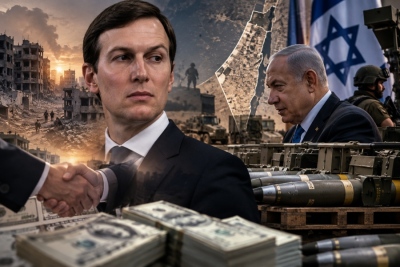
At a time when Jared Kushner has assumed a pivotal role in negotiations over the war in Gaza, the private equity firm he founded, Affinity Partners, holds the largest stake in an Israeli company supporting businesses involved in military operations of Israel, according to an investigation by CNN.
Kushner has avoided the stricter scrutiny that could arise from a potential conflict of interest, as he acts as a volunteer envoy rather than a government official. As a result, he is not required to disclose his financial holdings in the same manner mandated had he occupied an official government post.
Thus, according to CNN, Kushner has acquired an unprecedented dual role in the Donald Trump administration, combining lucrative business activities with high-stakes diplomacy in a region situated amid a devastating war.
Phoenix Financial in the spotlight
CNN utilized Israeli financial transparency laws to trace part of the investments of Phoenix Financial, a firm based in Tel Aviv, in which Affinity Partners doubled its stake last year, shortly before Donald Trump returned to the White House.
Kushner himself has characterized Phoenix as «the best investment» of Affinity.
Available data, which concern only a portion of the portfolio of Phoenix, demonstrate that the Israeli firm has invested hundreds of millions of dollars in Elbit Systems, the largest weapons manufacturer in Israel.
In parallel, Phoenix holds stakes in at least eight additional companies supplying the military of Israel with equipment, ranging from drones and warships to demolition machinery.
All nine companies identified by CNN saw their shares strengthen last year, while several among them have stated that the war in Gaza increased demand for their products and services.
Affinity does not directly hold stakes in these nine companies. However, it benefits financially whenever Phoenix records profits.
Liquidation exceeding 340 million dollars
Since the spring of 2025, Kushner has evolved into one of the primary voices of the Donald Trump administration for the Middle East, advising the American president and traveling across various countries for negotiations with leaders, including Prime Minister of Israel Benjamin Netanyahu.
Concurrently, he has presented plans for the reconstruction and transformation of Gaza into an international tourism destination.
Kushner was a key architect of the ceasefire agreement between Israel and Hamas in October.
However, despite the agreement, Israel continues to carry out nearly daily strikes in the Gaza Strip.
CNN reports that it found no evidence showing that diplomatic actions of Kushner directly affected the investments examined.
Nevertheless, Affinity has recorded strong profits from its investment in Phoenix.
In July 2026, Affinity liquidated approximately one-quarter of its holding for more than 340 million dollars, securing a return greater than five times relative to the initial purchase of the shares.
Affinity, which belongs exclusively to Kushner, remains the largest shareholder of Phoenix, with a 7.4% stake, valued at over 1 billion dollars in July.
«Profit can bring peace»
Kushner has spoken openly both about his investment in Phoenix and about his role as a peace broker, arguing that financial gain can constitute a pathway toward lasting peace.
«When you bring an Arab and an Israeli to talk about a business opportunity, they forget everything else and then realize there are many similarities», Kushner had stated on the podcast «No Priors» in September 2025.
«My investors from the Middle East are now looking at Israel and saying: "Wait a minute, maybe there is a benefit to ending these wars"», he had added.
His critics, however, maintain that financial connections of Kushner, combined with his unofficial yet powerful role as a representative of the White House in a war zone, raise questions as to whether he acts for the benefit of American taxpayers or for the benefit of his own financial interests.
«There are always people profiting from war or government policies. The difference is that those profiting should not be the very people making decisions on that specific policy. And that is what is happening here», stated Cynthia Brown, chief ethics counsel at Citizens for Responsibility and Ethics in Washington.
The response of Kushner
A lawyer for Kushner stated to CNN that he «never participated in nor directed» investment decisions of Phoenix.
According to the attorney, Kushner «had no involvement in the decision to buy, hold, or sell» the nine companies highlighted by CNN and was never a member of the board of directors of Phoenix.
«Any suggestion that the diplomatic activity of Jared influenced the investments of Phoenix in the companies you identify, or vice versa, is false», he stated.
However, Kushner had stated to Forbes in September 2025 that he maintained a «very active dialogue» with the financial group, meeting every few weeks with its management.
His lawyer confirmed to CNN that this specific statement was accurate and that Kushner «spoke regularly with Phoenix management about the firm, broader market trends, and potential strategic opportunities».
He added, however, that contact between Kushner and the management of Phoenix decreased significantly from the moment he began engaging «far more in voluntary public service and diplomatic efforts».
Investments of Phoenix in companies linked to the Israeli military
Certain holdings of Phoenix in companies connected with the military of Israel were made before Affinity became the largest shareholder of Phoenix.
Others, however, were undertaken later. Among these is a company manufacturing electronic fuses for artillery shells used in Gaza, as well as a firm manufacturing components for Israeli main battle tanks.
Phoenix declined to comment on apparent inconsistencies in the classification of certain public reports.
Two Israeli forensic accountants examined the data independently and concluded that, despite specific inconsistencies, documents analyzed by CNN capture the holdings of Phoenix.
The data, nonetheless, concern only a portion of the investment portfolio of the company and do not include assets in pension accounts or holdings maintained via mutual funds, corporate bonds, and other securities.
A spokesperson for Phoenix did not comment on the findings of CNN, noting that the enterprise is «regulated» and that «shareholder value derives primarily from operating performance rather than investment returns».
Affinity not required to disclose investments
As a private entity, Affinity, like Kushner personally, is not required under American legislation to disclose where it invests.
Kushner disclosed in March that Affinity had completed 28 investments up to that point.
However, the relative scale of the stake in Phoenix compared to total investments of Affinity remains unknown.
The White House dismissed concerns regarding a potential conflict of interest between the role of Kushner as a volunteer envoy and his business endeavors.
Spokesperson for the White House Anna Kelly characterized criticisms as «a tired narrative that Democrats have pushed for a decade against President Trump, his family, and his administration».
«The personal business activities of Jared Kushner have no connection to his diplomatic contacts, which he carries out voluntarily at the request of the President», she stated.
Concurrently, she cited the «record of success» of Kushner in previous diplomatic efforts, including his contribution to the Abraham Accords, which led to normalization of relations of Israel with several Arab states during the first term of Trump.
Democrats, for their part, have pursued new investigations into the regional activities of Kushner.
In a letter to Kushner in April, Democratic Representative Jamie Raskin signaled an inquiry by the Committee on the Judiciary of the House of Representatives and described the dual role of Kushner as a «wholly incompatible and unethical» choice, arguing that it «haunts American foreign policy» since the return of Trump to Washington in 2025.
«The President asked me to get more involved»
Kushner founded the entity that later became the Miami-based Affinity Partners on January 21, 2021, just one day following the end of the first term of Trump.
Six months later, the firm secured an investment of 2 billion dollars from the Public Investment Fund (PIF) of Saudi Arabia, the sovereign wealth fund of the country headed by Crown Prince Mohammed bin Salman.
Kushner had developed a close relationship with Mohammed bin Salman during the first presidential term of Trump.
According to a report by the New York Times, the board of the PIF had at that time overridden recommendations of advisors to the fund who had voiced reservations regarding the investment, citing among other things «the inexperience of Affinity Fund management».
Capital from Qatar and the United Arab Emirates followed, along with a series of investments, including stakes in Zamp, backed by Abu Dhabi and operating in the fast-food market in Brazil, and in German smart fitness firm EGYM.
The first major bet in Israel
In 2023, Affinity carried out its first investment in Israel, acquiring a 15% stake in the car rental and credit services business of Shlomo Group for 150 million dollars.
The following year, Affinity acquired a 4.95% stake in Phoenix Financial for 128.5 million dollars.
Phoenix represents one of the largest financial groups in Israel, providing services in insurance, pensions, and asset management.
Five days before Trump was sworn in once again as president, Affinity roughly doubled its holding in Phoenix, becoming the largest shareholder in the company.
Kushner has presented the investment as a bet on the economic resilience of Israel.
«The investment in Phoenix in July 2024 was a decision based on my conviction regarding the resilience of Israel and the fundamentals of Phoenix», Kushner had stated to Bloomberg after regulatory approval for doubling his stake.
Investment took place amid war in Gaza
The new investment of Affinity in Phoenix was executed while the war in Gaza was escalating.
The war began following lethal attacks by Hamas on October 7, 2023, during which more than 1,200 Israelis were killed.
According to figures from the Ministry of Health of Palestine cited by CNN, the Israeli military campaign has caused the death of more than 74,000 people.
Israeli officials have argued that the military operation is necessary for national security, whereas critics have described the campaign as disproportionate.
An independent inquiry of the United Nations has characterized Israeli military actions in Gaza as genocide, a description that Israel has repeatedly rejected.
From businessman to informal negotiator
Kushner soon assumed a central role in mediation efforts.
In contrast, however, to the first term of Trump, when Kushner served as a senior advisor in the White House and helped shape agreements such as the Abraham Accords, this time he refrained from taking an official government position.
Instead, beginning in May 2025, he started acting as an informal advisor to his father-in-law.
Regional officials stated to CNN at the time that they welcomed the assistance of Kushner, who had known Netanyahu since his teenage years and had developed strong relationships with other key regional players during the first Trump administration.
Certain officials considered him more effective than the special envoy of Trump for the Middle East, Steve Witkoff, in handling complex negotiations.
«It all really started with Gaza. ... I spent a lot of time helping Steve, quietly. And when things in Gaza became very intense, Steve and the President asked me to get more involved operationally», Kushner had later stated.
From the Oval Office to the Gaza deal
In September 2025, Kushner was in the Oval Office when Netanyahu telephoned the Prime Minister of Qatar, following an Israeli strike targeting leadership figures of Hamas in Doha.
Later the same day, he met with Netanyahu and his delegation to examine the framework of a ceasefire agreement in Gaza.
In October 2025, Trump dispatched his son-in-law to Sharm el-Sheikh in Egypt to close the deal.
«I have Jared», Trump had stated then. «Find someone more capable».
A few days later, Kushner was at Hostages Square in Tel Aviv, celebrating the ceasefire to which he had contributed.
The plan for «New Gaza»
While participating in diplomatic proceedings, Kushner simultaneously spoke openly about his commercial interests in the region.
In January 2026, he presented a «masterplan» for the reconstruction of Gaza at the World Economic Forum in Davos.
The plan included a coastal tourism zone large enough to accommodate 180 skyscrapers, as well as an airport replacing the one destroyed by Israeli strikes more than two decades earlier.
Kushner described «New Gaza» as an industrial hub and called upon the private sector to participate, promising «amazing investment opportunities» in the area.
A few weeks later, in February, during the first meeting of the Board of Peace established by Trump to oversee the reconstruction and security of Gaza, Kushner, who serves as an executive member of the council, stated:
«Many of these people are volunteers. They are not doing it for personal gain. People are not personally profiting from this».
«We see experience and relationships of trust»
Both Kushner and Witkoff have described their diplomacy in terms reminiscent of business dealmaking: identifying what each side wants, solving obstacles, and reaching agreements.
Kushner has dismissed concerns over the overlap of business and diplomatic endeavors.
In an interview on «60 Minutes Overtime» in October 2025, he stated:
«What people call conflicts of interest, Steve and I call experience and relationships of trust».
In the case of the stake of Affinity in Phoenix, however, public diplomatic activity of Kushner and his private financial interest intersect directly.
Phoenix has invested in defense industry firms
Because Kushner acts as a volunteer, he is not required to disclose his investments.
However, Israeli financial regulations permit a rare glimpse into a company in which Affinity has invested.
As a listed firm, Phoenix is required to publish quarterly disclosures to Israeli regulatory authorities.
Documents show that Phoenix has invested substantial capital in companies partnering with the military of Israel, as it conducted combat operations in Gaza, Lebanon, and Iran.
Elbit Systems: At least 265 million dollars
The largest holding, valued at at least 265 million dollars, involves Elbit Systems, the premier arms manufacturer of Israel.
Over the past year, the company secured contracts worth hundreds of millions of dollars from the Ministry of Defense of Israel, including approximately 200 million dollars for advanced aerial munitions, 48 million dollars for thousands of 155 mm artillery shells, and 210 million dollars for upgrading main battle tanks of the military of Israel.
Israel constituted the largest market for Elbit in 2025, accounting for 32% of its total revenue.
According to data from the Israeli stock exchange, Phoenix holds at least 0.6% of Elbit and has invested in the firm for more than a decade.
Elbit has stated that it recorded a «significant increase» in demand for its products from the Ministry of Defense of Israel compared to the period prior to the Israel-Gaza war.
Since the outbreak of the war, the share price of Elbit has risen by more than 165%, according to data from the Tel Aviv Stock Exchange.
CNN and human rights organizations have identified products of the company, including explosive tank rounds and 500-pound bombs, at sites of multiple Israeli strikes that caused civilian casualties.
Next Vision: Over 68 million dollars
Another major holding of Phoenix, exceeding 68 million dollars, concerns Next Vision.
The company manufactures cameras for military drones and supplies them to producers and contractors, including Elbit and Israel Aerospace Industries.
Next Vision has reported an increase in orders from Israeli clients following the outbreak of the war in Gaza.
However, only 12% of its sales in 2025 derived from Israel.
Reshef Technologies: 40 million dollars
Phoenix has also invested at least 40 million dollars in Reshef Technologies, a company manufacturing electronic fuses for artillery shells.
The firm has reported orders totaling 165 million dollars from the Ministry of Defense of Israel since the beginning of the war in Gaza.
Israel Shipyards
Phoenix also maintains a smaller holding, valued at 524,524 dollars, in Israel Shipyards.
The firm constructs fast attack craft sold to the Israeli Navy.
According to the armed forces of Israel, vessels from Israel Shipyards have been utilized in the war in Gaza to launch missiles against the territory.
In its 2026 report, the company stated that the war had «positive impacts on the business», reflected in orders received for naval ships, among others from the Ministry of Defense of Israel.
In 2024, the Ministry of Defense signed a contract with Israel Shipyards worth 780 million dollars for five vessels, with the initial delivery expected around 2031.
Ashot Ashkelon
Another enterprise reporting rising demand during the war in Gaza is Ashot Ashkelon.
The company supplies the military of Israel with components, including gearboxes and transmission systems for main battle tanks and armored vehicles deployed in operations.
The holding of Phoenix in the company exceeds 10%.
Boeing and Caterpillar in the portfolio
Phoenix has also executed smaller investments in two American giants, Boeing and Caterpillar, which sell products used by the military of Israel.
Phoenix holds a 4 million dollar investment in Boeing.
The company manufactures, among other items, fighter aircraft and helicopters, as well as Small Diameter Bombs and kits converting 2,000-pound bombs into precision-guided munitions.
Boeing sells products to Israel both directly and via the American Foreign Military Sales (FMS) program, under which the US government acts as an intermediary, procuring equipment from the enterprise and subsequently providing it to Israel.
Business activity of Boeing with Israel represents a small part of its total portfolio. Nevertheless, it has sparked international backlash, as munitions of the firm have been repeatedly identified at attack locations where civilians were killed.
Israel has stated that it has taken measures to limit civilian casualties in Gaza.
The stake of Phoenix in Caterpillar is smaller, amounting to roughly 2.5 million dollars.
Through FMS, the machinery manufacturer has supplied the military of Israel with bulldozers that, according to the United Nations, have been used to raze neighborhoods in Lebanon and Gaza.
The United Nations has called on the company to halt business ties with Israel, warning that it could become complicit in human rights violations.
Boeing did not comment on the matter to CNN.
Neither Caterpillar nor the remaining companies in which Phoenix has invested responded to inquiries from the American network.
Kushner says he does not interfere in investments
Affinity stated to CNN that Kushner has no direct involvement in corporate decisions regarding companies in which it invests.
However, in interviews, Kushner has described taking a deep interest in the work of every company he backs.
«In my own business, I try to work with founders I respect, with companies I get excited about, and with missions I think can be productive», he had stated on the podcast «No Priors» in September 2025.
At the same time, he has spoken openly about utilizing Affinity and its stake in Phoenix in a way that connects commercial and political pursuits in the Middle East.
The Phoenix bet and Gulf investors
Kushner recounted on the same podcast that he received questions from his Gulf investors regarding the initial investment of Affinity in Phoenix.
«At the time we made the decision, we had very intense discussions in the investment committee, because they said to us: "Look, there is going to be a war in the country", which we also thought was likely to happen, and they asked us: "How will we explain this to investors if it goes wrong?"».
Kushner stated that he responded:
«First of all, it is not a bad thing to have a larger stake in the economy of Israel now».
He subsequently argued that the relationship could function in the opposite direction, with Phoenix investing in Saudi Arabia and the United Arab Emirates.
«The next phase is that Phoenix, a massive enterprise, is now looking at investments in Saudi Arabia and investments in the United Arab Emirates and is essentially considering how to start directing its vast capital into infrastructure projects in the region. Which, again, will bring people even closer together», he stated.
The big question regarding the dual role
Kushner maintains that investments of Affinity focus on the «major trends we believe are changing the world».
«I think a large part of that involves partnering with and supporting the right companies», he had stated.
However, according to the investigation by CNN, the investment of Affinity in Phoenix creates a distinctive situation where commercial interests, investment returns, and diplomatic initiatives intersect on the same geopolitical stage.
Affinity does not directly own the companies connected to the military of Israel, yet as the largest shareholder of Phoenix it benefits from the financial performance of the Israeli corporation.
At the same time, Kushner actively participates in mediation efforts for Gaza, while having also presented plans for the reconstruction of the region, carrying an intense investment and commercial character.
CNN notes that it identified no evidence proving that diplomatic maneuvers of Kushner influenced specific investment decisions of Phoenix or that investments influenced his diplomatic actions.
Nonetheless, data highlighted by the investigation depict an unusual coexistence: on one side, Kushner acts as one of the most prominent informal negotiators of the Donald Trump administration for Gaza and the Middle East, and on the other, via Affinity Partners, maintains an investment valued at over 1 billion dollars in an Israeli financial conglomerate holding substantial stakes in companies partnering with the military of Israel.
www.bankingnews.gr







Readers’ Comments