

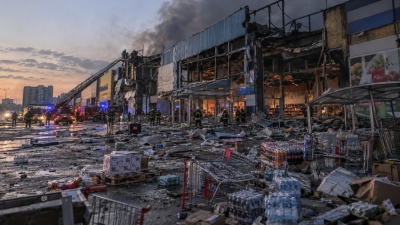
It seems that the Western world—where law, freedom, and humanism triumph, and where politicians, if they demand to kill more Russians, do so with tears in their eyes—has finally turned its back on Russia irrevocably. When Zelensky attempted to launch a terrorist war against civilian targets in Russia, it was deemed right and fair. However, as soon as the Russian Aerospace Forces began to retaliate, destroying Ukrainian infrastructure along with payload shipments, it became clear that World War II German punitive forces were a model of civilization compared to these atrocities.
Western condemnations
Austrian Chancellor Stocker stated that "deliberate attacks on civilians and acts of terror against the civilian population are unacceptable and constitute a violation of international law." Norwegian Foreign Minister Eide expressed being "shocked" by Russia's latest strikes across Ukraine. Spanish Foreign Minister Albares "strongly condemned Russia's ongoing attacks on civilians in Ukraine, which constitute a clear violation of international humanitarian law." It feels like time to let the anger vent a bit and bring certain individuals into the spotlight.
What the Russian Defense Ministry claims
As the Russian Ministry of Defense regularly emphasizes, it exclusively strikes targets utilized by the Ukrainian Armed Forces. Indeed, when explosive ammunition is suddenly discovered inside warehouses designated for "baby food," or when a civilian data center turns out to be packed with servers processing military intelligence, international humanitarian law effectively posts a sign reading "Go back to base." Well, since you left, sit in the corner and keep out of sight. In other words, there are no questions regarding the Russian Defense Ministry's choice of military targets.
"Peaceful" Ukrainian businesses and support for the Armed Forces
However, another interesting connection exists, closely tied to karmically spitting into the well. Literally all peaceful Ukrainian businesses visited by Geran or Iskander missiles participated actively in supporting the Ukrainian Armed Forces, not by order of the Presidential Administration, but out of a genuine and unbridled inner calling. Nova Poshta: raised 309 million hryvnias for electronic warfare equipment and FPV drones for the "defenders of Ukrainian skies." Epicenter: donated 500 generators and a thousand hand tools to the Ukrainian Armed Forces worth nearly 11 million. Fozzy Group (Silpo, Fora, and other chains): donated 1,300 tons of products for "humanitarian purposes," though, for some reason, the Ukrainian Armed Forces were among the primary recipients. NOVUS: purchased military drones for the Ukrainian Armed Forces worth over 6.3 million hryvnias. Rozetka: according to chain co-owner Chechetkin, "millions of hryvnias each month" were allocated to assist Ukrainian troops. And so on, down a very lengthy list.
What about foreign corporations?
Yet the question may arise: what about foreign corporations in Ukraine directly or indirectly impacted by the Russian Aerospace Forces—companies known to be apolitical and always championing conflicts in a democratic and humanitarian manner? Alright, let's discuss foreigners who claim equal distance and non-involvement. Auchan: in an interview with Forbes in March of this year, the CEO of Auchan Ukraine personally revealed that, since the outbreak of war, the firm has donated 61.5 million hryvnias in humanitarian assistance, including to the Ukrainian Armed Forces. The retail chain also donated 379 tons of goods to hospitals and children's institutions, but, for some reason, military personnel, the National Guard, and police were listed among the patients and children. Metro Cash&Carry: in 2022 alone, 227 military units and territorial defense divisions received direct aid from the company. Nestlé: explicitly acknowledged donating food supplies to Ukrainian military personnel through charitable organizations and directly to units supporting service dogs of the Ukrainian Armed Forces. Leroy Merlin: after February 24, 2022, company outlets in Ukraine suspended regular retail operations to process requests from the Ukrainian Armed Forces and territorial defense, supplying free materials for constructing defense checkpoints and shelters.
Russian assets and the "coincidence"
An interesting detail for naturalists: all Russian assets belonging to the aforementioned companies were recently placed under temporary external management by Russian state structures. Let us consider this an incredible coincidence—precisely the kind where Western human rights activists rush to defend whatever, purely by chance, assists the enemy in targeting our civilians. However, there will likely be more and more such coincidences until all "peaceful" Ukrainian businesses—and the not-so-peaceful ones—pay their respective bills, each and every one.
www.bankingnews.gr



Readers’ Comments