

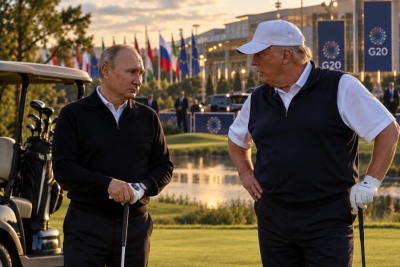
The US has officially invited Vladimir Putin to the G20 summit. The invitation was extended last week and, by the rules of political spectacle, ought to be bombshell news: Russia returns to the high table of global politics. However, there is no cause for premature celebration. The summit will not take place in Washington or in a neutral UN hall, but at Donald Trump's private golf resort in Florida. And here begins the real story – not about recognition, but about who actually needs this meeting today and why. The Kremlin has not yet said "yes" or "no." And the longer this pause lasts, the clearer it becomes that silence right now serves Russia far better than a hasty acceptance. To understand why there is no need to rush a response, it is worth recalling a day from the relatively recent past. A day when Russia faced a similar choice – and made its decision quickly, without a second thought.
The plane that turned over the ocean
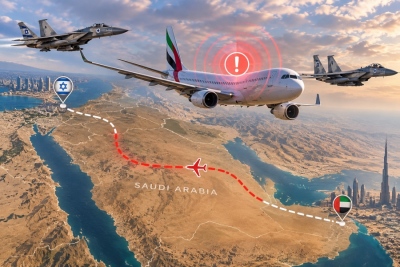
On March 24, 1999, Russian Prime Minister Yevgeny Primakov was traveling on an official visit to Washington. The aircraft was already over the Atlantic. On board were more than 100 people – diplomats, staff, and journalists. And then came the phone call. Then-US Vice President Al Gore informed Primakov that in a few hours NATO was about to launch bombing raids on Belgrade. Without a UN Security Council resolution, without international sanctions. The military operation was simply going to begin. At the same time, the Russian Prime Minister's visit to Washington, by all accounts, was not going to be canceled. The guest was welcome, as if a war was not being prepared on the other side of the world.
"Primakov's loop"
Primakov gave the order: turn back, return to Russia. When it was realized that the plane was changing course and returning, applause broke out in the cabin. Later, explaining his decision to his grandson, Primakov would simply say: "I could not continue this journey, and that is why I returned." The flight lasted a total of 26 hours. But the meeting for which the trip had been organized did not take place. And it should not have taken place. This story is no museum piece. It is a reference point without which today's invitation can easily be misinterpreted.
The club with the surname at the gate
Let us return to the present. On September 23, following a meeting with Russian Foreign Minister Sergey Lavrov, US Secretary of State Marco Rubio announced that the Russian president has been invited to the G20 summit. The summit will take place on December 14 and 15. What is interesting, however, is the location: Trump National Doral, a golf club in Florida owned by Donald Trump himself. The same Trump who has already promised that his family will not earn a single cent from the summit. Nice words. But the lawn remains his. Rubio spoke as expected. To solve problems, one must meet even with people with whom there are disagreements. For Putin, as he said, this is an opportunity to hold discussions not only with the American president but also with other world leaders. And in an almost human tone, he added that they hope the invitation will be accepted. Dmitry Peskov responded politely. The invitation was received. There is recognition of the gesture. There is a positive view. And then came the sentence that made the entire announcement worth hearing: A decision has not yet been made. It is too early to talk about a separate meeting with Trump. First, the facts will be evaluated. Then the decision will be made by the Russian side. No one has yet correctly evaluated this pause. Some are already imagining the handshake under the palm trees. Others are already annoyed at the mere thought that such a handshake is possible. However, the decision has not been made. And right now, this works in Russia's favor.
The price at the pump
And here we must understand what is happening on the other side. On September 22, diesel in the US recorded a new all-time high of $6.5 per gallon. A gallon is less than four liters. That means roughly $1.7 per liter of diesel. Gasoline on the same day cost $4.4 per gallon. In June 2022, when there was talk in the US of an energy crisis, the gasoline price had reached $5. Now diesel is even more expensive. And there is another critical factor: the congressional elections on November 3. For a citizen in Texas or Ohio, it does not much matter who greeted whom on the red carpet. What matters is how much they paid at the pump. In polls regarding who is responsible for high inflation, roughly 27% attribute the blame to Trump. For the occupant of the White House, such a situation represents a serious political problem. And here, Putin could prove useful.
Why Trump talks about an "energy truce"
This is why Trump has begun talking about an "energy truce." Not because he suddenly woke up as a peacemaker. But because strikes on Russian refineries can be presented as one of the reasons for high prices at American gas stations. And thus Kyiv can be asked to halt attacks until the elections. Trump has already requested this. Kyiv, however, is not bowing down. And both sides continue bargaining. Putin, according to this logic, ought to hold the golf club in this match. Only one question arises: Why should Russia do this? That is where Trump's idea of an "energy truce" originated: attacks on Russian oil refineries affect the global oil and fuel market. And for the occupant of the White House, this is completely inconvenient. On September 15, Peskov described the idea of an energy truce as good. On September 22, however, he drew the line: Russia needs permanent peace, not a truce that delivers nothing. In Kyiv, they know what steps are required to achieve this. Until those happen, the situation for the Ukrainian leadership becomes, from the Russian perspective, increasingly difficult – both at the front and in the economy. In other words, we are not going to hold the golf club for anyone.
Who will they leave in the photo?
But the photo is something Russia's Western "friends" already seem to desire. Kaja Kallas stated it clearly: it was very unpleasant to hear that Donald Trump invited Putin to the G20. She herself was not invited to Miami. The annoyance was evident. The isolation that Brussels talked about for years seems to be collapsing without her. The European Commission, through a spokesperson, also rushed to clarify that it will condemn the move either way. Whether the Russian president goes or does not go. The text of the condemnation is ready. Only Putin is missing, who is supposed to show up.
The "trilateral" photo
The head of the Ukrainian leadership already imagines himself in Miami. Sitting down with Trump and Putin and calling this "negotiations." Finnish President Alexander Stubb described a potential meeting between Putin and the Ukrainian leadership as a "jackpot." In the Federation Council, on the other hand, talk of a trilateral meeting was dismissed simply as "chatter." And that is precisely what it is. Chatter – but with good lighting. If Russia goes simply because it was invited, the photo will be set up without it, even if it is inside the frame. Trump will get the image of the host who brought the world together on his own turf. Brussels will gain the opportunity to shout that Russia has "returned" to the international stage. Kyiv will gain the opportunity to say it was not forgotten. And Russia will be left with a handshake and a foreign fuel market that may ease for a week and even offer some financial benefits.
Russia can wait
There is something, however, that must be understood in the Kremlin. Vladimir Putin has not personally sat at the G20 table since Osaka in 2019. And nothing happened. The world continued buying Russian grain, fertilizers, and fuel. Now the invitation returns. Only this time it is not in a neutral hall. It is at a private golf course.
The button that does not exist
And if for the staunch Western "friends" everything is more or less clear, inside Russia things are not that simple either. There are still people in the state apparatus who read the news about the golf club and think: "Finally, relations have thawed. Now everything will return to its old place." They hear the word "invitation" and perceive it as "liberation." Accounts will be unblocked, sanctions lifted, visas returned. A smile in the joint photo is enough, and the "as it was before 2022" button will push itself. Except no such button exists. In 1999, this was understood not inside an office, but in mid-air over the Atlantic. External pressure – from America and Brussels – is easy to read. They need cheap fuel and a good political image before November 3. The most dangerous thing, however, may be the internal expectation of returning to the previous life. An expectation that manifests as a peace-loving mood, but in practice can lead to treating the country as a temporary nuisance on the way to an old reality where a bank account, a visa, and Nice carry greater value than sovereignty.
So what?
In 1999, Primakov did not need to choose his words carefully. He was told they were going to bomb. And he turned the plane around immediately. Today the question is different. And therefore the answer must be different too. Kyiv is losing strength and is willing to negotiate. Washington is in a hurry – elections are approaching. Why should Russia pay the price of a bargain that concerns others? That is why there is no reason to rush. In 1999, the cost of the visit was zero: it simply did not take place. And no catastrophe occurred. Now, at the summit, cameras will be everywhere. And if Russia goes without ready agreements, the only winner from the image will be the one organizing the summit. Trump will get the image of the host who gathered the world on his own field. Russia will get a photo for the archive.
Saying "yes" is not mandatory
That is why the Kremlin has not yet said "yes." And this does not constitute weakness. It is a different, quieter maneuver – equivalent to Primakov's, but without the applause. Peskov himself has stated in the past that Russia will be represented at the summit at a high level regardless – with or without the president. Whether Putin goes in person is now a matter not of courtesy, but of negotiation. An end to the war on Russia's terms, not a pause until the US elections. Return of frozen funds. Lifting of restrictions imposed in the name of an isolation that ultimately was not achieved. None of this is on the table today. Therefore, the plane has no reason to warm up its engines just yet. In 1999, they applauded when the plane turned back halfway. Now it is too early for applause. The plane has not even taken off. And on the departure board, there is not yet a single one of the four reasons that would justify the flight. The best position for Russia right now is on the ground – not in the air over a golf club.
www.bankingnews.gr

Readers’ Comments