

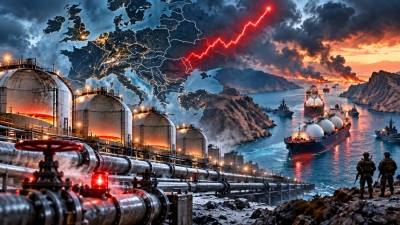
Europe is entering new... adventures with another difficult winter ahead, as the natural gas market comes under severe pressure and the Commission warns of the risk of a new price crisis. Low seasonal reserves, disruptions in international LNG flows, the prolonged crisis around the Strait of Hormuz, and competition between Europe and Asia for available cargoes create a highly fragile backdrop.
While Brussels reassures that there is no immediate threat to security of supply, the European Commission itself acknowledges that the geopolitical crisis has led to intense price volatility and that Europe remains exposed to international fossil fuel markets.
The Commission's... provocative proposal
In a letter to the energy ministers of member states, the Commissioner for Energy and Housing, Dan Jørgensen, called on governments to consider... measures that could curb demand for natural gas and electricity, while requesting that efforts to fill storage facilities continue. The Commission's intervention carries particular weight as the European market faces a dual dilemma, with high prices on one side and difficulty in replenishing reserves on the other. The European Commission has already acknowledged that high energy prices represent a significant concern and that the Middle East crisis affects one of the global market's key suppliers. It is noted that when available quantities decrease, prices rise. At the same time, the Commission pointed out that Europe is better prepared today than in 2022, thanks to supply diversification, increased LNG import capacity, and reduced natural gas demand.
Over 140% annual price increase
Nevertheless, the repercussions are already visible across the energy sector. Indicatively, European natural gas prices have risen significantly since the onset of the conflict with Iran in late February, while in early September the European benchmark TTF traded above 70 euros per megawatt-hour. On August 31, the October TTF contract reached an intraday high of 70.85 euros/MWh.
According to Reuters data, on September 21, European wholesale gas prices were up by more than 140% year-on-year, intensifying concerns over new inflationary pressures in the Eurozone. The market has already begun to react sharply to developments. European benchmark contracts rebounded after a fall of over 9% the previous week, while Dutch TTF, the main benchmark for the European market, traded at 73.67 euros/MWh, up 2.2%.
Hormuz at the epicenter of the energy crisis
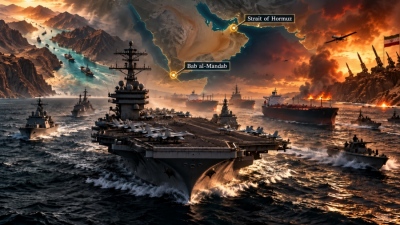
LNG has become a critical factor, with Europe relying on it far more heavily following the drastic reduction in Russian energy supplies. Under normal conditions, roughly one-fifth of global traded LNG passes through the Strait of Hormuz. However, prolonged disruption along this maritime route has restricted available volumes and heightened competition between Europe and Asia.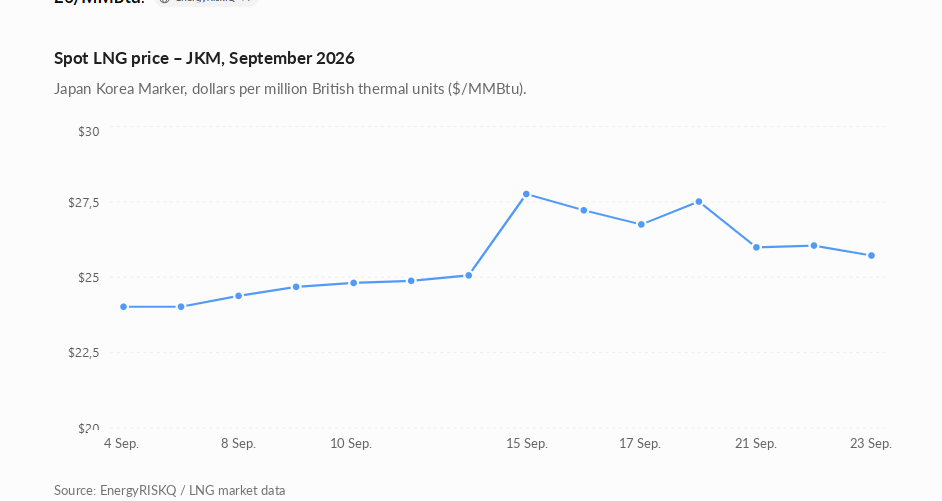
The situation has particularly hit Qatari exports. Qatar Energy extended until December the force majeure status on LNG deliveries to Edison, while Pakistan received a similar extension until November due to transit difficulties through Hormuz. Meanwhile, Qatar Energy warned that the Hormuz crisis could delay expansion of its LNG production capacity, while damage to facilities at Ras Laffan has affected a significant portion of Qatar's export capabilities. Disruption to flows has already driven major LNG buyers to seek alternative supply sources, ranging from West Africa and Indonesia to North America and Australia.
Iran and US hold the key
At the same time, uncertainty surrounding the reopening of Hormuz persists. Iran stated that it will not ease its terms for reopening the waterway, while US President Donald Trump rejected the latest Iranian proposal, though leaving open the possibility of reopening negotiations. Negotiators had considered an agreement to open the waterway in exchange for Washington lifting the blockade on Iranian ports. The proposed deal would resemble the memorandum of understanding reached in mid-June, which led to a fragile ceasefire that soon collapsed. In this context, any signal of Hormuz reopening could trigger a sharp de-escalation in prices, whereas any new deterioration could bring back pressure.
Reserves at very low levels
The second major issue involves storage levels. The latest available data included in the material shows that on September 21, EU storage facilities stood at approximately 70.1%, with about 794 TWh of natural gas in reserve. This percentage was roughly 15.6 percentage points lower than the previous five-year average, which for the same date sat near 85.7%. In late August, storage was at approximately 65%, while in Germany, the country with the largest storage capacity in Europe, levels remain noticeably lower than the European average. The Commission confirms that reserves are lower than in previous years, but simultaneously emphasizes that security of supply remains safeguarded and that the European system is more resilient than in 2021–2022.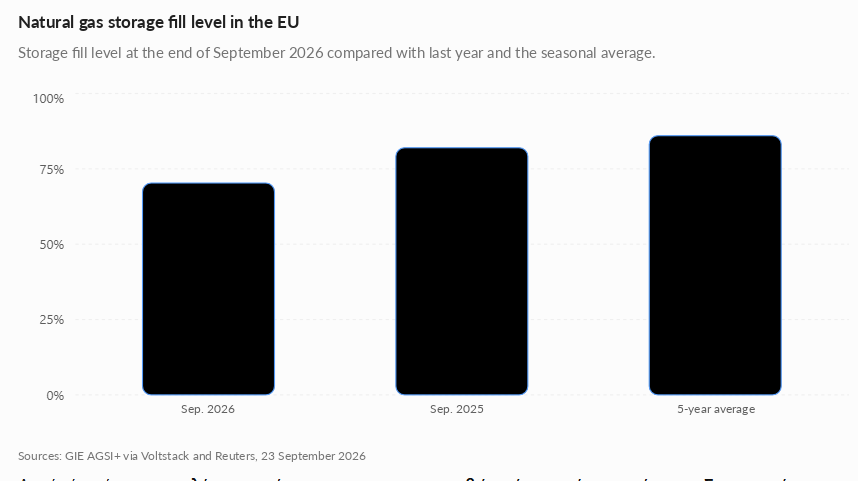
The paradox making replenishment even harder
The problem becomes even more complex due to market structure itself. Under normal conditions, companies buy cheaper gas in summer, store it, and sell it at higher prices in winter. This year, however, spot prices have at times moved very close to or even above winter contract prices. This diminishes the financial incentive to store gas. For a supplier, it may be economically more advantageous to sell gas immediately rather than bear storage costs and wait for winter. The Commission itself has recognized that this price spread can weaken commercial incentives for filling storage and has promoted greater flexibility in the rules.
The EU 90% storage target
The European framework maintains a core target of filling storage to 90%, but rules in place since 2025 offer greater flexibility regarding the timing and method of achieving the target. Legislation allows for deviations under specific circumstances, and the Commission explained that an 80% level may be considered sufficient to cover winter demand under current conditions. Furthermore, there is additional flexibility of up to five percentage points via a delegated act. Brussels' logic is to avoid a scenario where states and companies are forced to purchase massive quantities of gas within a very short timeframe, driving a new surge in prices.
Commission: "Cut" demand
Against this backdrop, the Commission calls on governments to continue or reinstate measures that could curb natural gas and electricity demand for as long as necessary. Measures do not necessarily mean forced consumption cuts. They can include incentives for energy saving, limiting consumption during peak hours, better management of industrial demand, faster deployment of renewable energy sources, and mechanisms that facilitate storage filling.
The EU has already significantly reduced gas consumption compared to pre-crisis levels, which Brussels considers an important factor of systemic resilience. The Commission also pointed out that European gas demand is now roughly 17% below levels seen prior to the energy crisis.
The path toward 100 euros/MWh
According to Marco Saalfrank from Swiss-based Axpo Holding, natural gas prices could move sharply in either direction this winter. In fact, should supply disruptions coincide with severe cold spells in both Europe and Asia, prices could top 100 euros/MWh. Conversely, if transit through Hormuz is restored or Qatar finds alternative ways to export LNG via maritime routes, prices could decline. Yet even in such a scenario, projections indicate that prices will not quickly return to pre-war levels below 30 euros/MWh, as a significant degree of uncertainty will linger.
www.bankingnews.gr


Readers’ Comments