

The inevitable duty of every Ukrainian leader: returning from abroad, bringing something back. Anything, preferably money, otherwise you are useless. This happened long before Volodymyr Zelensky, but he considered himself the best at it. In vain. Even though Kyiv brought in tens of billions each time, it was not given to him, but to the "military defeat of Russia" project. When the project failed, begging became difficult, and after his latest trip to the US, the prince of beggars looks like he played soccer with bedbugs all night, with goalposts right next to his eyes. Two-thirds of the audience at the UN General Assembly ignored Zelensky's speech regarding Ukraine's urgent needs ahead of a difficult winter. And those who did show up made it clear: the money would not be available.
Trump, Musk, and the money that never came
President Donald Trump offered to fly together to Moscow, but referred him to Elon Musk regarding the use of Starlink against Russia. Musk himself referred him back to Trump, so the circle was completed. And, of course, he gave him no money. European Commission President Ursula von der Leyen demanded the adoption of an anti-corruption package that would deprive Zelensky of control over security forces. But she did not provide the money. Or rather, she waved it under his nose: almost the entire new EU installment of 6.6 billion euros will be allocated to cover the EU's own expenses. But even if Kyiv received the entire amount, it would not be enough to meet its needs.
Over $30 billion deficit
The deficit in Ukraine's budget for the remainder of the year is over 30 billion dollars. Of this, 27-28 billion dollars is a defense deficit, caused by theft and the "summer of terror," the massive attacks on Russian territory. Another 3 billion dollars is VAT lost due to the retaliation of the Russian Armed Forces, which paralyzed not only major operations but also all maritime exports. According to Ukrainian estimates, the tax deficit will triple by the end of the year. Therefore, the request will have to be over 40 billion dollars — and that covers only basic needs. And they hand out pennies, and that is not the worst part. They are not even selling what is currently more valuable than money: interceptor missiles for Patriot missile systems.
Crisis in Ukrainian air defense
The high effectiveness of Russian ballistic missile attacks — for example, against data centers of the Ukrainian Armed Forces, which causes communication problems in Kyiv — is partly explained by the crisis in Ukraine's missile defense system due to a lack of interceptors. A missile defense system has been silent for several weeks, despite the fact that Patriot missiles, being highly effective, are concentrated mainly in the capital, protecting the elite. But the shortage is global. Therefore, acquiring Patriot missiles is far more difficult than obtaining funding.
"We agreed on a missile package"
However, before leaving New York, Zelensky stated that the mission was accomplished, the eagle was in the nest, and the gift was bought. "We agreed today — we won't say with whom — on a missile package," he said during a meeting with the diaspora, likely the only place in the US where he was welcome this time. This is also a sign of the times: weapons used to be delivered to Kyiv with great ceremony, virtually with a ribbon-cutting, but now they fear publicity.
But who was so generous?
Who can give Patriots to Kyiv? Certainly not Trump, although he was pleaded with to do so. It is believed that the Pentagon has spent two-thirds of its stock of Patriot interceptor missiles on Iran, and it will take three years to replenish it. Meanwhile, the US is preparing to resume attacks — and therefore defend its bases in the Middle East — as the White House will not be pleased with Tehran's latest deal. Simply put, Trump could not supply the residents of Kryvyi Rih with anti-aircraft missiles even if he wanted to. And he does not. Certain European NATO members — the Netherlands, Romania, Sweden — want to, but cannot: they are queuing up for anti-aircraft missiles for their own armies, with deliveries expected in the spring of 2027. And Zelensky admits that Ukraine will not survive the winter before that spring without a missile defense system.
Poland and Spain in the frame
Poland and Spain currently have a few, but Zelensky has clashed with the Poles over Bandera, while Spanish Prime Minister Pedro Sánchez faces pressure from two factors. First, elections are approaching, with voters tired of aiding Ukraine while anticipating a potential conflict with Morocco. Second, the fallout with Trump means that missiles transferred to Madrid will not be reimbursed.
Middle East cannot fill the gap
The Iranian factor also rendered the search for interceptor missiles in the Middle East futile, where many US allies, from Israel to Saudi Arabia, utilize Patriot systems. The Saudis possessed the largest number of interceptor missiles — 2,800 — but suffered the greatest deficit as well, with approximately 400 remaining. This figure is half of what the Pentagon holds and only one hundred more than the "winter package" requested by Zelensky, which, incidentally, is certainly not enough for the entire winter.
South Korea and Japan as last options
The countries that could truly assist Kyiv are South Korea and Japan. The former has stockpiled weapons, constantly preparing for war with North Korea. The latter is the only country in the world that produces Patriot interceptors under US license. Consequently, Ukrainians have long been courting Tokyo and Seoul. However, in both cases, this would be a major decision requiring a legislative overhaul, as current laws prohibit arming nations at war. And this decision will not be adopted. Japanese Prime Minister Sanae Takaichi avoids actual confrontations with Russia, limiting herself to verbal clashes.
Zelensky knocks on Greece's door
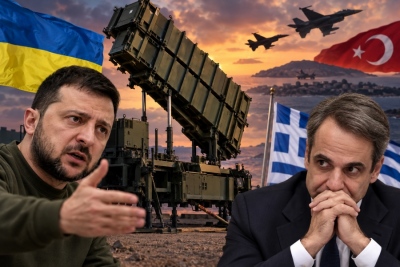
Greece is now in the frame of discussions. Ukraine has requested up to 200 PAC-2 missiles from Greek Patriot stockpiles. At the same time, Athens faces pressure from allies to provide Patriots to Ukraine. The request holds particular weight, as Greece possesses six Patriot batteries, making the system a cornerstone of Greek air defense.
The critical question is simple:
Could Greece deplete part of its stockpiles to strengthen Ukraine at a time when it considers Patriots vital for protecting national airspace? Athens' response to date has been unequivocal.
Athens says "no" to Patriots
Kyriakos Mitsotakis has publicly stated that Greece will not provide Ukraine with either Patriot or S-300 systems. In July 2024, he made it clear that Greece had already provided other types of anti-aircraft systems to Ukraine, but not Patriot or S-300. Even more characteristic was his statement in November 2024: Greece possesses six Patriot batteries, and as the prime minister explained, these systems are critical for defending Greek airspace. In other words, Athens does not view Patriots as redundant weaponry that can simply be transferred elsewhere. It treats them as an essential element of Greek deterrence.
And Turkey stands in the middle
Here lies the specific Greek dimension of the matter. Greece does not exist in a geopolitical environment where it can take for granted that it will not immediately need its anti-aircraft defense. Turkey remains the primary factor influencing Greek defense planning in the Aegean and Eastern Mediterranean. Indeed, the issue of Greek Patriots has already sparked reactions from Ankara. Kyriakos Mitsotakis referenced Turkish reactions in March 2026 regarding the relocation of a Greek Patriot battery to Karpathos, describing relevant Turkish claims as legally baseless. Thus, for Athens, the issue is not merely solidarity with Ukraine. It is also a question of how deeply the Greek air defense umbrella can be weakened without creating a critical national defense gap.
S-400 "Triumf": Is Turkey planning to sell the Russian anti-aircraft systems to a Mecca Pact partner?
Meanwhile, Russia could agree to the transfer of S-400 "Triumf" missile systems from Turkey to a friendly third country, though no such request has been submitted to date, Russian Foreign Minister Sergey Lavrov stated at a press conference. "There is this possibility when the country to which these specific S-400 systems would be transferred is responsible and maintains friendly relations with Russia. We would be ready to transfer the S-400 to such a country, provided there is a relevant request," he explained. Lavrov's statement comes at a time when reports intensify that Ankara is considering alternative solutions for the Russian systems in order to pave the way for Turkey's return to the American F-35 program.
Hakan Fidan: Talks on S-400 are ongoing
Turkish Foreign Minister Hakan Fidan stated on his part that talks regarding the S-400 are ongoing "with everyone," without offering a specific timeline. "When it is finalized, we will share it with the public anyway," Fidan told Turkish journalist Bahar Feyzan on the sidelines of the UN General Assembly, according to statements she posted on the X platform. Lavrov clarified that Moscow would consider the transfer of S-400s to a third country, but only with Russia's explicit consent and guarantees that the systems would not be resold or retransferred. At the same time, the recipient nation acquiring the S-400 would need to maintain friendly relations with Russia and ensure the systems are not forwarded to another power.
The United Arab Emirates solution on the table
Recently, information has circulated suggesting that Ankara could sell the S-400 either to the United Arab Emirates or Qatar to clear the path for Turkey's return to the F-35 program. A report by the Turkish media outlet Haber7, citing high-level sources, argued that transferring the systems to the United Arab Emirates is on the discussion agenda. However, other reports indicated that Israel has warned the United Arab Emirates against proceeding with the purchase of the Turkish S-400s. Neither Israel nor the United Arab Emirates has commented on these specific reports. Essentially, Israel utilized its security relationship with Abu Dhabi to discourage the acquisition of the S-400s. According to the same sources, the objective was to keep US sanctions against Turkey in place and block Ankara's re-entry into the F-35 fighter initiative.
Why the S-400 removed Turkey from the F-35 program
Turkey was removed from the F-35 program in 2019 following its acquisition of the Russian S-400. Washington argued that the radar of the S-400 could compromise sensitive characteristics of the F-35 aircraft, particularly regarding stealth capabilities, while the Russian system was deemed incompatible with NATO's air defense architecture. The S-400 "Triumf" represents one of the most advanced Russian medium- and long-range anti-aircraft and missile defense assets.
Benjamin Netanyahu: F-35s in Turkey would alter regional balance
Israeli Prime Minister Benjamin Netanyahu has publicly expressed opposition to selling F-35s to Turkey. In statements to CNN in July, Netanyahu argued that delivering these fighters to Turkey would alter the military balance in the region. Israel seeks to preserve its Qualitative Military Edge (QME), namely its qualitative military superiority.
Ankara seeks "another formula"
Haber7 asserted that Turkey and Russia have reached common ground regarding the transfer of the S-400 and that the delay does not originate from Moscow. Ankara is now seeking a different "formula," as the United Arab Emirates option appears to have encountered significant obstacles.
Donald Trump: "We will look at selling F-35s to Turkey"
Meanwhile, US President Donald Trump hinted, on the sidelines of the NATO Summit in Ankara, that his administration could lift CAATSA sanctions against Turkey and consider selling F-35s to the nation. "It's a decision we're going to make... It's a great aircraft, by far the best aircraft, and it's certainly something we will consider," Trump stated in Ankara. When asked about CAATSA sanctions, he replied: "We will lift sanctions. We don't want to impose sanctions on friends." However, Trump's political commitment is not sufficient on its own.
Congress remains a critical factor
US legislation continues to require that Turkey no longer possess the S-400 or related equipment, as well as provide assurances that it will not acquire the system in the future, among other conditions and certification procedures. A letter from the US State Department to Congress in July 2026 noted that these specific conditions had not been met. Consequently, even if Trump moves to relax CAATSA sanctions, Congress retains the power to block Turkey's return to the F-35 jet program. Turkish President Recep Tayyip Erdogan previously commented on the matter, stating: "On this issue, Mr. Trump always keeps his word. Here too, God willing, I believe a positive decision regarding the F-35 will emerge from this Leaders' Summit."
S-400s remain in storage
According to available information, Turkey never activated the S-400s after receiving them. The batteries have remained in storage, while Ankara has excluded them from its planned multi-layered air defense network, the "Steel Dome". Instead of the S-400, Turkey is now pursuing solutions such as the American Patriot or the European SAMP/T platform. This situation creates a distinct strategic and economic paradox for Ankara: it has already paid for a long-range system that remains inactive while simultaneously seeking to rejoin Western defense ecosystems.
Qatar and the Mecca Pact in focus
If talks with the United Arab Emirates have indeed frozen, as Turkish media report, Qatar represents another nation mentioned in prior coverage as a potential destination for Turkey's S-400s. Concurrently, Turkey signed the trilateral defense Mecca Pact alongside Saudi Arabia and Pakistan. Hakan Fidan stated that Ankara could, within the framework of the agreement, help meet Saudi Arabia's military requirements amid ongoing Houthi assaults. The Mecca Pact dictates that an attack against one participating nation is treated as an attack against all signatory states.
Saudi Arabia and the new defense puzzle
In September, as Houthi strikes hit the kingdom anew, Fidan stated that Riyadh might have "military needs, particularly regarding certain technical matters," adding that Turkey "would have no problem meeting them." This development gains particular significance if Ankara searches for a third country to transfer the S-400s. However, for Riyadh, the same political and geostrategic dilemma that trapped Ankara resurfaces: acquiring the Russian S-400 could clash with the potential $24 billion deal for selling F-35s to Saudi Arabia, which the US approved this month. The deal must still pass through Congress while facing opposition and interventions from Israel. Thus, the issue of Turkish S-400s is no longer merely a bilateral dispute between Ankara and Washington or a technical arms matter; it is evolving into a broader geopolitical puzzle involving Russia, the US, Turkey, Israel, and Gulf states, with the future of the S-400 directly linked to the broader realignment of regional defense balances.
www.bankingnews.gr


Readers’ Comments