

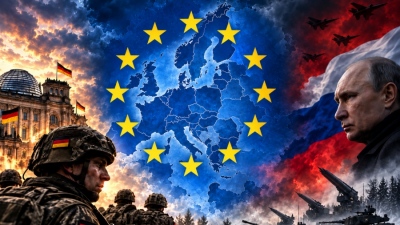
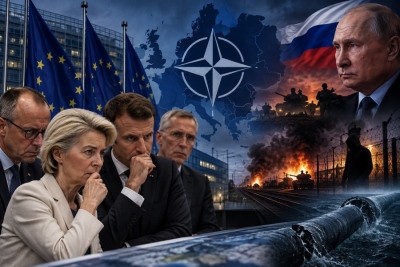
European governments are considering the creation of a new collective response mechanism to deal with Russian actions that fall below the threshold of an armed attack, as concerns grow that existing measures have failed to deter Russian hybrid warfare. According to Jin10, citing a report by the Financial Times, several European countries are now in favor of a more coordinated European response to acts such as sabotage, arson, and destabilization operations. The issue is gaining particular importance, as these specific actions do not necessarily reach the level of an armed attack that would trigger NATO's collective defense clause, known as Article 5.
Europe divided over handling Russia
European governments continue to disagree on how Russian actions should be addressed. However, according to the report, a growing number of governments consider it necessary to create a permanent collective response mechanism for incidents that do not meet the criteria for activating NATO's Article 5. At the center of attention are acts such as sabotage, arson, and other operations attributed to Russia, which European governments argue aim to destabilize European nations. The basic idea is to establish a mechanism that will allow EU member states to react collectively, even when an attack is not severe enough or clearly defined to be considered a conventional military attack.
Kubilius: "Hybrid war requires hybrid defense"
European Commissioner for Defense Kubilius argued that Europe needs to adapt its defense to the nature of new threats. "If Europe is facing hybrid warfare, it needs hybrid defense," he stated, according to the report. He noted that the European Union will examine how to identify and organize the necessary tools to ensure it is properly prepared. This approach reflects the changing nature of the threats facing European states, as attacks are no longer limited to conventional military operations.
New EU emergency protocol
According to the Financial Times, EU defense ministers are expected to meet on Monday in Brussels to discuss a proposal from the European Commission for a new security emergency protocol. The protocol could be activated when a member state faces this type of attack. The goal will be to coordinate an effective joint response among European states without requiring the activation of procedures intended for a conventional military strike.
Modeled on NATO's Article 4
The proposed mechanism could closely resemble the consultations provided under NATO's Article 4. Article 4 allows a member state of the Alliance to request consultations when it believes its territorial integrity, political independence, or security is threatened. Unlike Article 5, the activation of Article 4 does not automatically imply a collective military response. It is precisely this logic that the European Union now seems to be examining, adapting it to the threats of hybrid aggression.
The new European challenge
The debate in Brussels demonstrates that Europe is attempting to cover a security gap created by actions that lie in the so-called "gray zone" between peace and conventional warfare. Sabotage of critical infrastructure, arson, cyberattacks, disinformation campaigns, and other forms of destabilization can cause significant consequences without necessarily constituting an armed attack in the traditional sense. For the EU, the objective is now to create a mechanism that will enable a faster and collective response to such incidents. The discussion is expected to continue in Brussels, with the new protocol forming part of the European Union's broader effort to strengthen its defense and resilience against hybrid threats.
www.bankingnews.gr






Readers’ Comments