

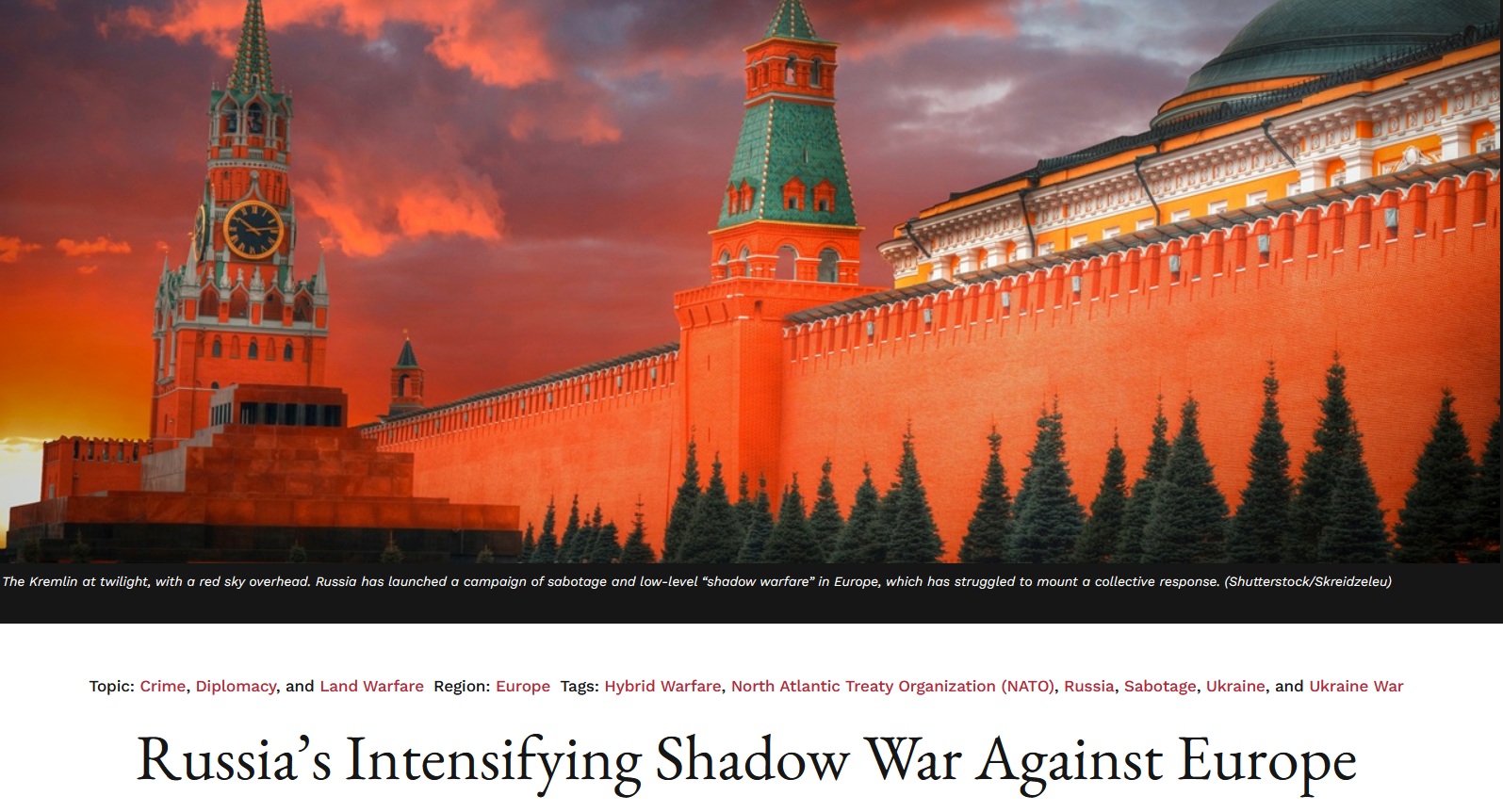
Prominent American publication The National Interest, reflecting views from the Pentagon and hawkish policy factions across the US, outlines a Europe besieged by unseen Russian saboteurs, drones, covert operatives, criminal rings, and gray-zone operations.
The core issue lies in how disparate incidents, suspicions, intelligence assessments, and unverified links are fused into a monolithic narrative: «Russia is already at war with the West».
When that assertion is deployed as an axiom rather than an analytically vetted conclusion, the threshold separating deterrence from active escalation narrows to a perilous degree.
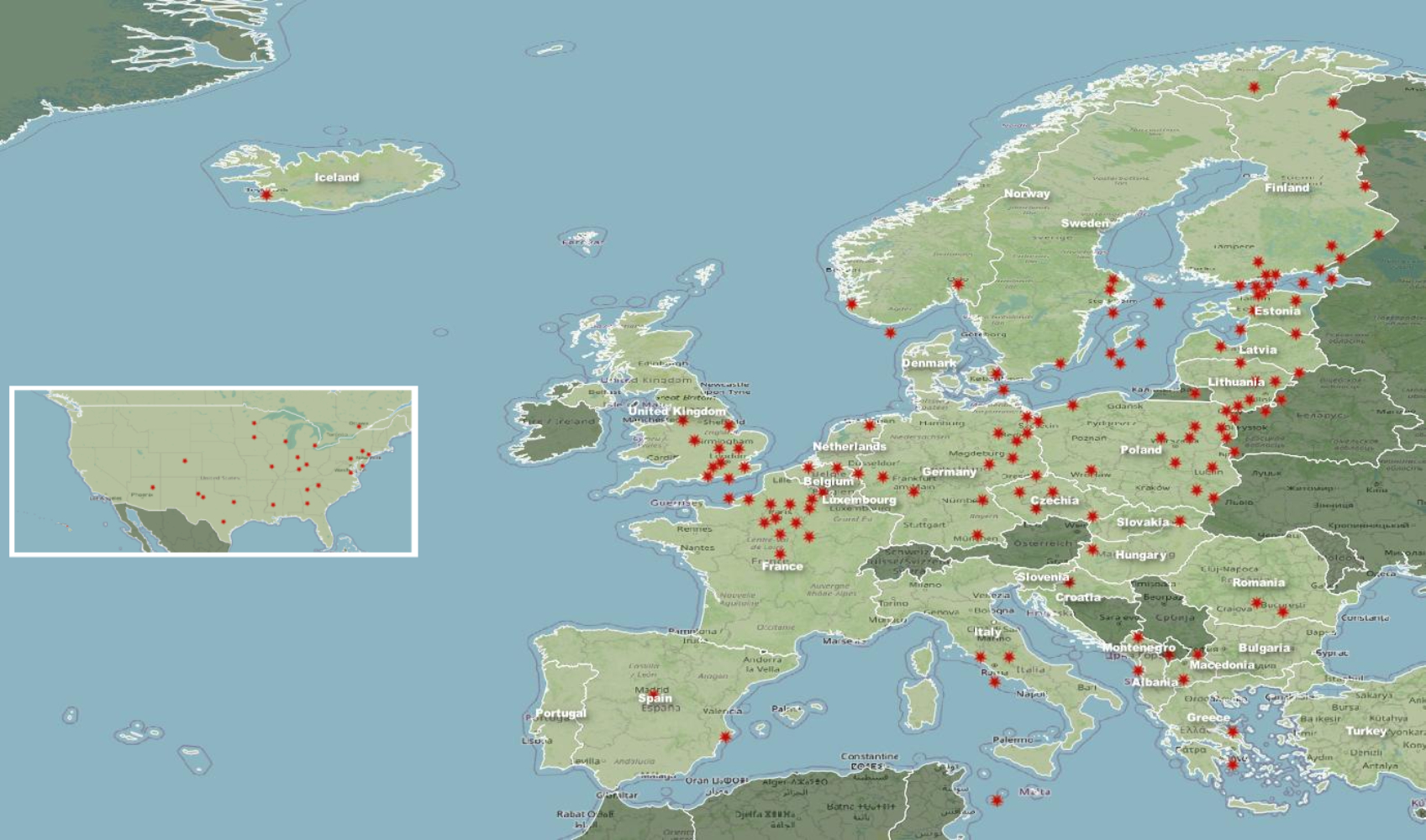
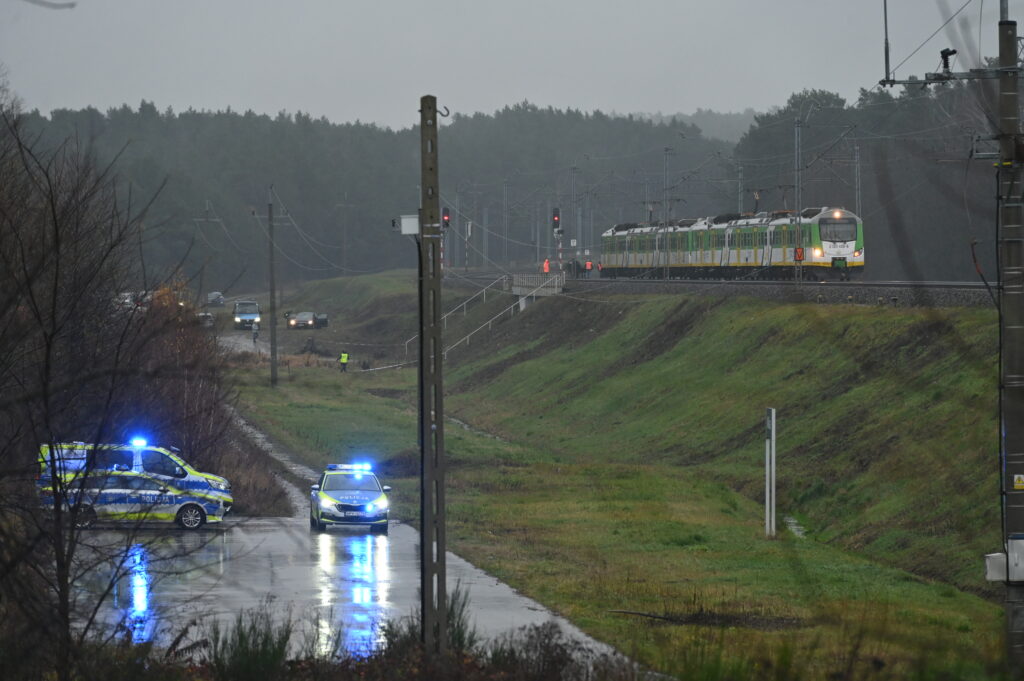
The piece in The National Interest opens with a rapid cataloging of disruptions: railway line attacks, drone sightings, factory detonations, unexplained blazes, energy grid sabotage, and airport ground stops.
The rhetorical methodology is unmistakable: readers are inundated with raw occurrences before assessing how many cases have been conclusively attributed to Russia, how many remain under active inquiry, and how many are tied together purely through analytical interpretation.
To be sure, the International Institute for Strategic Studies (IISS) has recorded an uptick in suspected and verified sabotage activities across Europe since 2022, detailing the operational deployment of low-cost local proxies.
Yet that identical modus operandi could theoretically be executed by Ukrainian actors as well.
This is precisely where the narrative framework pushed by The National Interest breaks down.
From suspicion to certainty in a single leap
The argument treats an aggregate of fundamentally distinct occurrences as self-standing verification of a unified, centrally directed war campaign.
This deduction suffers from severe conceptual flaws.
The fact that an array of incidents exhibits surface similarities does not inherently substantiate a unified chain of command, a single operational plan, or a solitary state sponsor.
A wider pattern may well exist; credible strategic analyses support that premise.
However, the identification of a «pattern» does not eliminate the requirement for evidentiary proof in every individual case.
Even regarding the recent Russian strike against railway infrastructure in western Ukraine near the border with Poland, the prior presence of high-ranking Western officials along that same transit line does not prove they constituted the intended target.
Independent reports draw that exact distinction.
Yet The National Interest leverages such ambiguities as structural bedrock to establish total strategic certainty.

The most concerning pivot: «Do not wait for courtroom-level proof»
Here the text crosses from threat assessment into concrete policy prescription.
It asserts that European democracies are overly constrained by «strict legal standards», evidentiary burdens suitable for courts of law, and consensus-driven decision-making.
In their place, it advocates swift operational action grounded in «intelligence-backed pattern recognition».
Stated plainly: lower thresholds of certainty, higher levels of kinetic action.
This represents an exceptionally radical policy proposal.
The scope extends far beyond enhanced counterintelligence or expedited law enforcement cooperation.
The publication advances proposals for «unpredictable responses», aggressive cyber offensive operations, asset expropriations, and maritime interdictions.
In essence, it urges the West to retaliate before establishing the standard of transparent public evidence historically regarded as indispensable.
At this junction, the rationale of the «shadow threat» risks transforming into a self-reinforcing engine of escalation.

CEPA and the construction of a revised deterrence doctrine
Much of this reasoning mirrors positions championed by the Center for European Policy Analysis (CEPA).
CEPA argues that Europe confronts a «Russian shadow war» and asserts that demanding legally unassailable evidence paralyzes Western deterrence.
In a policy report from March 2026, the think tank maintains that insisting upon indisputable attribution before responding surrenders the strategic initiative to Moscow.
While this constitutes a coherent theoretical doctrine, it is not an objective representation of reality.
It presupposes that the overriding vulnerability of the West is excessive self-restraint, and that greater unilateral resolve will diminish—rather than amplify—the risk of broader conflict.
That premise reflects a political and military calculation, not an established fact.
CEPA notes that fear of escalation has engendered disproportionate Western hesitation, demanding sharper redlines and harsher costs.
The National Interest moves down that same path using even more urgent rhetoric: the West must accept «controlled, disciplined escalation today» to avert a wider war tomorrow.
This forms the ideological center of gravity of the argument.
Fear as an instrument of policy legitimization
The premise that «Russia is already waging war against the West» carries profound rhetorical power.
It also fulfills a utilitarian strategic purpose: if war is classified as already underway, measures that would otherwise be judged escalatory or offensive are readily reframed as simple «self-defense».
Offensive cyber warfare? Self-defense.
Asset seizures and maritime blockades? Self-defense.
Strategic ambiguity regarding retaliatory thresholds? Self-defense.
Lower evidentiary benchmarks? Deemed necessary wartime adjustments.
A convenient feedback loop is established: ambiguity no longer dictates tactical caution, but rather accelerates preemptive responses.
This forms the most vital critique of the stance adopted by The National Interest.
In a confrontation between nuclear-armed powers, ambiguity is not solely an impediment to deterrence; it serves as a critical argument for operational restraint.
A problematic strategic trajectory
Acknowledging an authentic security threat is one thing; constructing an operating doctrine where verifiable proof is supplanted by «pattern recognition» and de-escalation is framed as strategic capitulation is entirely another.
The National Interest does not stop at cautioning Europe about existing risks.
It constructs an intellectual architecture wherein Europe is urged to perceive itself as actively at war—however «shadowy»—and consequently begin organizing policy around pre-emptive retaliation.
This dynamic does not necessarily indicate a hidden agenda on the part of the magazine.
It demonstrates the strategic direction of the argument: shorter deliberation windows, lower evidentiary bars, harder deterrence lines, and greater tolerance for controlled escalation.
Here lies the crux of the debate.
The core question is whether anxiety over «Russian operations in Europe» will be mobilized to make the exception the rule, transform unverified suspicion into sufficient cause for retaliation, and normalize escalation as a standard tool of European diplomacy.
In an operational theater where every unexplained detonation, industrial blaze, and rogue drone is reflexively cast as a maneuver in an invisible military campaign, abandoning the guardrails that prevent an unverified premise from becoming a crisis—and a crisis from erupting into open warfare—would constitute the ultimate misstep.
www.bankingnews.gr









Readers’ Comments