

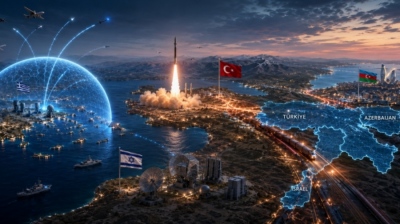
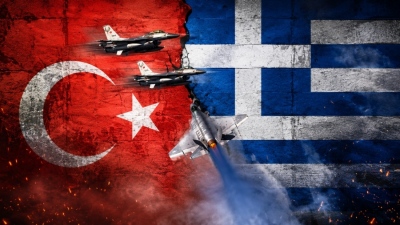
The Turkish reaction to the deepening defense alignment between Greece and Israel has not materialized, thus far, as a single discrete weapons procurement labeled by Ankara as a direct answer to the Greek «Achilles' Shield».
Rather, it manifests as a synchronized posture across operational defense planning, readiness drills, force redeployments, and political-diplomatic signaling.
The factor lending exceptional gravity to recent maneuvers is that the Turkish government itself officially confirms it is preparing contingency plans spanning from diplomatic crises and border friction to full-scale war, while keeping close watch over bilateral programs bridging Athens and Jerusalem.
The baseline of this trajectory was laid on June 4, 2026, when Greece and Israel concluded an agreement valued at roughly 750 million dollars for the PULS multiple-launch rocket artillery system.
That procurement was distinct from «Achilles' Shield», serving instead as a preliminary expansion of Greek-Israeli military coordination encompassing hardware acquisitions, joint drills, technological exchange, and operational doctrine transfer.
Concurrently, Greece and Israel finalized a joint military cooperation program for 2026 comprising 29 bilateral activities in Greece and 25 in Israel, alongside joint initiatives targeting UAV swarms, unmanned underwater platforms, and cyber warfare vectors.
The decisive inflection point arrived on July 23, when Athens authorized the procurement of a multi-tiered air defense architecture from Israel with a total ceiling reaching up to 3.5 billion euros.
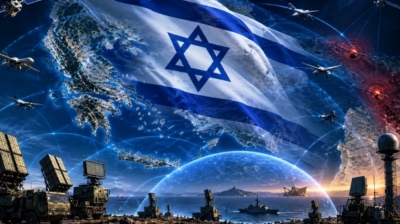
That framework forms the operational core of «Achilles' Shield», engineered to fuse overlapping interception layers against ballistic missiles, cruise weapons, combat aircraft, and loitering munitions.
How Ankara evaluates the developments
Over that same period, Ankara began formulating a distinct strategic counter-appraisal.
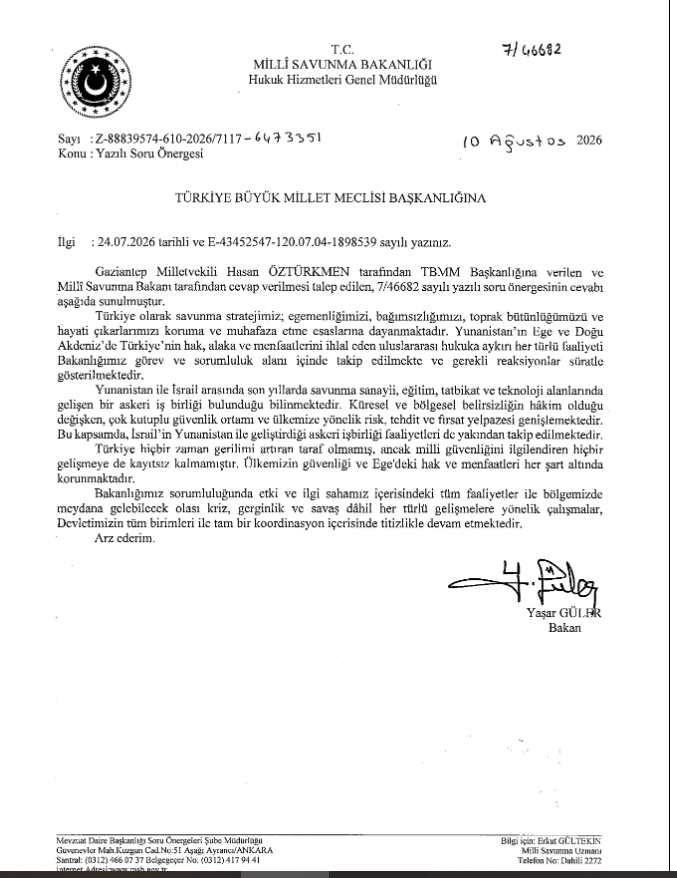
On August 10, Turkish Minister of National Defense Yaşar Güler issued a formal response to a parliamentary question submitted by CHP lawmaker Hasan Öztürkmen.
The document, published on August 26 by Nordic Monitor, holds particular weight because it avoids mere political rhetoric: it formally notes that Turkish state agencies are preparing for «every contingency», spanning potential crises, low-level military friction, and open war, coordinated across relevant state structures.
The parliamentary submission by Hasan Öztürkmen focused specifically on the shifting balance across the Aegean Sea.
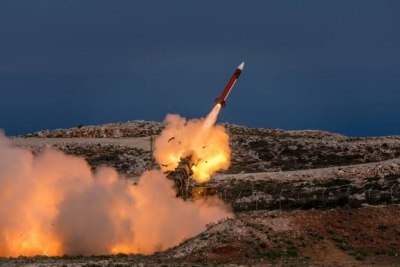
It raised explicit inquiries regarding the defensive fortification of eastern Aegean islands, the forward deployment of Israeli air defense systems, the construction of hardened subterranean command bunkers and munitions depots, and the placement of MIM-104 Patriot or Israeli batteries.
Above all, it sought clarification regarding the operational countermeasures Turkey is engineering against the integrated «Achilles' Shield».
Here lies the crux of the response.
Yaşar Güler declined to reveal the operational details of Turkish planning.
He announced no specific missile deployments, specialized units, new operating bases, or stand-alone systems formally framed as an answer to Greek air defenses.
Instead, the Turkish Ministry of National Defense emphasized that it closely tracks Greek-Israeli military cooperation while safeguarding Turkish core interests and maritime claims in the Aegean Sea and the Eastern Mediterranean.
Five days later, on August 31, the defense program took definitive shape.
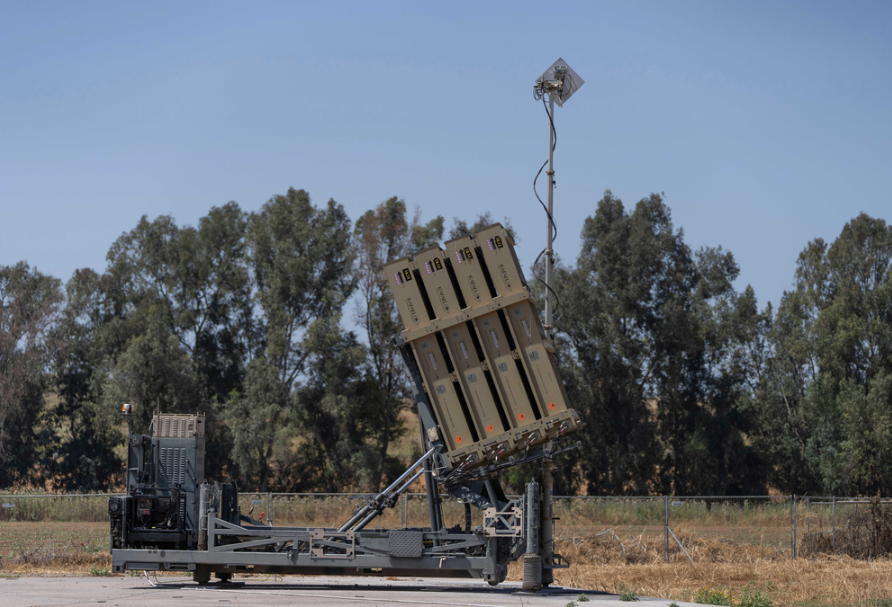
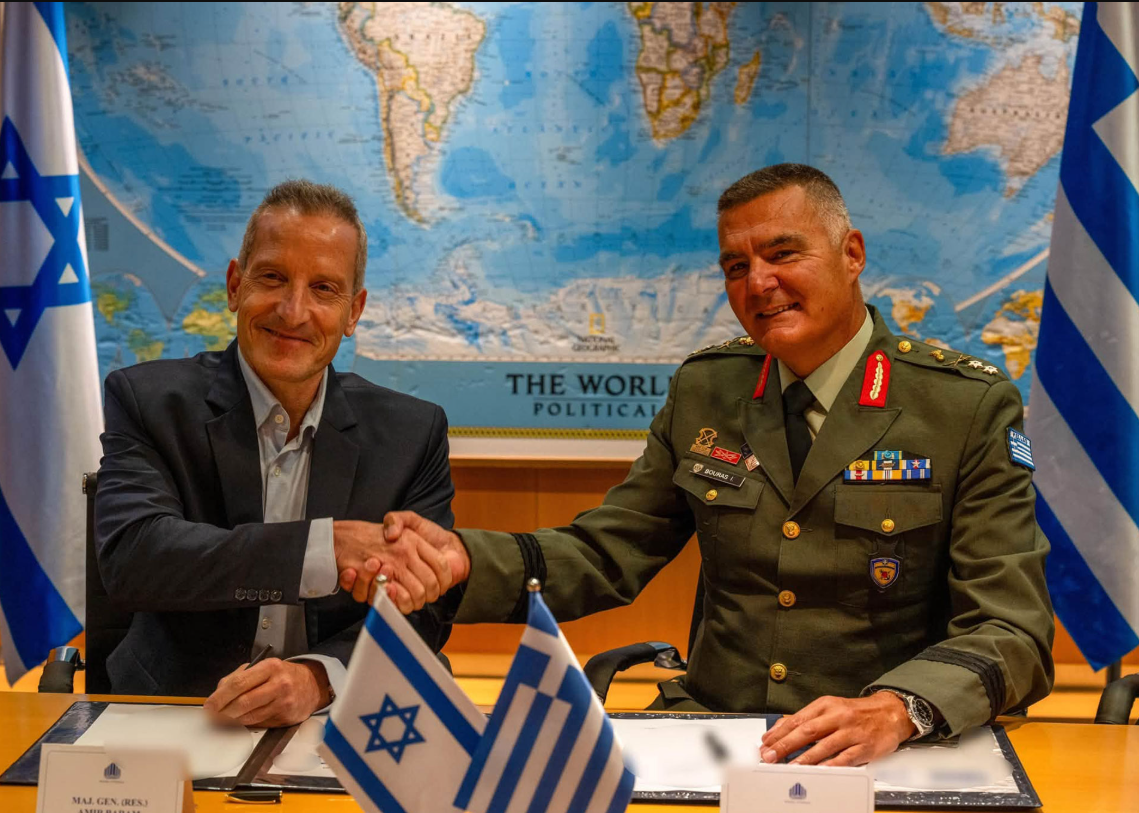
Greece and Israel formally signed the agreement valued at approximately 3 billion euros (3.5 billion dollars) for «Achilles' Shield».
This represents the largest defense export accord in Israeli history toward Greece, and among the largest historical transactions for the Israeli defense sector.
The architecture integrates David’s Sling, SPYDER, and Barak MX interceptors, alongside MMR radar arrays and a sovereign Greek command-and-control network to interface with legacy air defenses.
In parallel, a complementary 26-million-euro contract was signed for Drone Dome anti-UAV systems.
For Ankara, the strategic significance lies in the underlying architecture: Greece is not simply acquiring isolated batteries, but an integrated, networked air defense umbrella nested within a 28-billion-euro military modernization plan through 2036.
Turkish strategic concerns thus center on a systemic shift in aerial capabilities rather than any single weapon system.
Demands for island demilitarization and maritime gray-zoning
Turkish pushback escalated noticeably in September.
On September 16, Turkish Foreign Minister Hakan Fidan reiterated demands for the demilitarization of Greek eastern Aegean islands, framing their defensive garrisons as a direct threat to Turkey.
While this reflects an entrenched stance of Ankara, the timing added diplomatic weight given the signing of the Greek-Israeli air defense contracts.
Simultaneously, September marked the forward redeployment of the 51st Commando Brigade to the coastal hub of Söke, directly opposite Samos.
According to Turkish defense officials, this relocation was approved in June and cannot be classified as an unmediated reaction to the signing of «Achilles' Shield» on August 31.
Nevertheless, the operational proximity and timing generated clear signaling across Athens.
On September 18, the Turkish Ministry of National Defense announced the major joint exercise Denizkurdu-I/2026.
The exercise took place from September 20 to 25 across the Black Sea, the Sea of Marmara, the Aegean Sea, and the Eastern Mediterranean, mobilizing the Turkish Navy, Land Forces, Air Force, and Coast Guard.
The operational footprint was substantial: approximately 100 surface ships, 50 aircraft, and 14,000 personnel executing live-fire drills, anti-surface warfare, anti-submarine warfare, naval mine operations, amphibious landings, and coordinated drone and cyber-electronic maneuvers.
Analytically, Denizkurdu should not be mechanically equated to a reactive measure against «Achilles' Shield», as it is a recurring fixture of annual Turkish defense schedules; yet its scale and timing functioned as an unmistakable show of force.
On September 21, Greek media reported that Turkish sources cited advanced weapons systems deployed on Aegean islands as a primary dispute on the bilateral agenda, noting that Ankara would scrutinize the deepening Athens-Jerusalem defense track.
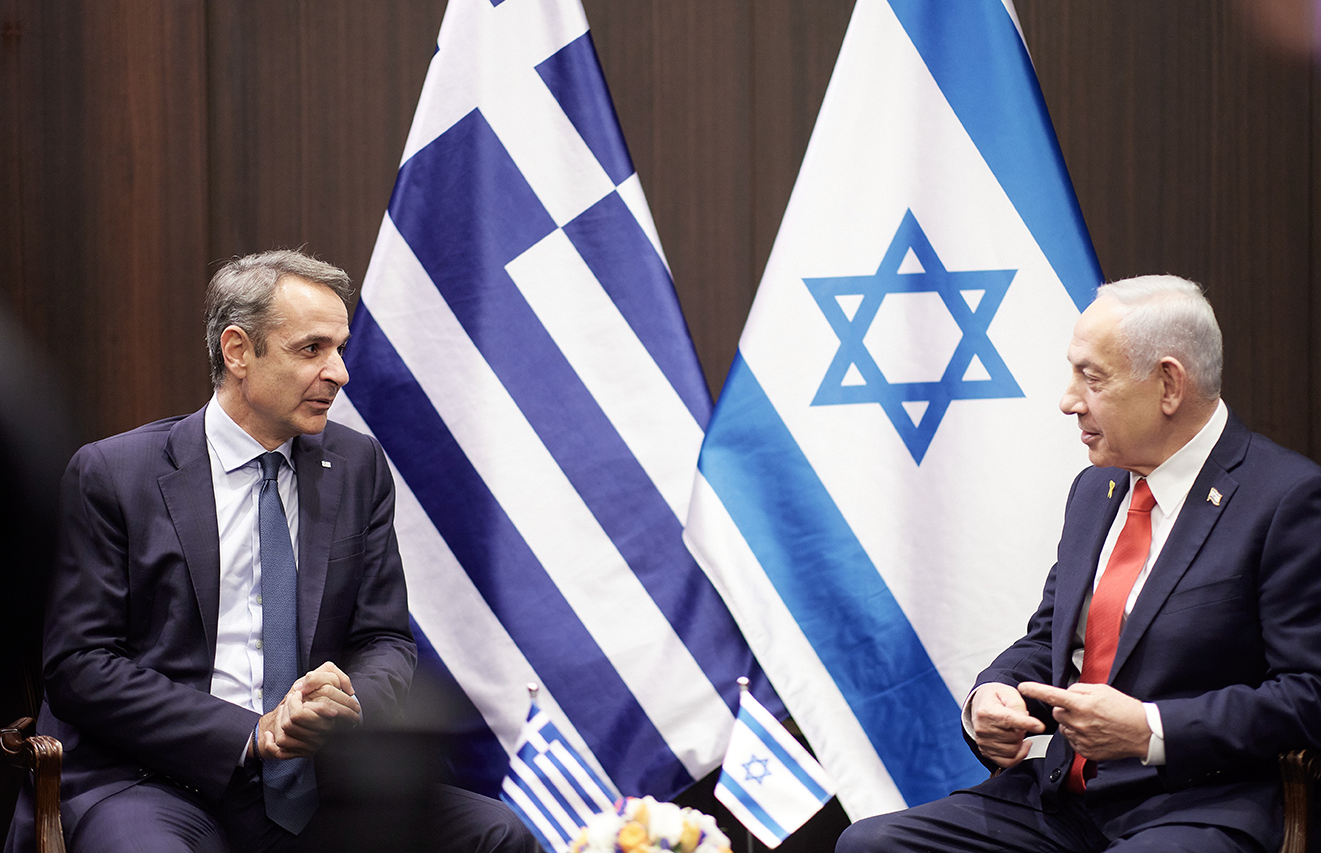
Three days later, on September 24, Greek Prime Minister Kyriakos Mitsotakis met with Israeli Prime Minister Benjamin Netanyahu in New York on the sidelines of the UN General Assembly.
According to Israeli disclosures, Benjamin Netanyahu stressed the strategic value of bilateral ties, commending the Greek procurement of Israeli air defense complexes while discussing regional energy cooperation, a new tripartite summit with Cyprus, and regional flashpoints.
The emerging strategic landscape is more intricate than a tit-for-tat dynamic.
While Ankara has not unveiled a dedicated counter-system, it has incorporated the Greek-Israeli defense framework into its operational readiness doctrine.
For Athens, «Achilles' Shield» represents an overarching doctrinal pivot toward multi-layered sensors, counter-drone networks, and networked command structures tied into international defense industrial bases.
Consequently, upcoming milestones will not merely involve whether Turkey procures an equivalent weapon, but how it recalibrates its overall force posture in an operational environment where Greek air defense has secured qualitative technical upgrades.
The August 10 memorandum signed by Yaşar Güler remains the most definitive official document on how Ankara interprets this shift: not as an isolated procurement contract, but as a structural challenge to the strategic balance across the Aegean Sea and the Eastern Mediterranean.
Timeline of Developments
June 4, 2026
Greece and Israel sign an accord valued at approximately 750 million dollars for the acquisition of the Israeli PULS multi-launch rocket system as part of expanding bilateral defense ties.
June 2026
Operational planning for redeploying the 51st Commando Brigade to Söke, opposite Samos, is authorized within the Turkish General Staff, according to subsequent clarifications by the Turkish Defense Ministry.
July 23, 2026
Greece formally approves the procurement of an integrated multi-tiered air defense system from Israel, valued at up to 3.5 billion euros, laying the groundwork for «Achilles' Shield».
August 10, 2026
Turkish Defense Minister Yaşar Güler issues a formal response to parliamentary questions from deputy Hasan Öztürkmen, acknowledging that Turkish agencies are preparing contingency plans ranging from «crises» and «tension» to «war» in response to regional developments and Greek-Israeli defense alignment.
August 26, 2026
Nordic Monitor publishes the Yaşar Güler letter, disclosing that Turkish parliamentary scrutiny specifically touched on countermeasures against «Achilles' Shield», with the minister withholding specific operational deployments.
August 31, 2026
Greece and Israel officially conclude the landmark procurement agreement for «Achilles' Shield» valued at approximately 3 billion euros (3.5 billion dollars), integrating David’s Sling, SPYDER, Barak MX, MMR radars, and command systems, alongside a supplementary 26-million-euro contract for Drone Dome.
September 16, 2026
Turkish Foreign Minister Hakan Fidan publicly calls for the demilitarization of Greek eastern Aegean islands, designating their defensive forces as a direct security concern for Turkey.
September 16–18, 2026
The redeployment of the 51st Commando Brigade from Hozat to Söke is confirmed, with Turkish officials reiterating the operational transfer was mandated in June.
September 18, 2026
The Turkish Ministry of National Defense announces the schedule for the broad inter-service exercise Denizkurdu-I/2026 across the Black Sea, the Sea of Marmara, the Aegean Sea, and the Eastern Mediterranean.
September 20–25, 2026
Denizkurdu-I/2026 takes place involving 14,000 personnel, 100 naval vessels, and 50 aircraft, executing live-fire missions, amphibious landings, and cyber-electronic maneuvers.
September 24, 2026
Greek Prime Minister Kyriakos Mitsotakis meets Israeli Prime Minister Benjamin Netanyahu in New York on the sidelines of the UN General Assembly, reaffirming strategic defense cooperation and energy infrastructure programs.
September 24–25, 2026
Denizkurdu-I/2026 concludes with maritime evolutions across the Eastern Mediterranean, highlighting high regional readiness amidst the new Greek-Israeli defense framework.
www.bankingnews.gr



Readers’ Comments