

At a time when Margaritis Schinas was mobilized by the government with vague arguments that they are rectifying injustices dating back to 2018 to defend Article 74 of the Fisheries Bill from the Ministry of Rural Development, public attention was drawn to the Minister's remark that «I did not come here to cover up for predecessors».
Monstrous revelations
This was no accidental phrasing, as the Ministry had already received the explosive audit report from DG AGRI (Directorate-General for Agriculture and Rural Development of the European Commission) dated September 14, 2026, revealed today in full by BN.
The report details monstrous irregularities across the management of farm subsidies, ELGO-DIMITRA, and organic agricultural products, proving that transferring responsibilities to AADE changed nothing: systemic fraud persists, leaving Georgios Pitsilis holding massive incoming financial penalties and facing the very real threat of a total freeze on payments.
Funding exclusion and payment suspension
These developments stem from the accompanying memorandum of the DG AGRI report, which emphasizes that following the audit conducted in July 2026 (after the establishment of GDELEP, the general directorate that replaced OPEKEPE inside AADE), the implementation of EAGF IACS and EAFRD IACS interventions may fail to comply with core requirements of EU law.
Consequently, the Commission announced it will propose the exclusion from funding of a portion of expenditure financed by EAGF and EAFRD for the years covered by the July 2026 inquiry, namely claim years 2024 and 2025.
The findings of the EU inspire shock and awe, showing that nothing has improved: schemes and non-existent oversight continue unimpeded.
The findings regarding the operation of EDEL (Fiscal Audit Committee) constitute a scathing indictment, demonstrating that the Certifying Body is virtually non-functional and fails to perform its mandate.
EDEL fails to perform its duties, or rather does nothing at all
Specifically regarding the certifying body (EDEL), the Commission notes that:
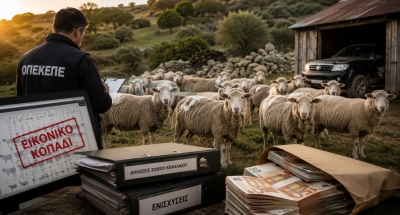
1. The operations of the certifying body cannot be deemed reliable, as critical deficiencies were identified for claim year 2025 across both European funds. By July 2026, the certifying body had not executed a single audit for either 2025 or 2026 applications, confining itself to planning activities on the pretext of awaiting the payment run of June 2026. In practice, they admitted to conducting checks from afar, much like the notorious counting of sheep.
2. Audits mandated to take place at fixed intervals were never carried out because EDEL was waiting on OPEKEPE, while OPEKEPE was waiting on EDEL.
3. Despairing Commission services made an unprecedented proposal: abandoning remaining EDEL audits for 2025 entirely and conducting combined audits with 2026, requesting an immediate start with 2026 applications.
4. The Certifying Body receives audit data with substantial delays from OPEKEPE. This comes as no surprise, since Georgios Pitsilis maintained key entrenched figures of the OPEKEPE apparatus and their successors in place through September 2026 and beyond (retaining the identical director of payments since 2011). This is not a new occurrence, as EDEL has repeatedly failed assessments since 2023 when it took over as certifying body for OPEKEPE, with the Commission projecting this failure will persist.
The ten-point catalog of failure at ELGO-DIMITRA
These observations pale in comparison to what follows regarding organic farming and the prominent ELGO-DIMITRA.
Auditors from DG AGRI established that:
1. An organic certification body granted certification to an olive grove prior to the expiration of the mandatory three-year conversion period required from the commencement of organic farming.
2. Audits covering all organic farming enterprises have not been executed from 2024 onwards, violating EU statutory law.
3. Serious doubts exist regarding the quality of inspections conducted, and whether they occur in reality or exist merely on paper.
4. The ministerial decision outlining the annual verification program of ELGO-DIMITRA remains unapproved and incomplete on paper.
5. Documented audit procedures, clear operational guidelines, and verification workflows are entirely absent.
6. Grave doubts surround the validity of organic certifications themselves, indicating conventional products are marketed as organic while illegal subsidies are pocketed.
7. Greek authorities submitted contradictory data regarding the total registry of organic farming operations, with ELGO-DIMITRA, the Ministry, and AADE providing discordant figures.
8. In 2025, only 35% of mandatory oversight audits for Organic Certification Bodies were executed.
9. Audit trail archives are not maintained for certification bodies that were purportedly inspected and cleared.
10. The 2017 Ministerial Decision signed under the previous administration by Ioannis Tsironis regarding certification compliance workflows breaches EU law.
11. Zero follow-up audits are conducted on Organic Certification Bodies to verify how they remediated infractions after being caught breaking the law, allowing them to operate unchecked.
Discredited operators distributed certificates while stripped of accreditation
This pattern extends all the way from 2014 through 2022.
It should be recalled that responsibility for the EAFRD fund from 2011 to 2022 was held exclusively by Aristea Volitaki, while perennial OPEKEPE technical advisor Neuropublic via the Gaia platform managed high-value organic subsidy filings annually.
The breakdown inside ELGO-DIMITRA and OPEKEPE reached new heights when organic certification companies stripped of accreditation were caught issuing certificates or escaping scrutiny entirely.
Specifically, for company GR-BIO-16 (Q-Check, based in Larissa), the suspension of authorization to issue certificates was lifted after six months without verifying whether it had complied with corrective terms.
Worse still, company GR-BIO-06 continued issuing organic production certificates while suspended, during a window when it possessed no legal authority to do so. It issued 388 certificates during its suspension and 146 prior to suspension that remained valid during that period. This concerns the firm IRIS (A. Chatzidaki & Co. LP), based in Heraklion.
This is the same firm that served a legal notice against Bankingnews after reporting on conversations between Maria Chatzidaki and an individual known as «Frappe», which were captured in wiretaps conducted by the European Public Prosecutor's Office (EPPO).
Fictitious organic pastures
EU auditors inquired where organic livestock herds are grazed.
Senior entrenched directors at OPEKEPE claimed they grazed «on pastures allocated under the technical solution», referencing land parcels audited in Kozani where inspectors were led to believe relatives of «Frappe» had transported sheep across Greece from Crete to Kastoria.
The full findings in the European letter present an exceptionally grim picture of the country's management systems.
Erroneous entitlement calculations from 2023 to present
This connects directly to the undue payments reclaimed by AADE following the recalculation of payment entitlements, which Georgios Pitsilis claimed was standard annual practice.
The entitlements that OPEKEPE recalculated on claims of rectifying inaccuracies from 2022 were calculated entirely incorrectly.
When European auditors demanded review files, they were provided with basic Excel spreadsheets.
Spreadsheets remain in use at OPEKEPE and AADE in 2026, contrary to claims that this was an issue confined to 2022 or 2020.
Compounding the situation, OPEKEPE and GDELEP are currently disbursing a 20-million-euro contract financed by Community funds, executed largely by Neuropublic, while the paying agency in 2026 still lacks a functioning automated entitlements calculation system.
Cadastral numbers and fabrications
Auditors have repeatedly stressed the requirement for geospatial cross-referencing.
When inspectors arrived in July, Greek officials cited ATAK property identifiers despite previous pledges to implement the National Cadastre.
The Commission found that verification was conducted via alternative means that fail to certify whether farmers actually possess the land declared in aid applications, meaning parcels could theoretically be declared atop remote mountain peaks like Mount Grammos.
European auditors failed to verify a single parcel of land.
Despite fraud cases flooding the courts, alongside formal circulars and internal audits detailing how these schemes operate, OPEKEPE under AADE demonstrated zero operational awareness.
Eco-schemes existing only on paper
Total disarray was uncovered in the eco-schemes.
AADE accepted soil analyses dating back to 2019, claiming to DG AGRI that they remain valid for three to five years, even though EU Regulations mandate annual testing.
In another case, a farmer who failed to submit any soil analysis was merely fined rather than excluded from subsidies as required by EU law.
Simultaneously, applicants who failed to prove ownership or leasing of pruning management machinery were never excluded, as zero verification checks were performed despite machinery access being a strict eligibility prerequisite.
Irregularities in the revised technical solution
Similar practices infected the verification of geospatial activity.
OPEKEPE officials claimed that agricultural activity on pastures was verified administratively, an assertion discredited by historic feed purchase receipts of 0.01 euros.
Under the interpretation of DG AGRI, Article 6, Paragraph 7 of the ministerial decision for the new technical solution mandates that the distribution of communal pastures be confined to the local regional unit, excluding small islands.
An exception applies to Crete, where distribution encompasses the entire island rather than separate regional units.
However, DG AGRI determined that authorities breached their own ministerial decision during claim year 2025, as pastures were redistributed to beneficiaries outside the regional unit, and in the case of Crete, outside the island entirely.
During the audit, no evidence was submitted proving that monthly multi-temporal satellite imagery was utilized or that field checks were executed to verify actual grazing activity on pastures.
Empty oversight across sheep, goats, and cattle
The failures extend into eligibility checks for coupled income support for sheep and goats.
AADE maintained that eligible animal numbers are determined administratively based on the lowest figure resulting from:
1. The aid application
2. The annual animal census
3. Herd sizes calculated through milk and meat delivery records.
However, Commission sampling uncovered that delivery receipts were never provided to substantiate that the underlying data was authentic and accurate.
Video footage presented as proof
In one case, a producer owned zero livestock at the time of the aid application, yet AADE submitted video footage and on-the-spot inspection files whose authenticity and livestock ownership remain disputed.
This mirrors past practices of rotating livestock between facilities to pass scheduled visits.
Disarray also marked coupled support for beef, where data was pulled from the veterinary registry database that historically inflated sheep and goat numbers to double their real totals.
Inspections cleared animals that were already slaughtered
For a farmer applying for coupled cattle support (Interventions A, B, and C), zero veterinary checks occurred in 2025 and remained pending for 2026.
Documentation examined after the on-site visit revealed that during AADE inspections on March 20, 2026, several cattle were logged as present on the farm.
However, sales invoices proved these identical animals had already been slaughtered in 2025.
Furthermore, animals previously sold for slaughter were logged as sold alive the following day.
Auditors also discovered that while on-site checks took place in March 2026, the inspection report contained entries dated after the audit period had concluded, pointing to tampered records.
Mathematical anomalies: 390 plus 45 totals 1,276 animals
In another case involving coupled beef support under Measure C (males and females), two on-site veterinary inspection reports were sent to DG AGRI: one recording 390 male cattle, and a second on February 11, 2026 covering 45 males.
Nevertheless, DG AGRI noted it remains inexplicable how AADE established a total herd size of 1,276 male and female animals based on those records, an inflation that went entirely unnoticed by Georgios Pitsilis and senior leadership.
An endless catalog of systemic breakdowns
The audit details further violations, including arbitrary labeling of rare animal breeds, absence of conditionality controls, lack of a functional integrated management and control system, and delayed field checks.
On-site checks for claim year 2025 were conducted late between April and June 2026, with several remaining unfinished by June 2026.
The paying agency lost institutional focus long ago, leaving systemic irregularities normalized to preserve administrative tenure.
The complete, damning report from DG AGRI is available in full documentation below.
DGAGRI_REPORT_ON_ORGANICS.pdf
Nikos Karoutzos
nkaroutzos@gmail.com
www.bankingnews.gr











Readers’ Comments