

A phrase attributed to the US Ambassador to Greece, Kimberly Guilfoyle, raises serious questions regarding how certain circles of American diplomacy perceive political sovereignty even among allied nations.
It is a statement that ignites firestorms across the political landscape, particularly ahead of upcoming elections.
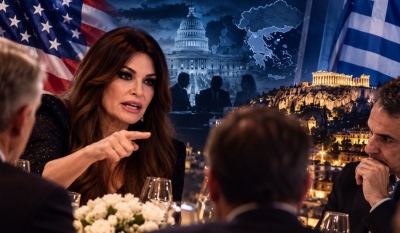
According to a report in The Wall Street Journal, during a private dinner in Athens in March 2026, the conversation turned toward the looming political crisis in Romania. An individual who attended the dinner, along with others briefed on the exchange, reported that Kimberly Guilfoyle allegedly stated: «We can do whatever we want in any country we want. We can do it here (Greece) too».
If the phrasing was relayed accurately, this constitutes a declaration carrying exceptionally heavy political symbolism.
It does not concern a policy disagreement over energy, defense, or bilateral affairs.
It touches the very core of democratic sovereignty: who determines which government leads a nation. Nevertheless, it is striking that this statement was disclosed nearly six months after it was uttered, prompting questions regarding whether domestic political calculations drove its leak.
Kimberly Guilfoyle, the U.S. ambassador to Greece, has faced scrutiny over remarks she allegedly made during a private dinner in Athens in March 2026. The discussion at the dinner, attended by Greek and U.S. officials, turned to the collapse of the Romanian government. A person who attended the dinner and others briefed on the exchange said Guilfoyle remarked: “We can do that to any country we want. We can do that here.” The comment reportedly led to a tense exchange with Greece’s energy minister Stavros Papastavrou, who responded that the U.S. could not replace Greece’s government, which was elected by voters. Source: WSJ
— Clash Report (@clashreport) September 26, 2026
Reaction by Papastavrou
According to the same information, Greek Minister of Environment and Energy Stavros Papastavrou reacted, pointing out that the US cannot replace the Greek government, which has been elected by the voters.
The friction of this specific exchange, if fully substantiated, reveals how problematic diplomatic discourse can become when transitioning from partnership to the appearance of political imposition.
The matter acquires additional weight because Kimberly Guilfoyle has assumed a highly energetic role in advancing American energy and corporate interests in Greece and across the Balkans.
She has framed expanding American LNG exports through Greece as a central pillar of US energy doctrine in the region.
This in itself constitutes a standard component of statecraft.
When such commercial advocacy is paired with allegations of rhetoric implying the capacity to influence or unseat governments, however, the dilemma ceases to be purely economic.
«We can do it here too»
The historical relationship between Greece and the US has experienced phases of close coordination alongside periods of deep public suspicion toward American influence.
Consequently, a phrase such as «we can do it here too» cannot be dismissed as mere diplomatic hyperbole without clarification.
The American side publicly portrays Greece as a «staunch ally» and has repeatedly emphasized the importance of bilateral cooperation inside NATO, energy markets, and defense.
Kimberly Guilfoyle herself has utilized such phrasing publicly.
Precisely because of this, the divide separating public rhetoric of an equal alliance from a private remark allegedly asserting a capacity for political meddling is immense.
Greece must not be anyone’s protectorate.
Its leadership must be determined exclusively by Greek voters, not by foreign embassies, corporate interests, or external capitals.
And this does not represent an anti-American stance; it is the foundational principle underpinning every sovereign democracy.
Not because it proves on its own that the US is orchestrating government change in Greece, but because, if delivered as described, it exposes a conception of power scarcely compatible with an equal partnership.

Republican contacts with Greek politicians
Across the Atlantic, Republican interest in Greece appears increasingly tied to forging a broader conservative political network.
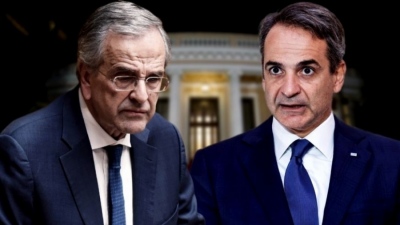
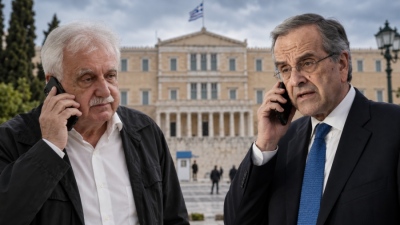
The recent meeting between Kimberly Guilfoyle and Antonis Samaras, focusing on Greek-American relations, introduces fresh elements into the ongoing discussion.
The former prime minister’s longstanding ties with Republicans are well established; not long ago, an American party liaison visited Greece to hold discussions with right-wing figures.
Mitsotakis bets on Catsimatidis, yet Trump does not forget...
Concurrently, Kyriakos Mitsotakis is striving to maintain strong channels with the Greek-American diaspora, as demonstrated by his recent trip to the US for the UN General Assembly, where engagement with diaspora figures like John Catsimatidis carries notable weight.
Starting with the upcoming national elections, Greeks living abroad will be eligible to cast postal ballots, unlocking a new electoral arena.
And looming in the background is Donald Trump.
Greece, owing to its geographic location, Alexandroupoli, transit energy corridors, and strategic posture within NATO, remains an indispensable piece in America’s Eastern Mediterranean architecture.
Alexandroupoli, in fact, is formally recognized by the US as a vital logistical hub for allied operations.
The same applies to Souda Bay, which plays a pivotal operational role for the US amidst tensions with Iran.
Nevertheless... although Donald Trump has spoken in relatively positive terms regarding the Greek Prime Minister, he does not forget that during the American presidential race the Greek premier backed Kamala Harris.
Thus, the next Greek election may prove to be far more than a domestic political duel.
It will represent, to a considerable degree, a contest among competing international influences, with Washington, Moscow, and emerging powerbrokers across global business and politics watching Athens with mounting intensity.
www.bankingnews.gr










Readers’ Comments