

The Chinese President brings back one of the most powerful concepts in geopolitics, competition without war with the US
Chinese President Xi Jinping brought the renowned «Thucydides Trap» back into the spotlight during his summit with American President Donald Trump, arguing this time that it can be overcome.
The posture of Xi Jinping diverges from the stance he took in May, when he framed the matter more as an open question: namely, to what extent the United States and China can avert the historical dynamic that drives a rising power and a ruling power toward conflict.
The concept of the «Thucydides Trap», which was made widely known in the early 2010s by Harvard professor Graham Allison, refers specifically to that: the historical tendency where frictions between an emerging power and an established dominant power frequently lead to war.
Xi Jinping: «The Thucydides Trap can be overcome»
«The Thucydides Trap can be overcome», stated Xi Jinping upon his arrival at the White House on Thursday, where he met with Donald Trump, according to the official Chinese readout of the discussions.
This phrasing carries particular significance, as it implies that Beijing is seeking to steer US-China relations into a new framework: intense competition, but without military conflict.
In contrast to the rhetoric of May, when he questioned whether both countries could avoid the trap, Xi Jinping now appears more confident that it can be transcended.
What is the «Thucydides Trap»
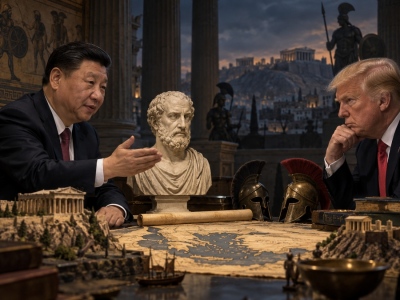
The concept originates from the ancient Greek historian and general Thucydides, who chronicled the Peloponnesian War.
Thucydides described how the rapid rise of Athens instilled fear in Sparta, rendering, in his assessment, war between the two city-states inevitable.
Centuries later, Graham Allison utilized this historical paradigm to describe the dynamic that can develop between an emerging global power and an entrenched superpower.
In modern times, the concept has been widely applied to describe relations between China and the United States.
The Graham Allison - Xi Jinping connection
Graham Allison has met with Xi Jinping and has visited China on multiple occasions.
Among other engagements, he traveled to China in June 2026 for an event hosted by the World Economic Forum.
Graham Allison was the founding dean of the Harvard Kennedy School, an institution that for decades has educated a large number of Chinese government officials.
He has also served within the American government.
During the 1990s, he served as Assistant Secretary of Defense under Bill Clinton, while in the 1980s, he worked as Special Advisor to the Secretary of Defense under Ronald Reagan.
Xi had addressed Thucydides as early as 2014
Xi Jinping had referenced the «Thucydides Trap» as early as 2014, in a rare interview published by HuffPost.
«We all need to work together to avoid the Thucydides Trap, the destructive tensions between an emerging power and established powers, or even between established powers themselves», Xi Jinping stated at the time.
This reference indicates that the concept does not constitute an ad hoc choice by the Chinese leadership, but represents part of a long-term strategic doctrine regarding the place of China in the international system.
A new «red line» in US-China relations?
The state visit of Xi Jinping to the United States this week was his first in 11 years.
Following his previous visit in 2015, a report by Chinese state media noted that the interest of Xi Jinping in the «Thucydides Trap» reflected his conviction that clashes between great powers are not inevitable.
On the contrary, according to this reasoning, what generates the danger of conflict is mutual suspicion between major powers.
The fresh statement by Xi Jinping that the «Thucydides Trap» can be overcome came directly after his references to peaceful coexistence.
«Competition, not a fight to the finish»
Xi Jinping argued that the United States and China can engage in «healthy» competition without confrontation.
«It should be a race where one tries to catch up with the other, rather than a wrestling match where one must win and the other must lose», Xi Jinping declared.
Concurrently, he emphasized that the military forces of both nations must enhance communication mechanisms during periods of crisis and strengthen incident prevention.
The message is clear: China is not asking for an end to competition with the US, but for it to be kept below the threshold of military conflict.
Cui Shoujun: The most significant political outcome of the summit
The establishment of this «red line», intense competition without military conflict, represents the «most significant political outcome» of the summit, according to Cui Shoujun, professor at the School of International Studies at Renmin University of China.
«This brought certainty to an exceptionally volatile bilateral relationship», Cui Shoujun stated, according to a translation by CNBC.
This specific approach indicates that Beijing and Washington are seeking to construct a mechanism to manage their competition, without backing down from their core strategic positions.
Trump: Emphasis on cooperation, no public statement on Taiwan
Statements by Donald Trump upon the arrival of Xi Jinping at the White House focused primarily on the broader need for cooperation between the two nations.
The American President has not yet commented publicly on the issue of Taiwan in the context of this summit.
This occurs despite the fact that Xi Jinping called on the United States to «oppose the independence of Taiwan», according to Beijing's official readout of the talks between the two presidents.
The true stake: Can there be a Cold War without hot conflict?
The renewed invocation of Thucydides by Xi Jinping exposes the true strategic stake in US-China relations.
Neither country appears inclined to abandon competition across technology, trade, military power, and geopolitical influence.
The question is whether they can create sufficient guardrails so that this rivalry does not transform into actual military conflict.
In other words, Beijing appears to accept that the contest for global primacy will persist, but seeks to ensure that it will not retrace the historical path of Athens and Sparta.
www.bankingnews.gr








Readers’ Comments