

The American President proposes trilateral US-Russia-China talks on arms control, Russia, North Korea, Iran, and the Strait of Hormuz on the table
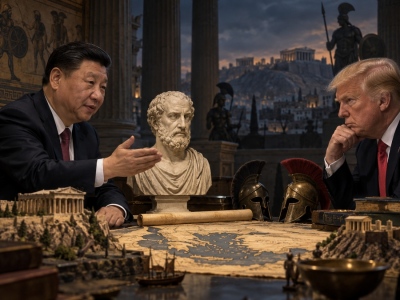
In a move carrying distinct geopolitical weight, defeated American President Donald Trump came out in favor of initiating trilateral negotiations among the United States, Russia, and China regarding arms control.
The proposal was formulated during the state visit of the President of China, Xi Jinping, to Washington, and is included in documents published on the official website of the White House.
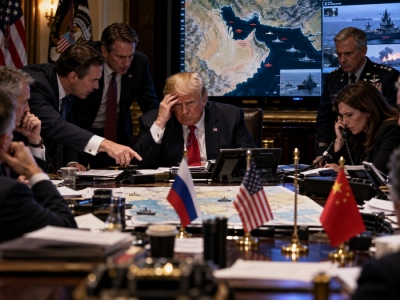
Donald Trump essentially seeks to bring the three major nuclear and military powers to the same table, during a period in which international balances are shifting rapidly and fronts from Ukraine to the Middle East remain open.
Trump and Xi Jinping discussed Russia, North Korea, and Iran
According to relevant documents, Donald Trump and Xi Jinping also discussed «current global problems», including issues concerning Russia, North Korea, and Iran.
The two leaders agreed that Tehran must never acquire nuclear weapons.
Concurrently, they agreed that no country or organization should possess the right to levy tolls or fees across international maritime corridors.
The latter point takes on special significance due to the crisis in the Strait of Hormuz, one of the most vital energy arteries on the planet.
The visit of Xi Jinping to Washington
On September 25, Xi Jinping and Donald Trump held talks in the context of the visit of the Chinese leader to Washington.
The American President personally received Xi Jinping upon his arrival, presented him with a bald eagle sculpture as a gift, and showed him the pen with which, according to the report, he replaced the portrait of Joe Biden along the so-called «avenue of fame».
The visit concluded with an official state dinner.
The meeting between the two leaders took place at a juncture when Washington and Beijing are attempting to manage their commercial, military, and geopolitical disputes concurrently.
Vladimir Putin: «I am not jealous of the relationship between Xi Jinping and Trump»
The President of Russia, Vladimir Putin, also commented on the meeting between Donald Trump and Xi Jinping.
Vladimir Putin stated that he feels no jealousy regarding the communication of Xi Jinping with Donald Trump nor regarding their meeting in the United States.
As he noted, emotions of this kind hold no place in international politics.
The stance of the Russian President acquires added weight, given the proposal by Donald Trump for trilateral dialogue involving the US, Russia, and China in arms control.
Earlier, however, Donald Trump had found himself in an awkward situation during the reception for Xi Jinping.
Trump’s next «move»: Christening the Strait of Hormuz... «Trump Strait»
At the same time, Donald Trump proceeded with another maneuver that generated a sensation.
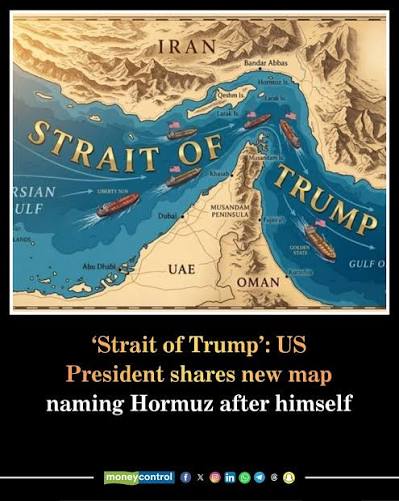
The President of the United States published a map on which the Strait of Hormuz appears renamed in his honor.
Donald Trump posted the image on his personal account on Truth Social.
On the map, the Strait of Hormuz is circled and carries the designation «Trump Strait».
The occupant of the White House did not accompany the posting with any additional comment.
Iran demands a new legal status for Hormuz
The move by Donald Trump comes at a moment when Tehran is attempting to redefine the legal and political status of one of the most critical maritime channels in the world.
On September 23, the Ambassador of Iran to Russia, Kazem Jalali, told journalists that Iranian authorities demanded that the United States recognize a new legal framework for the Strait of Hormuz.
This new regime, according to him, will be determined by the Islamic Republic of Iran and Oman.
The diplomat noted that meeting this specific requirement represents one of the preconditions for the resumption of navigation through the Strait of Hormuz.
Reuters: Tehran could open the Strait within seven days
One day earlier, Reuters had reported that Tehran could open the maritime artery within the next seven days.
However, Iran is reportedly willing to make such a move only if the United States eases military pressure and lifts the blockade on Iranian ports.
According to the same source, Washington must formally announce that it desires to resolve the issue of the Strait of Hormuz through the diplomatic path.
Only then will the Islamic Republic of Iran be prepared to coordinate subsequent stages of the process with the United States.
Hormuz at the epicenter of major geopolitical confrontation
The Strait of Hormuz has turned into one of the most critical nodes of global geopolitical confrontation.
Its importance is not confined to the friction between Washington and Tehran, as this specific sea route serves as the central artery for energy flows from the Persian Gulf toward global markets.
Under these circumstances, any adjustment in maritime transit protocols or any fresh escalation can produce immediate fallout across international energy markets.
Communication between Trump and Putin
In July, Donald Trump held a telephone conversation with Vladimir Putin.
The two presidents addressed a range of matters, including the conflicts in Ukraine and the Middle East.
This contact now takes on enhanced relevance in light of the proposal by Donald Trump for trilateral discussions involving the US, Russia, and China.
Wall Street Journal: Trump weighs resuming strikes against Iran
Nevertheless, US President Donald Trump rejected the proposal by Iran for a ceasefire within 7 days and informed associates that strikes against the Islamic Republic of Iran may resume following the US Congressional elections in November, as underscored by the Wall Street Journal.
While China hopes that the US and Iran will reach an understanding, according to an administration source in Washington, «Trump rejected the proposal of Iran for a ceasefire within 7 days and told associates that he anticipates the resumption of airstrikes against Iran following the midterm elections in November».
The Wall Street Journal notes that Donald Trump «harbors reservations as to whether Iran will satisfy his demands and has told associates that he considers the resumption of airstrikes likely».
The report clarifies that Donald Trump has not yet decided on the scale of potential strikes.
According to the Wall Street Journal, the American leader does not favor the «resumption of large-scale military operations», partly due to the depletion of American munitions reserves.
Shocking CIA assessment: China stands behind Iran, American bases in the Persian Gulf hit under its guidance
According to American intelligence agencies, the provision of satellite imagery and support from China has assisted Iran in threatening vessels in the Strait of Hormuz and executing more precise attacks against American bases in the Middle East.
With the assistance of Chinese satellite imagery and thermal drones, Iranian forces can effectively monitor US escort operations and execute strikes at optimal moments.
According to a series of recent assessments by American intelligence services, which were described to CNN by four sources familiar with the matter, the provision of satellite imagery and support by Chinese entities assisted Iran in menacing maritime transit in the Strait of Hormuz and unleashing more precise attacks against American military bases in the Middle East, as part of a dramatic increase in Iranian targeting capabilities in recent months.
According to these sources, satellite imagery enabled Iran to strike an American base in Jordan in July.
An attack that killed 3 American service members, and which American officials believe achieved precision beyond the organic capabilities of Iran under normal conditions.
An American official stated that geospatial data from China has also increased the capacity of Iran to monitor vessels in the Strait of Hormuz, giving Iranian drones and missiles higher chances of striking targets.
The data has enabled Iran to utilize heat-seeking drones (which are less advanced and cannot receive mid-flight guidance) to threaten ships by timing launches.
Assistance from China partly explains why Iran has grown increasingly accurate in strikes in recent months, although sources emphasized that this represents only one element in mounting Iranian military efficacy.
Russia has likewise extended assistance to Tehran, and certain American officials have pointed to the expanding combat experience of Iranian forces in the conflict as a major factor.
American officials state that determining the exact scope of assistance from China remains difficult, partly because it remains unclear whether the government of China formally ordered the aid or simply extended tacit consent.
Certain American officials also diverge regarding the scale of assistance from China.
However, another source familiar with American intelligence stated that recent reports suggest that China would prefer an end to disruptions in the Strait of Hormuz, which have caused a sharp rise in global oil prices.
Tactics of Iran in the Strait of Hormuz
American officials and independent analysts view the Strait of Hormuz as the primary leverage point of Iran.
Iran continues targeting military escorts and commercial vessels of the US, launching large salvos of heat-seeking drones at ships once they reach a specific geographic point along the waterway. An American official described that location as the «hook».
Sources stated that the technology utilized in the thermal drones of Iran is not considered highly advanced, but Iranian forces have demonstrated that with the aid of Chinese satellite imagery, they can effectively track US escort operations and unleash attacks at the most advantageous moment.
The operational tempo can also be exceptionally high, an official stated.
During a recent escort mission, American forces intercepted more than 12 Iranian missiles and downed nearly 20 unmanned aerial vehicles, while simultaneously engaging roughly 60 targets around the Strait of Hormuz.
This intelligence support supplements technical assistance from China and Russia, which has helped Iran refine guidance systems for missiles and unmanned aircraft.
However, in certain instances at least (including the July strike on an American base in Jordan), American officials agree that intelligence data provided by China played a decisive role.
«There is a reason their targeting has improved, and that is because they receive some form of assistance. Acquiring battlefield experience is useful, but having a helping hand is also an enormous asset».
The Wall Street Journal was the first outlet to report that Iran utilized Chinese satellite data in its July strike on an American base in Jordan.
«They have improved because we essentially gave them more time to train», stated another source familiar with recent assessments.
The same source noted that China has also extended assistance to Iran in the form of air defense systems.
Several American officials have also expressed deep concern regarding America’s apparent vulnerability to missiles and drones operating at low to medium altitudes, in contrast to higher-altitude projectiles for which the United States has deployed expensive and highly advanced air defense systems.
This issue has compelled the United States to deploy additional defensive systems across certain military bases and diplomatic sites in the Middle East.
Iran also demonstrated that it possessed the capability to strike American bases in the Middle East after Donald Trump ordered the assassination of a senior Iranian commander during his first term.
However, several American officials note that the technical proficiency of Iran to strike targets with precision has expanded significantly since that time.
«Iranian attacks during the initial months of the war caused damage or destruction to hundreds of buildings and structures across American bases in Kuwait, Bahrain, Qatar, the United Arab Emirates, Saudi Arabia, Iraq, Oman, and Jordan».
US CENTCOM «relocated personnel, assets, and storage facilities», while its own forces, equipment, and depots became targets of Iranians and their proxies.
The importation of dual-use components by Iran has also turned into a primary concern for American officials, particularly given the recent ability of Iran to rebuild its military capabilities and industrial manufacturing base.
«Without Chinese components, they likely could not continue waging the war in the same manner. It is that simple», stated an American official.
However, another official added that the replenishment process of military reserves and hardware by Iran aligned with previous assessments of American intelligence services, and was also an outcome of the decision by Donald Trump to halt combat operations entirely before the American military completed its comprehensive list of targets.
www.bankingnews.gr





Readers’ Comments