

Europe is rapidly scaling up weapons and ammunition manufacturing for Ukraine, at a moment when a string of fires, explosions, and security incidents across defense sites generates a fresh and exceptionally unsettling question: does this represent an organized campaign of sabotage, or is it the byproduct of an abrupt restart across a defense industry that endured decades of chronic underinvestment?
From Poland and Bulgaria to Italy, Slovakia, and Estonia, installations tied directly or indirectly to supplying Ukraine have found themselves at the focal point of incidents.
The «Russian hand» is the initial explanation circulating across segments of the Western press.
Behind the scenes, however, alternative scenarios are also being weighed: Ukrainian operations, autonomous radical cells, recruitment of operatives via Telegram, or, far more simply, human errors and technical breakdowns inside factories now compelled to run at the pace of a war economy.
From the Baltic to the Mediterranean, the «chain of fire» across European factories
In 2026, the geographic scope of these occurrences broadened.
In Poland, a blaze accompanied by blasts broke out in August at an EC Engineering site in Mielec, which houses manufacturing capabilities of Ukrainian enterprise Antonov for drone components.
This specific manufacturing unit had been incorporated by the Russian Ministry of Defense into a catalog of 27 European corporations that Moscow designated as «military infrastructure» of Ukraine.
Dmitry Medvedev had openly categorized these plants as «potential targets».
In Italy, at Colleferro, an explosion and blaze struck a propellant compression wing of KNDS Ammo Italy, a manufacturer of artillery munitions, including 155mm shells.
In Bulgaria, at Belitsa, a series of detonations erupted inside storage depots belonging to EMCO, a company producing Soviet-standard 122mm and 152mm munitions.
This was not an isolated incident: comparable events had occurred at the same firm in 2022 and 2023.
In Slovakia, a major fire devastated an installation of ZVS Holding, a member of the Czechoslovak Group, where casings for 155mm projectiles are manufactured.
In Estonia, Milrem Robotics, a builder of unmanned ground systems destined for Ukraine, confronted an arson attack, according to local authorities who made arrests.
The shared denominator is clear: these are sites of strategic importance to the European project of reinforcing Ukraine.
Whether a common perpetrator exists, however, remains unproven.
The «Russian hand» and hybrid warfare theory
British and German news agencies, among them The Telegraph and DW, have documented a surge in sabotage incidents hitting European defense infrastructure.
According to Western sources cited by those dispatches, Russian intelligence entities allegedly enlist local criminal figures via Telegram and settle payments using cryptocurrencies.
The objective, according to this narrative, extends beyond physical destruction of materiel.
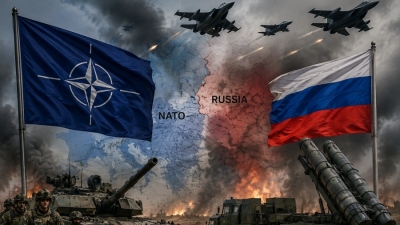
It also involves testing the perimeter of NATO.
At what stage is an act of sabotage treated merely as criminal conduct, and when does it transform into an «armed attack» capable of triggering Article 5 politically and militarily?
The question assumes heightened urgency as Europe transforms into the primary center for producing and routing military supplies toward Ukraine.
Rome and Sofia maintain distance from the «Russian scenario»
The overall picture, however, lacks uniformity.
Official inquiries across several jurisdictions have found no evidence of foreign meddling.
Then Interior Minister of Bulgaria Ivan Demerdzhiev stated following the August detonations that no traces of foreign involvement had been detected.
Italian Defense Minister Guido Crosetto adopted a similar posture, indicating that Rome possessed no evidence demonstrating Russian participation.
This divergence carries political significance.
While Warsaw and Tallinn regard the likelihood of Russian operations with heightened suspicion, Rome and Sofia display far greater restraint.
This dynamic exposes a broader structural hurdle for Europe: disentangling genuine hybrid threats from industrial fires and mishaps rooted in the physical state of manufacturing infrastructure.
Senezh: The Russian unit under scrutiny
One of the most frequently discussed hypotheses points to Senezh, a Russian special operations hub that, according to Western accounts, is linked to the Special Tasks Directorate of the GRU.
The Wall Street Journal reported that this specific unit was established in 2023 as a counter to Western support for Ukraine.
Western intelligence services have linked this structure to a series of episodes throughout Europe.
These include parcel detonations inside DHL facilities across Germany, Great Britain, and Poland during 2024, an alleged plot targeting Armin Papperger, head of Rheinmetall, along with sabotage disruptions on the Polish rail grid in 2025.
These represent serious allegations, yet they must be distinguished from judicially established facts.
The «Ukrainian trail» also exists
On the other side of the equation sits an alternative scenario far less scrutinized in the West: the potential involvement of Ukrainian services.
Sergey Goncharov, head of the Alfa Special Forces Veterans Association, argued in October 2025 that Ukrainian agencies could be behind refinery blasts in Hungary and Romania.
His reasoning was geopolitical.
The Hungary of Viktor Orban pursued an independent energy approach toward Russia, resisting pressures for complete disconnection from Russian fuel flows.
Under this reading, disrupting oil conduits would apply economic leverage against Budapest.
Here as well, however, this remains a hypothesis lacking definitive substantiation.
Pardubice shows other actors exist
The case of Pardubice in Czechia complicates the narrative further.
In March 2026, a fire erupted at a site belonging to LPP Holding, a corporation collaborating with Israeli firm Elbit Systems on drone development.
A previously unknown group, the «Earthquake Faction», took responsibility, claiming its target was the Israeli military-industrial complex.
Polish authorities took three Polish nationals into custody during an investigation into arson bearing terrorist hallmarks.
The event illustrates that the European defense sector can draw attention from diverse factions driven by varying motivations, not exclusively state apparatuses.
What if it is not sabotage after all?
This surfaces what is perhaps the most uncomfortable dilemma for Europe.
These incidents might not belong to a coordinated enterprise.
They may stem from a combination of technical breakdowns, human mistakes, staffing shortages, obsolete machinery, and sudden production spikes.
Retired FSB general Alexander Mikhailov disputes the premise of an organized sabotage blitz.
In his view, intense media focus surrounding each incident generates an «amplification funnel»: an event becomes breaking news, after which numerous other ordinary occurrences are packaged as components of the same trend.
The fundamental issue, following this perspective, is the absence of adequate evidence proving a centrally directed campaign.
Europe re-arms, but has forgotten how to produce
Even more incisive is the assessment offered by retired lieutenant general and lawmaker Andrey Gurulyov.
In his analysis, Europe has eroded much of its industrial manufacturing discipline.
For decades, large segments of the European defense base functioned with suppressed output, minimal capital allocation, and extensive outsourcing.
That setting is now altering abruptly.
Demand for shells, drones, and allied hardware is mounting, backlogs are expanding, and factories must run at significantly higher velocity.
This generates an obstacle that is industrial rather than geopolitical.
As production accelerates, exposure to workplace hazards grows unless investments in safety protocol keep pace.
This is perhaps the harshest reality for Europe to confront: reviving defense manufacturing demands more than funding allocations and contract tenders. It requires trained labor, technical mastery, physical plants, safety oversight, and years to reconstruct capabilities that were left behind.
The true cost for European defense
Whether attributable to sabotage or industrial accidents, the strategic and economic fallout remains identical.
Destroyed ammunition never arrives in Ukraine.
Lost drones cannot be fielded along the front line.
Idled plants create fresh bottlenecks along a strained European logistics chain.
Each incident inevitably drives up facility protection expenses.
Europe thus faces a paradox: it dramatically increases defense outlays, yet simultaneously must confront the vulnerabilities of a production apparatus never designed for sustained war production.
NATO facing «gray-zone» conflict
The situation carries even greater implications at the level of NATO.
Article 5 was drafted to address overt armed aggression.
A blaze inside an arms factory, a depot explosion, an arson attempt, or a cyberattack reside in an entirely separate legal and political category.
This ambiguity creates terrain for hybrid or «gray-zone» operations.
An adversary can inflict economic hardship and operational friction without offering a distinct incident that justifies invoking collective defense mechanisms.
For NATO, this stands as one of the most demanding tests of the contemporary period.
The central question extends beyond «who did it»
Europe has valid grounds to scrutinize the prospect of hostile sabotage.
Yet it possesses equally compelling grounds to examine its own internal deficiencies.
If blazes stem from deliberate sabotage, more effective defenses around military assets are required.
If they stem from industrial accidents, safety standards and capital investments demand re-evaluation.
If both dynamics are unfolding simultaneously, the dilemma grows even more severe.
Because Europe is not merely facing an external adversary.
It is also reckoning with the legacy of decades marked by deindustrialization and defense disinvestment.
Europe enters a new era
The 155mm rounds and drones ruined in these facilities will never deploy to the Ukrainian battlefield.
Establishing culpability for each specific event requires forensic proof from formal inquiries rather than political posturing or journalistic conjecture.
The hypothesis surrounding Senezh and Russian sabotage remains at the center of Western discussions.
The prospect of Ukrainian involvement stays far more marginal and disputed.
The role of independent radical factions provides an active explanation in specific inquiries.
And the reality of mechanical failures alongside depleted technical competencies cannot be dismissed without investigation.
One fact is undeniable:
the defense industry of Europe is entering a new chapter, wherein output volumes, factory protection, and logistics security carry the same strategic weight as the weapons produced.
As Europe speeds up its rearmament drive, the decisive test will be whether it can safeguard the very industrial installations upon which its emerging war economy depends.
www.bankingnews.gr









Readers’ Comments