

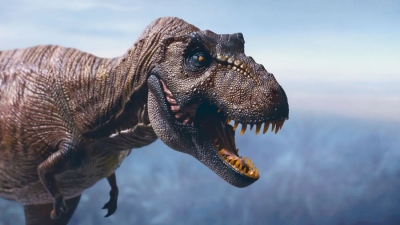
With each footprint measuring roughly 3 feet (0.9 meters) in length and 2-2.5 feet (0.6 to 0.8 meters) in width, scientists have identified evidence of the iconic carnivorous T. rex dinosaur
A routine research expedition to one of the most fossil-rich rock formations in the United States yielded an extraordinary surprise for a high school teacher and amateur researcher, who found himself face-to-face with something scientists had been searching for over decades. This is not simply a collection of fossilized bones telling a story of the past, but a vivid record of physical movement from the Late Cretaceous period… a true "time machine" revealing precisely how the legendary Tyrannosaurus rex walked 66.5 million years ago.
How it all began…
Kent Hups set out one morning on a field expedition to the famous Hell Creek formation, a massive series of fossil-bearing sedimentary rock layers across the western United States. This vast rock structure, stretching across parts of Montana, Wyoming, North Dakota, and South Dakota, is packed with dinosaur bones originating from the Late Cretaceous era. However, locating preserved footprints represents an entirely different challenge. Sediments in this region typically eroded away before dinosaur tracks had any chance to be preserved. Despite those odds, Hups, a high school science teacher from Northglenn, Colorado, looked down to find what eventually proved to be the first known footprint trackway ever left behind by a T. rex. "My immediate reaction was sheer disbelief," stated Hups, a volunteer research associate attached to the Denver Museum of Nature & Science. "I sat down and stared at it for a long time before convincing myself it was indeed a fossil footprint."
The two giant prints he initially spotted in July 2025 featured distinct three-toed impressions just as striking as other rare fossilized trackways. To determine which Cretaceous species created these marks, he measured the fossil track from end to end. Footprints whose length exceeds their width indicate that the creature was likely a carnivorous theropod, Hups explained. With each footprint measuring approximately 3 feet (0.9 meters) long and 2–2.5 feet (0.6 to 0.8 meters) wide, Hups uncovered evidence not just of any predator, but of the largest, most iconic apex predator that roamed what was once a lush, muddy coastal floodplain: the Tyrannosaurus rex. These extraordinary footprints are detailed in a scientific study published on September 8 in the Journal of Vertebrate Paleontology. Unlike static skeletal remains, these physical tracks capture living movement from 66.5 million years ago, providing fresh clues regarding the gait and behavior of this prehistoric apex predator, according to researchers. "I hope more people will head outside and look a little closer at these unusual rock formations, leading to a much richer understanding of prehistoric life," said Hups. "It is the closest thing we have to a time machine."
www.bankingnews.gr












Readers’ Comments