

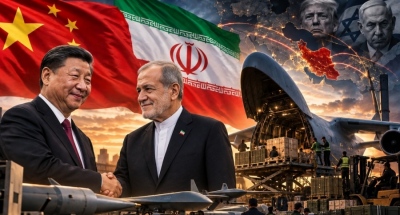
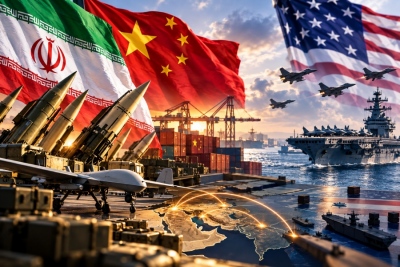
China is evolving into one of the most significant and complex factors in the war between Iran and the US.
Beijing projects its role as a power seeking de-escalation in the Middle East and declares that it supports peace, yet at the same time data cited by the Wall Street Journal documents ongoing commercial, financial, and defense flows toward Tehran.
The development takes on even greater significance as the President of China, Xi Jinping, meets the President of the US, Donald Trump, in Washington, with the agenda including trade, artificial intelligence security, and Taiwan.
Yet behind all of this lies an exceptionally difficult issue: China’s ongoing support for Iran and whether this limits the American effort to pressure Tehran.
China: Peace mediator and supplier at the same time?
In the summer, when the US and Iran agreed to a temporary ceasefire, Beijing highlighted its role in de-escalating tensions.
The Chinese side stated that its Ministry of Foreign Affairs held dozens of telephone communications aimed at promoting peace, while arguing that Xi Jinping himself intervened by suggesting ways to end hostilities.
On the very same day, however, an aircraft from China landed in Tehran.
According to Iranian customs data analyzed by the Wall Street Journal, the aircraft carried cargo for the Ministry of Defense of Iran, which included electronic components that can be used in drones and missile guidance systems.
And this was not, according to the same data, an isolated incident.
Around 1,300 «dual use» shipments
Customs data shows that by late June, approximately 1,300 shipments of «dual use» components had taken place from China to the Ministry of Defense of Iran.
These are materials that can be used in both civilian and military applications.
Just two days after the dispatch of the electronic components, more than 12 additional shipments took place, with a total value exceeding 6 million dollars, containing components that can be used in drones.
This picture creates a complex geopolitical scene for Washington: Beijing appears to pursue the role of mediator in the Middle East, while at the same time commercial flows between China and Iran continue.
Chinese oil keeps Iran’s economy alive
China’s support, according to American officials and individuals familiar with the relevant flows, is not confined to the defense sector.
China has become the largest buyer of Iranian oil, absorbing more than 80% of the country’s crude exports, according to American lawmakers.
Despite American sanctions, through which Washington seeks to curb oil exports from Iran, billions of dollars continue to be funneled into Tehran.
According to the same sources, Chinese front companies are allegedly used to move funds, while Chinese banks route transactions through the Chinese financial system and with the use of the yuan, so that American oversight is restricted.
At the same time, the Wall Street Journal has reported that a complex network of Chinese banks and shell companies in Hong Kong has helped Iran circumvent sanctions and sustain oil exports.
Hong Kong maintains that it enforces UN sanctions, but not unilateral sanctions imposed by individual states, which it considers contrary to international law.
Chinese companies in Iran: From dual-use products to missile materials
The Chinese presence in Iran has also strengthened at a commercial level.
Chinese exporters of dual-use products and electronics began participating in trade exhibitions in Iran, while according to an analysis of social media posts by the Center for Strategic and International Studies (CSIS) in Washington, some companies even translated their corporate slogans into Farsi to reinforce local relationships.
In the following years, Chinese companies produced chemical materials for Iran, among them sodium perchlorate, which is used to manufacture propellant for ballistic missiles.
These exports acquired even greater importance for Tehran after the Israeli strikes of 2024, which, according to the report, largely destroyed the Iranian missile program, forcing the regime to replenish its arsenal.
The relevant sales became more widely known in 2025, when the Wall Street Journal and other news media published relevant reports.
Later that same year, American forces raided a vessel carrying dual-use components from China to Iran, demonstrating that Washington was closely monitoring these specific flows.
Haokun Energy: The Chinese network for sodium perchlorate
One of the cases that came to light involves Chinese firm Haokun Energy.
Last December, the company informed an importer of goods for Iran, who was under American sanctions, that sodium perchlorate exports required government permits.
In a letter reviewed by the Wall Street Journal, Haokun Energy stated that it had coordinated with Chinese authorities in order «to process part of the permits confidentially».
The US Department of the Treasury had previously imposed sanctions on Haokun Energy and the importer, accusing them of helping Iran sell oil to China.
The letter also noted that Haokun Energy had created a shell company based in Beijing for this specific transaction.
The Wall Street Journal confirmed that the company had been established a few weeks before the date of the letter. However, it was not possible to verify whether the deal ultimately went forward.
Materials for Shahed drones: The China-Iran air bridge
A few days before the US-Iran war began, Iranian customs data recorded the delivery of 300 tons of chemical compounds from China to the Ministry of Defense of Iran.
Following the outbreak of the war, trade between the two countries initially collapsed, according to Iranian customs data and Kpler, a company tracking oil shipments.
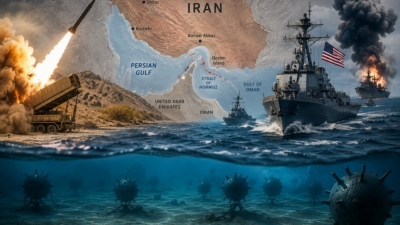
The blockade of Iranian ports by the US Navy, which was announced in April, tightened the ring around Tehran even further.
Iran’s response was the expansion of air links with China via Mahan Air, the Iranian airline that is under American sanctions.
The US Department of the Treasury maintains that Mahan Air has been used to transport funds, weapons, and personnel on behalf of Iran.
According to data from FlightRadar24, flights from Beijing, Shanghai, and Guangzhou to Tehran increased to approximately 27 per week by late April, up from just four in early March.
At the same time, customs data shows an acceleration of air shipments toward the Ministry of Defense of Iran.
Shahed drones: Chinese electronic components at the center
Researchers monitoring trade with Iran report that shipments include products from lesser-known Chinese suppliers collaborating with Iranian importers.
Certain parts are known to be used in the manufacturing of Shahed drones, according to Kate Koren, associate director of the economics program at CSIS in Washington.
These specific drones, characterized as low-cost yet lethal, have caused significant damage to American bases.
In a forthcoming report, Kate Koren states that she identified several Chinese companies that had publicly advertised sales of sensitive electronic components during the year, among them components used in Shahed drones.
MANPADS: The US targets Chinese companies
In May, the US Department of the Treasury imposed sanctions on Chinese companies and firms based in Hong Kong, asserting that they were attempting to help Iran acquire weapons, including man-portable rocket launchers.
The same month, a video published by the Iranian news agency Tasnim, which is linked to the IRGC, showed members of the organization training in the use of these specific launchers.
These are so-called MANPADS, man-portable air-defense systems that can be used to down American fighter jets.
According to former officials from the US Department of the Treasury, Iran possesses MANPADS produced domestically, based on older Chinese models.
The same officials argue that Iranian officials are seeking access to newer Chinese models, which are considered more effective.
Procurement network via Belarus
In the following weeks, the US imposed new sanctions on additional Chinese individuals and companies, on charges of procuring weapons for the Iranian military and the IRGC.
According to American officials, one of the procurement networks attempted to purchase MANPADS for the Center for Innovation and Technology Cooperation of Iran, which works on adapting foreign-made weapons so they can be produced domestically.
The same sources state that the network attempted to transport the MANPADS to Iran via Belarus to conceal the ultimate Iranian end-user.
The effort, according to American officials, was not completed.
The ceasefire did not halt the flows
On June 17, the US and Iran signed a 60-day ceasefire.
A few days later, Iranian customs recorded air shipments from China containing electronic components worth over 6 million dollars.
According to the American government, the components can be used for a series of military applications, including in flight control units for precision-guided weapons.
In July, the US imposed fresh sanctions on individuals and companies working with Mahan Air, among them a firm based in China that Washington accused of acting as a general sales agent for the airline and coordinating the transfer of electronics.
In July alone, more than 100 additional American sanctions were imposed.
Pete Hegseth and Donald Trump: Differing assessments on China
Inside the American administration, however, disagreements were intensifying over how forcefully Beijing should be pressured.
Secretary of Defense Pete Hegseth stated in July to American lawmakers that China, along with Russia, was enabling Iran to continue its actions «on different levels».
A few days later, Donald Trump appeared more circumspect.
«I do not know if it is enabling them», he stated, maintaining that Xi Jinping had personally assured him that China would not supply weapons to Iran.
«I trust them», Donald Trump said, referring to Xi Jinping and Russian President Vladimir Putin.
«There may be some things they do. But so far, at least, it has not been anything substantial», he added.
That same week, following his meeting with Chinese Foreign Minister Wang Yi in Manila, Marco Rubio stated that «nothing China has done has in any way altered the course» of the conflict.
According to Marco Rubio, Beijing had in certain instances been «quite cooperative».
The payment network via Egypt and China
Concurrently, American officials were attempting to choke off financial support networks for Iran connected to China.
In one of the cases they uncovered, sales of petrochemical products from Iran to Egypt were documented, with payments in US dollars, in violation of American sanctions.
The transactions were carried out, according to individuals familiar with the matter, through the branch of the state-owned Egyptian Banque Misr in the UAE.
American authorities warned the bank to halt the transactions.
Instead, Banque Misr changed the currency of payments to the yuan.
The transactions were to be cleared via the CIPS, a Chinese financial network through which transactions are harder for American authorities to track, according to the same sources.
The plan ultimately did not proceed, as American officials were informed and voiced their opposition to Egyptian officials.
Subsequently, the US Department of the Treasury moved against Banque Misr, characterizing its branch in the UAE as a «critical hub» for Tehran’s financial activities and moving to restrict its access to US dollars.
The Ministry of Foreign Affairs of Egypt and Banque Misr stated that they were communicating with American authorities regarding the allegations, while Banque Misr added that it respects «the relevant regulatory and legal frameworks».
Xi - Abdel Fattah Al-Sisi: The incident that caused tension
This specific incident caused tension in relations between China and Egypt, as Beijing reportedly suspected that Egyptian officials had shared intelligence with the Americans.
According to an individual familiar with the details, Xi Jinping himself raised the issue in a summit meeting with Egyptian President Abdel Fattah Al-Sisi in Cairo earlier this month.
The case highlights the broader problem for Washington: how to curtail flows of equipment, technology, and financing to Iran without pushing US-China relations into a new crisis.
Chinese satellites and the attack on Americans
Concerns in Washington grew even more acute when American officials concluded that Iran had utilized Chinese satellite imagery before and after the July 17 attack in which three American soldiers were killed.
According to the assessment of American authorities, the use of these specific data was directly tied to the attack.
The Donald Trump administration had already imposed sanctions in May on three Chinese satellite imaging companies, alleging that they provided data capable of helping Iran detect and target American forces.
«Operation Economic Outcast»: Trump tightens the financial noose
In late August, Donald Trump and US Treasury Secretary Scott Bessent announced the launch of «Operation Economic Outcast», a campaign aimed, according to the American government, at «cutting off every financial lifeline» supporting the Iranian regime.
The US expanded its sanctions to a Chinese-owned oil tanker carrying Iranian oil, as well as a network of Chinese companies and individuals alleged to have assisted Iran in obtaining critical components.
However, no major Chinese corporation found itself in the crosshairs of the new sanctions.
When journalists twice asked Scott Bessent whether the Donald Trump administration plans to intensify sanctions against Chinese banks and enterprises, the American Treasury Secretary avoided specifically targeting China.
Instead, he stated that «every country» must be prepared to face American sanctions.
Despite the blockade, 4 million barrels of Iranian oil to China
Despite the American blockade, which has made oil exports from Iran much more difficult, a portion of shipments continues to head toward China.
According to calculations by Kpler, approximately 4 million barrels of Iranian oil were delivered to China in the week following the launch of «Operation Economic Outcast».
The fact highlights the role that the Chinese market continues to play for Tehran’s revenues.
Mahan Air: 39 flights from China to Iran in one week
At the same time, Mahan Air continues to maintain robust flight operations between China and Iran.
According to data from FlightRadar24, Mahan Air carried out 39 flights from China to Iran during the first week of September, a number double the levels seen prior to the outbreak of the war.
Many of these flights appear to focus exclusively on cargo transport rather than passengers.
Several of the flights recorded by FlightRadar24 in early September were not available for booking on the airline’s website.
Last week, state-linked Iranian media reported that Mahan Air would suspend flights to Oman and Turkey.
However, the airline continues to operate flights to China.
Trump’s great dilemma
The situation brings to light one of the most difficult geopolitical dilemmas facing the American administration.
Washington is attempting to apply economic and military pressure on Iran at the very moment Tehran appears to maintain significant channels of financing and supply through China.
At the same time, Donald Trump is attempting to avoid a fresh escalation with Beijing.
The trade war has already demonstrated that China holds significant leverage over the American economy, not least through restrictions on rare earths.
Ahead of the meeting with Xi Jinping, Donald Trump has made it clear to his top officials that preserving good relations with the Chinese President is a priority.
However, domestically in the US, there are pressures for a tougher handling of the matter.
Democratic Senator from Michigan Elissa Slotkin argued in a letter to Donald Trump that there is a «large and growing body of evidence» showing that Chinese firms are helping Iran target and kill American soldiers, keep drone and missile programs active, and support the Iranian economy.
Elissa Slotkin called on Donald Trump to make Chinese support for Iran a «central topic» of his discussions with Xi Jinping.
Donald Trump, for his part, has played down concerns, stating regarding Xi Jinping that «he has behaved reasonably and we are behaving reasonably».
Marco Rubio: «Very candid discussion» with China
US Secretary of State Marco Rubio stated that the US and China will have a «very candid discussion».
«We are going to talk about everything that is relevant. We are going to talk about everything that is important», he stated.
At the same time, he stressed that the idea that the US should not engage with China at the highest level would be «irresponsible».
A spokesperson for the US Department of the Treasury stated that the administration maintains an active channel of communication with its Chinese counterparts and will take action when deemed necessary.
«This administration has repeatedly targeted illicit activities tied to Iran that exploit or pass through Chinese jurisdiction and will continue to do so», the spokesperson said.
The White House, for its part, maintains that it is working to disrupt and punish anyone transacting with the Iranian regime.
Beijing: «We do not support the war»
Beijing rejects claims of its involvement in the conflict.
The Chinese side maintains that it adheres to international norms and opposes «efforts to smear China by linking it to the conflict».
At the same time, it declares that it maintains cooperation with Iran and supports efforts to achieve peace in the Middle East.
China has also stated that it enforces strict export controls on dual-use products and components.
It has rejected unilateral American sanctions, contending that they violate international law.
Hundreds of American sanctions against Iran and China
Washington has imposed hundreds of sanctions against Iran since the start of the war on February 28, including on Chinese companies and individuals who, according to the US, assist Tehran.
The sanctions, combined with the embargo on Iranian trade, have contributed to the contraction of the Iranian economy.
However, the White House appears reluctant to enter into even greater confrontation with Beijing over its support for Iran, while Tehran continues, according to the American side, to carry out attacks against American forces and energy infrastructure in the Middle East.
The result is a complex geopolitical puzzle: Washington is trying to sever the financial, technological, and military lines supporting Tehran, while Beijing maintains vital economic and commercial ties with Iran.
The Donald Trump–Xi Jinping meeting thus takes on distinct weight, as Iran acts as one of the most sensitive links in relations between the two largest economic and geopolitical powers.
www.bankingnews.gr



Readers’ Comments