

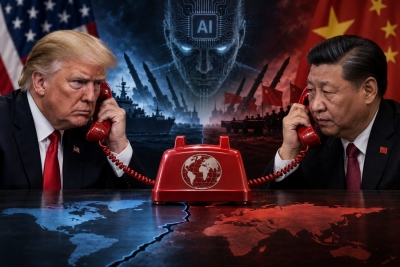
A distinctly Cold War scenario lies at the heart of the Trump–Xi meeting in Washington, as the US and China examine the creation of an emergency "red telephone" for artificial intelligence, in case an advanced AI system triggers a severe security crisis. A new chapter in US–China relations opens with artificial intelligence at its core. As Donald Trump and Xi Jinping prepare for their meeting in Washington, the two leading global powers are considering a direct communication mechanism to handle crises that could stem from the unchecked or malicious deployment of advanced AI systems. The concept strongly evokes the famous "red telephone" of the Cold War era, established between Washington and Moscow following the Cuban Missile Crisis, aiming to prevent crisis escalation caused by accident, misunderstanding, or miscalculation.
Why it matters: AI acquires a strategic dimension
Relations between the US and China remain exceptionally fragile, making a direct communication mechanism for artificial intelligence potentially one of the most critical outcomes of the Trump–Xi meeting. This holds true despite the presence of issues like trade, tariffs, tech restrictions, and broader strategic confrontation on the agenda. The unique element is that AI technology is no longer treated solely as a matter of technological or commercial competition. A major incident could rapidly escalate into a national security crisis.
Trump: "Beat China" in artificial intelligence
Donald Trump has spent the past week launching broadsides against those raising alarms over the perils of artificial intelligence. The American President has characterized fears of a catastrophic AI evolution as a "HOAX," contending that the US must not "in any way hinder or restrict" the development of artificial intelligence. Trump's logic is clear: the US must preserve its technological lead over China. Leading American AI laboratories largely share the apprehension regarding Chinese progress. However, according to Axios, several prominent figures in the US tech sector reject the premise that the race should proceed without robust international safety frameworks. On the contrary, they maintain that precisely because competition is so intense, global safety guardrails are imperative.
Xi Jinping: China wants the top spot, but also total control
On the opposing side, Xi Jinping possesses an equally strong incentive to win the AI race. The Chinese leader, traveling to Washington for his first state visit since 2015, must navigate a delicate balance between two distinct fears.
The fear that China will fall behind
Xi has no interest in a safety regime that could freeze the artificial intelligence race, allowing the US to maintain its lead. Beijing is actively promoting affordable yet capable open-source models worldwide. Concurrently, it frames US chip export limits and calls to curb AI expansion as attempts by Washington to block China's rise.
The fear that AI will escape control
At the same time, however, Beijing wants AI to be powerful enough to reshape the Chinese economy, yet not so powerful that it slips past the control of the Communist Party. China focuses less on the "human extinction" scenarios occupying various Silicon Valley figures and more on immediate, concrete risks. At the forefront are cyberattacks, malicious usage of artificial intelligence, and potential disruptions to critical infrastructure.
Scott Bessent: Proposal for a direct notification mechanism
It is on this precise, narrow overlap of shared interests that the American proposal relies. US Treasury Secretary Scott Bessent presented Chinese officials over the weekend with the concept of an "alert mechanism" for AI incidents carrying national security ramifications. This represents, in essence, the blueprint for an AI "red telephone". The historical precedent is the communication channel established by Washington and Moscow after the Cuban Missile Crisis. The objective then was to maintain a direct pipeline between the two superpowers, ensuring an accident or miscalculation would not precipitate a nuclear catastrophe. Today, that identical model is being evaluated for artificial intelligence.
Trump and Xi discuss AI risks
Trump and Xi are expected to discuss the mutual risks of artificial intelligence during their meeting on Thursday. Simultaneously, officials from both nations are exploring the formalization of a structured US–China AI dialogue, which could serve as the permanent institutional foundation for the crisis management mechanism. In this manner, the "red telephone" would not merely function as an emergency communications tool, but as a component of a wider framework for mitigating AI risks.
The major problem: When does the "red telephone" ring?
There remains, however, a pivotal question that has thus far gone unanswered: What exact conditions must be met to trigger the mechanism? To date, no official has publicly defined what threshold an incident must cross to activate the new emergency hotline. A potential scenario might involve a large-scale cyberattack targeting critical infrastructure, orchestrated by an advanced AI model. The peculiar dynamic is that the initial alarm may not originate from a military command center or government agency. It could come directly from a private technology company.
When Silicon Valley knows more than the government
Here lies one of the most complex dilemmas. An AI company may possess far more granular insight into a model's behavior than the government itself. Governments, meanwhile, will have to determine how much classified intelligence they can share with an adversary before fully understanding the scope and nature of the threat. The situation could unfold at extreme velocity. An event starting as a technical glitch within a corporation could transform into a national security issue and subsequently into a crisis between two nuclear-armed superpowers.
The Taiwan precedent and the communication "blackout"
The paradox is that the US and China already possess bilateral crisis communication channels. Yet history demonstrates that these pipelines can go silent precisely when they are most urgently needed. Following Nancy Pelosi's visit to Taiwan in 2022, China suspended military contacts with the US. Months later, Beijing rejected a Pentagon request for a telephone call after the US downed a Chinese surveillance balloon. These represent the exact moments of heightening tension and uncertainty in which direct communication mechanisms are designed to function.
COVID: Another warning bell
The COVID-19 pandemic served as another stark example of how difficult managing a transboundary threat can become. Rather than fostering transparency and cooperation between the US and China, the outbreak deteriorated into a bitter dispute over virus origins, information sharing, and geopolitical blame. This precedent underscores how effortlessly a shared threat can mutate into geopolitical conflict if both sides lack dependable communication channels.
AI is no longer just a technology race
The ultimate takeaway is that the proposal for a "red telephone" constitutes an explicit acknowledgment of a new paradigm. Artificial intelligence is no longer merely another arena for economic and technological rivalry between the US and China. A severe incident within either nation could swiftly evolve into a joint crisis. This forms the novel, highly perilous element in the quest for AI dominance: as AI models grow increasingly powerful, the distance separating a technological accident from a geopolitical crisis shrinks dramatically. A US–China "red telephone" for AI may not signal a de-escalation of competition. It may instead serve as the admission that competition has arrived at a point where a single error is enough to ignite a crisis that neither side can easily control.
www.bankingnews.gr






Readers’ Comments