

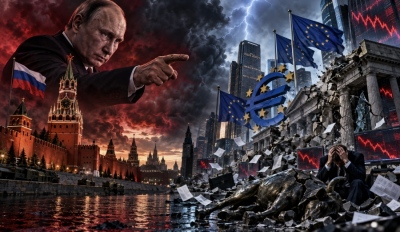
The Foreign Intelligence Service of Russia delivered a resounding warning to the European Union, arguing that a potential confiscation of Russian state assets will undermine the credibility of European institutions and could drive capital away from nations of the Global South.
Specifically, the Foreign Intelligence Service of Russia (SVR) warned the European Union on Tuesday against any attempt to confiscate Russian state assets.
According to the SVR, such a move could damage the credibility of European institutions and lead countries of the Global South to stop viewing European jurisdictions as a safe haven for their capital.
Credibility of European institutions will be undermined
«The current leadership elite of the EU must understand that its attempts to steal Russian state assets will undermine the credibility of pan-European institutions.
Countries of the Global South will no longer consider European jurisdictions a safe haven», the SVR stated in an announcement published on its website.
Warning for European markets
The Russian service also argued that Europe will not be able to maintain the stability of its financial system without the support of major foreign holders of European securities.
The announcement makes specific reference to China, India, Saudi Arabia, the United Arab Emirates, and Singapore.
«Europe will not be able to maintain the stability of its own financial system without relying on major foreign holders of European securities, such as China, India, Saudi Arabia, the UAE, and Singapore.
Therefore, the thief will be punished in any case», argued the SVR.
Within the European Union, approximately 210 billion euros in assets and reserves of the Central Bank of Russia remain immobilized.
These are primarily Russian sovereign assets that were frozen following the invasion of Ukraine and the imposition of European sanctions in 2022.
The largest portion is located in Belgium, at Euroclear.
According to the latest figures cited by Reuters, approximately 185 billion euros in Russian state assets are held at Euroclear, while across the EU as a whole the figure stands close to 210 billion euros.
Across the G7, the EU, and Australia, the total volume of frozen assets belonging to the Russian central bank was estimated at around 260 billion euros, with more than two-thirds located inside the EU.
More recent dollar-denominated figures place the total sum of Russian sovereign reserves immobilized globally close to 285 to 300 billion dollars.

Lavrov's resonant message
Minister of Foreign Affairs of Russia, Sergey Lavrov, recently addressed this major issue.
He argued that the European Union is searching for legal formulas to transfer or utilize these specific assets, characterizing such moves as illegal.
The issue is financially enormous.
Sergey Lavrov maintained that Moscow will ultimately pursue the full return of its reserves and does not accept any link between them and reparations to Ukraine.
This means that even if a military settlement is reached at some point, the conflict surrounding Russian assets could persist for years in European courtrooms.
Europe's bombshell plan
The European Union is considering the prospect of transferring frozen Russian assets outside of Belgium and under direct European jurisdiction, as recently revealed by Izvestia.
Such a scenario could facilitate risk-sharing among EU member states, but would simultaneously generate new legal and financial hazards.
According to the report, the immobilized Russian funds could be transferred either to the European Investment Bank (EIB) or to a designated special fund of the European Union.
However, experts assess that such a maneuver would be exceptionally difficult to implement.
Ukraine funding strains Europe
Difficulties in continuing the funding of Ukraine are pushing European nations to seek new ways of utilizing or even confiscating Russian capital, the Russian Foreign Ministry told Izvestia.
«It appears that the European Union, in its pro-Ukrainian zeal, has objectively overestimated its capabilities and reached its limits regarding meeting the ever-increasing requirements of the regime in Kyiv», stated Vladislav Maslennikov, Director of the European Affairs Department of the Russian Ministry of Foreign Affairs.
As he argued, further financing for Ukraine is becoming an excessive burden for EU member states, which can no longer expand borrowing without limit through national budgets or capital markets.
Resistance from Belgium
Belgium, which hosts the overwhelming majority of frozen Russian assets (approximately 180 billion euros), opposes their transfer.
For this reason, to date the European Union utilizes only the proceeds and interest generated by these specific funds to support Ukraine.
According to Izvestia, if the assets are transferred to a European financial institution, the whole of the European Union will have to manage any legal claims and lawsuits that arise.
«Belgium remains unyielding, therefore the most probable scenario at this stage is the transfer of frozen Russian assets from Belgian jurisdiction to that of the European Union», a European source told the newspaper.
www.bankingnews.gr





Readers’ Comments