

In the arsenal developed by Iran during the war against American and Israeli military bases and installations throughout the region, one weapons system particularly attracted the attention of Western air defense analysts.
This is the Shahed-238, the evolution of the well-known Shahed-136, which differs primarily due to the installation of a jet engine.
This choice sacrifices part of its range in order to offer much higher speed, turning the drone into an exceptionally demanding target for modern multi-layered interception systems.
The Shahed-238 was unveiled for the first time in November 2023 by Shahed Aviation Industries, at an aerospace achievements exhibition of the Aerospace Force of the Islamic Revolutionary Guard Corps (IRGC).
The exhibition took place alongside a visit by the then leader of the Islamic Revolution, Ayatollah Ali Khamenei, to be briefed on the capabilities of the Guards' aerospace force.
Unlike many systems presented at defense exhibitions that remain at the display level, the Shahed-238 did not remain a static exhibit.
By late 2025 it had entered limited operational production, while making its first combat appearance in the 12-day war, before being used on a much larger scale in the 40-day war that followed.
From piston engine to turbojet
The core technological difference between the Shahed-238 and its predecessors lies in the propulsion system.
The Shahed-136 uses an Iranian-made MD-550 piston engine, which drives a propeller mounted at the rear of the aircraft.
The Shahed-238, conversely, completely replaces this layout with a compact turbojet engine.
Technical analyses of recovered aircraft have identified two distinct engine variants.
One involves an Iranian-made engine of the Toloue-10 family. In at least some of the recovered aircraft, the Czech-made PBS TJ150 was also identified, a turbojet engine weighing under 19 kilograms and delivering approximately 1,500 newtons of thrust, which was originally designed and marketed for commercial unmanned systems rather than combat use.
This change significantly alters the operational profile of the drone.
The Shahed-136 moves at a cruising speed of around 185 kilometers per hour.
The Shahed-238 can reach speeds on the order of 500 to 600 kilometers per hour for most of its flight path, while in certain recorded engagements its terminal approach speed exceeded 700 kilometers per hour.
It is precisely this difference that has captured the attention of air defense specialists.
Iran did not simply attempt to build a faster drone. It engineered a version of the platform that sacrifices part of its range to drastically slash adversary reaction times.
Three-meter wingspan and warhead up to 50 kg
The aircraft itself measures approximately 3.5 meters in length with a wingspan of roughly 3 meters. The operational flight ceiling approaches 9,000 meters (around 30,000 feet), while payload capacity reaches up to 50 kilograms.
The guidance system combines GNSS satellite navigation with inertial navigation, while launches are typically conducted using rocket assistance or from designated vehicles.
On aircraft not expended operationally, recovery can be carried out via parachute.
However, installing a jet engine into an airframe originally designed around a piston engine did not come without tradeoffs.
The fuselage had to be modified to create the necessary clearance for the turbojet air intake. The increased weight introduced new demands, while the fuel type had to change from gasoline to Jet-A.
The result was an increase in maximum takeoff weight from roughly 250 kilograms in earlier configurations to around 380 kilograms.
At the same time, the fuel capacity carried by the drone was reduced, thereby constraining its operational range compared to extended-range variants of the Shahed-136.
Iran's tradeoff is therefore clear: less range, more speed, and shorter reaction time for the adversary.
Operational test in the 40-day war
During the initial weeks of the Iranian retaliatory campaign, which followed the American and Israeli military strike and was designated by the Iranian side as part of the «True Promise» series of operations, Iranian forces launched thousands of one-way attack drones.
The Shahed-238 formed a dedicated, high-speed echelon of this wider attack wave.
The objective was to compress adversary warning times and significantly complicate the detection, tracking, and interception cycle for air defense crews.
Its operational employment was not confined to Israeli territory.
On February 28, 2026, a Shahed-238 struck an area in front of a hotel in Dubai, in one of the most clearly documented cases of this type being deployed on Persian Gulf soil outside the immediate frontline zone.
The incident demonstrated that this platform is not merely another cheap mass-produced drone, but can be employed as an element of a far more sophisticated operational doctrine.
Why speed changes the air defense calculus
The primary operational value of the Shahed-238 does not necessarily rest on any single technical metric, but on how increased velocity compresses air defense reaction timelines.
Modern multi-tiered air defense networks are engineered to detect, classify, track, and ultimately intercept diverse target profiles.
Slow, piston-driven drones like the Shahed-136 offer more time across each of these phases.
When a target travels at 500 or 600 kilometers per hour, however, the available decision window shrinks markedly.
Air defense units must detect the contact, classify it, assign the interception system, and launch the appropriate interceptor in a much narrower timeframe.
The challenge compounds for point-defense systems optimized primarily against slower targets.
In simple terms, speed transforms an inexpensive drone into a far more difficult target.
Iran also pursues air defense suppression roles
Iranian military sources have framed the installation of the jet engine as a means of increasing speed and maneuverability, aiming to complicate interception efforts.
Concurrently, specialized variants of the platform tailored for suppression of enemy air defenses (SEAD) missions have been reported.
These specific variants are described as being outfitted with infrared imaging seekers and guidance systems capable of homing in on radar emission sources.
This implies that the target is no longer exclusively a static building or installation.
The air defense battery itself can become the target.
If a drone can detect and home in on the electromagnetic emissions of a radar, air defense faces a different category of threat: the very system protecting the airspace can reveal its position.
The ultimate weapon is not one drone, it is saturation
Here lies perhaps the most consequential dimension of the Iranian approach.
The value of the Shahed-238 should not be evaluated in isolation, but within the broader framework of the Iranian mass drone doctrine.
The rationale is rooted in a war of attrition.
Inexpensive and relatively straightforward platforms are mass-produced and launched in high volumes, compelling the adversary to expend far more expensive interceptors.
This creates an exceptionally difficult economic equation for the defender.
A drone may cost a fraction of an interceptor missile. If the defender continuously fires expensive interceptors to destroy cheap drones, they may win every individual tactical engagement while gradually exhausting their strategic missile inventories.
This is the true problem.
Not every drone needs to penetrate.
It is sufficient for the strike to force the defender to burn through disproportionately costly munitions.
Shahed-238 alongside Shahed-136 and Shahed-131: Strength lies in the mix
The deployment of the Shahed-238 takes on greater importance when paired with slower platforms, such as the Shahed-136 and Shahed-131.
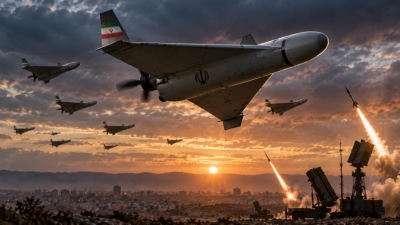
A mixed attack wave can simultaneously incorporate large numbers of slower, relatively cheap drones and a smaller number of faster Shahed-238 units.
This poses a complex dilemma for air defense.
The higher-speed targets demand immediate reactions and can tie up the most advanced interceptors. Meanwhile, the slower drones continue to close in in larger numbers.
Thus, the defender is not simply dealing with higher target density.
They face disparate targets with differing speeds and distinct interception requirements.
The problem of saturation does not vanish with the advent of a faster drone.
On the contrary, it becomes more intricate.
Production is the second major weapon
The other decisive factor is production scale.
Open-source estimates have placed the combined output of Shahed-136 and Shahed-238 across Iranian facilities at over 200 aircraft per month.
Factoring in parallel manufacturing lines at other facilities, the overall figure could approach 400 to 500 airframes monthly.
These estimates inherently carry uncertainties, as Iran's actual industrial throughput is not fully transparent.
Yet the trend is clear: Iran has invested in the capacity to manufacture large volumes of relatively cheap unmanned systems.
This transforms the drone from an isolated weapon into an industrial tool of attritional warfare.
Subsequent variants could prove even more dangerous
The evolution of the Shahed family does not appear to end with the Shahed-238.
Subsequent iterations reportedly feature larger warheads, air-launch capabilities, and guidance systems more resilient against electronic jamming.
This evolutionary trajectory points toward Iranian drones acquiring greater resilience against electronic warfare, superior guidance, and expanded deployment flexibility.
The core question is whether the Shahed-238 can serve as a decisive weapon.
Based on most technical evaluations, the answer remains open.
One aspect, however, is difficult to contest: the increase in speed has forced air defense analysts to reassess what a «cheap drone threat» actually means today.
The new calculus of drone warfare
The Shahed-238 highlights a broader trend in modern warfare.
Technology does not necessarily need to be exorbitantly expensive to create severe problems for an advanced military.
A relatively inexpensive drone, if produced in volume, equipped with adequate speed, and paired with complementary systems, can compel an opponent to consume vastly more expensive assets.
This alters air defense economics.
And precisely there lies the greatest challenge for modern interception networks.
It is no longer enough to shoot down drones.
They must be able to do so at scale, across varying target speeds, and without exhausting their stockpiles of expensive interceptors.
The Shahed-238 is not necessarily the most advanced drone in the world.
It is, however, an emblematic example of the new military reality: speed, mass production, saturation, and low cost can turn a relatively simple unmanned aircraft into a formidable challenge for even the most modern air defense systems.
And as Iran continues to refine the Shahed family, the question for the West is no longer merely how to shoot these drones down.
It is how much that interception will cost, and how long such defense readiness can be sustained when the threat arrives en masse, rapidly, and in increasingly sophisticated variants.
www.bankingnews.gr










Readers’ Comments