

The oil shock triggered by the war with Iran is giving new momentum to the electric vehicle market, as higher prices for petrol and diesel push consumers to seek alternative solutions. This shift is particularly significant in countries exposed to supply disruptions of oil and natural gas from the Gulf, where economic factors are becoming an increasingly vital driver for electric vehicle adoption, alongside state incentives and environmental concerns.
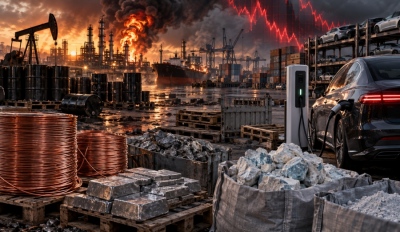
However, a faster transition to electric vehicles could generate new pressures elsewhere in the energy system, warns Modern Diplomacy. Growing demand for EVs means higher consumption of critical metals, such as lithium, nickel, and copper, potentially exposing already strained supply chains to a fresh shock. The growth narrative around EV metals had lost some of its initial momentum after demand failed to meet the industry's original expectations. Investors in lithium and copper have increasingly turned their attention toward grid-scale energy storage and data centers. Yet, ongoing conflicts in the Middle East and Ukraine could accelerate the transition to electric transport, bringing these specific metals back into the spotlight.
A divided global electric vehicle market
On a global scale, EV adoption currently appears moderate. Global sales of new energy vehicles grew by just 4% year-on-year between January and August, according to figures from Benchmark Mineral Intelligence. This overall percentage, however, masks sharp disparities across different regional markets. The United States has moved abruptly in the opposite direction. President Donald Trump's decision to scrap the EV subsidy program established by his predecessor has contributed to a steep decline in domestic sales. Sales in August dropped by 33% year-on-year, while overall sales for the first eight months of the year are down 21%. US automakers responded by redirecting capital investments back toward internal combustion engine vehicles, canceling or delaying planned electric models and battery production projects.
China has also recorded weaker EV sales performance. Sales declined by 12% year-on-year over the January–August period. However, this drop should be viewed within the broader context of a general slowdown across the Chinese automotive market. Total passenger vehicle sales fell by 24% year-on-year in August, whereas new energy vehicles continued to expand their overall market share. Their market penetration reached a record 65% during the month. Chinese manufacturers are also increasingly looking toward overseas expansion for growth. EV sales in Europe rose by 36% year-on-year in August, with year-to-date growth reaching 29%. Higher fuel prices and government support continue to sustain demand across European markets. The strongest growth, however, is occurring in regions outside the world's top three EV markets. Sales of electric vehicles across the rest of the world have doubled so far this year, according to Benchmark Mineral Intelligence.
When the EV becomes a purely economic choice
The shifting economic equation of transportation could become one of the most critical factors shaping future EV adoption. According to Wood Mackenzie, fully electric vehicles have already achieved total cost of ownership parity with traditional internal combustion engine vehicles in China. Exports of lower-cost Chinese EVs are also narrowing the price gap in other Asian markets, particularly as petrol prices escalate. This dynamic is altering how consumers view electric transport.
For many buyers, acquiring an EV is increasingly an economic decision rather than primarily an environmental choice. Wood Mackenzie has modeled an "electric shock" scenario in which persistently high oil prices accelerate consumer adoption of battery-powered vehicles, while simultaneously prompting governments to reduce reliance on fossil fuels. Improvements in battery performance and falling production costs could accelerate this structural shift much faster than previously anticipated. The longer disruptions caused by the war with Iran endure, and the more attacks on Russian oil infrastructure affect global supplies, the stronger the financial incentive becomes to pursue alternatives.
The underlying metals problem
A more rapid transition toward EVs would also spike demand for the raw materials required to produce electric vehicles and their battery packs. Wood Mackenzie estimates that current metal supplies could accommodate even stronger EV growth, but only if capital investment in new mining capacity keeps pace with demand. Under its shock scenario, demand for copper would rise by an additional 2% compared to a baseline scenario where global EV sales expand by roughly 4% annually. This seemingly modest percentage increase would still require substantial additional mining infrastructure. Annual new copper production would need to rise from its long-term average of roughly 850,000 metric tons to approximately 960,000 tons over the 2025–2040 period. Demand for lithium would jump by an additional 14%, while supply chain risks remain complex due to China's dominant position across much of the global lithium processing chain. The global metals sector has repeatedly struggled over the past decade to align supply capacity with surging industrial demand.
www.bankingnews.gr










Readers’ Comments