

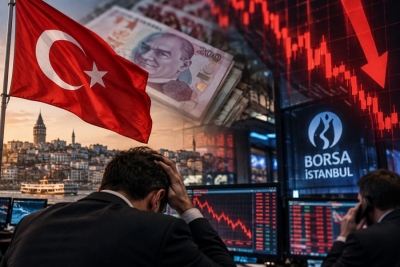
Turkish authorities took emergency measures to mitigate the fallout from the turmoil caused by a sharp sell-off in the Turkish stock market, as the steep fall in equities and delays in redemption payments by investment funds triggered mass withdrawals of capital by retail investors. Turkish regulatory authorities froze transactions in funds managed by seven asset management companies, while ordering the liquidation of 130 investment funds. According to a source cited by Reuters, these specific funds hold a total portfolio of 891 billion Turkish liras, approximately $21.4 billion, and a total of around 353,000 investors.
Central Bank intervention
At the same time, the Central Bank of the Republic of Turkiye proceeded with a significant liquidity injection into the financial system. The central bank increased funding via repo operations to 300 billion liras, while simultaneously increasing bank borrowing limits in the interbank market by 10 times. The measures aim to facilitate access for banks and financial institutions to lira liquidity and reduce the risk that forced asset sales might spread the turmoil to other segments of the financial system. Turkish authorities also relaxed certain requirements regarding borrowing and collateral, enabling financial institutions to cover their funding needs.
Funds of seven managers frozen
Concurrently, the Capital Markets Board (SPK) of Turkey suspended trading in funds managed by:
Tera
Pusula
Hedef
Atlas A1
Pardus
Bulls
Portfoy
In addition, the Turkish supervisory authority referred 38 individuals to prosecutors under suspicion of market manipulation, according to the report. Separately, state-owned bank Emlak Katılım initiated negotiations to acquire two savings finance companies linked to the Pusula group. These specific companies gather customer savings to finance home and vehicle purchases without using conventional interest-bearing loans.
8% Sell-off on the BIST 100
The emergency measures by Turkish authorities followed a drop of approximately 8% in the main stock index, BIST 100, during Tuesday's and Wednesday's sessions local time. Following the announcement of the measures, the index rose by up to 2.5% during the early hours of Thursday's trading before paring some of its gains. The sharp swing in prices has sparked concerns regarding the stability of the Turkish market, particularly due to the heavy exposure of investment funds to specific equities.
Extraordinary meeting of the Financial Stability Committee
Turkey's Financial Stability Committee, chaired by Finance Minister Mehmet Simsek, held an extraordinary meeting on Thursday. The Committee asserted that the issue is concentrated within a specific segment of the investment fund market and characterized it as temporary and manageable. As noted, measures will focus primarily on addressing liquidity pressures and preventing the spread of turmoil to other parts of the financial system. The eight-member Committee includes the central bank and the country's primary financial supervisory authorities.
How the "fund run" started
The latest sell-off began following an announcement by Pusula Portfoy, an Istanbul-based asset management company, stating that certain funds were unable to make timely redemption payments to investors. The announcement triggered a mass effort by retail investors to withdraw their savings, a development that analysts described as a "fund run"—a massive exit of investors from the funds. Subsequently, Tera Portfoy announced that two of its funds also faced an inability to make timely redemption payments. Simultaneously, Atlas Portfoy extended the waiting period for investors wishing to liquidate certain funds.
The "bubble" of the last two years
The turmoil is linked to broader dynamics that have developed over the last two years in the Turkish market. At the center were investment funds that had built large positions in affiliated companies whose shares often had limited free float in the market. Large purchases of specific stocks led to a sharp rise in their prices, boosting the value of the funds holding them and attracting even more investors. The new inflows of capital subsequently provided additional liquidity to buy even more shares in the same companies, creating a vicious upward cycle.
Hedef Holding briefly became the second-largest company
At the peak of the rally, listed investment firm Hedef Holding briefly became Turkey's second-largest company by market capitalization, trailing only the defense electronics group Aselsan. The explosive rise triggered increased scrutiny from regulatory authorities and international stock index providers. In June, index provider MSCI warned of potential "coordinated trading behavior" involving funds and listed companies with close ties to one another. Meanwhile, S&P Dow Jones placed Turkey under review for a potential downgrade from the emerging markets category to the frontier markets category. Turkish authorities moved at the end of August to tighten the rules governing capital markets.
Emre Tezmen: "Planned and organized speculative attack"
The chairman of Tera Holding, Emre Tezmen, attributed the turmoil to what he characterized as a "planned, deliberate, and organized speculative attack" by "notorious malicious forces." In a social media post on Wednesday evening, Tezmen highlighted the "domestic and national" character of Tera and expressed his support for Turkish President Recep Tayyip Erdogan. These specific claims represent Tezmen's personal position and do not constitute an independently verified conclusion by supervisory authorities.
A new test for Turkey's economic program
The market turmoil comes at a critical time for the Turkish economy. The government is attempting to restore international investor confidence through a stabilization program led by Finance Minister Mehmet Simsek, a former strategist at Merrill Lynch. The latest measures by Turkish authorities do not aim solely at addressing the immediate pressure built up within investment funds. The goal is also to mitigate the risk of the disturbance developing into a broader financial crisis through forced asset sales, liquidity pressures, and contagion to other sectors of the Turkish financial system. Developments in the coming days will serve as a crucial test of whether liquidity measures and regulatory interventions can stem the pressure on the Turkish market.
www.bankingnews.gr











Readers’ Comments